Showing posts with label 1930. Show all posts

Thursday, December 31, 2009

A Recap Of The Katie Award Winners For 1930-31 And The Year's Must-See Movies

Picture: City Lights (prod. Charles Chaplin)
Actor: Charles Chaplin (City Lights)
Actress: Marlene Dietrich (Morocco)
Director: Fritz Lang (M)
Supporting Actor: Peter Lorre (M)
Supporting Actress: Joan Blondell (Sinners' Holiday, Other Men's Women and Night Nurse)
Screenplay: René Clair (Le Million)
Special Awards: M (prod. Seymour Hebenzal) (Best Picture-Drama); Edward G. Robinson (Little Caesar) (Best Actor-Drama); Marie Dressler (Min and Bill) (Best Actress-Comedy); René Clair (Le Million) (Special Achievement In The Use Of Sound); "Makin' Whoopee" (Whoopee!) (Best Song); Fritz Arno Wagner (M) (Cinematography)
Must-See: L'Age d'Or; Animal Crackers; The Big Trail; City Lights; The Dawn Patrol; Dracula; Little Caesar; M; Le Million; Morocco; The Public Enemy

In retrospect, the twelve months running from August 1, 1930, to July 31, 1931 (in the Academy's odd Oscar season of the day) turned out to be a year of beginnings and endings.

The best movie of the year, Charlie Chaplin's delicate, poignant comedy City Lights was the last silent movie Hollywood ever produced (like the website "Silent Era," I judge Modern Times to be a "mute sound picture"). For all practical purposes, the silent era had come to close by 1929, and only Chaplin's enormous popularity and the brilliance of City Lights could have induced an audience to accept the anomaly of a silent movie in 1931.

1931 marked the last gasp for a German film industry that had given the world F.W. Murnau, Fritz Lang, Marlene Dietrich, Peter Lorre, Expressionism, and such films as The Cabinet Of Dr. Caligari, Nosferatu, Metropolis and M. Within two years, the Nazis would come to power and those artists who didn't flee or collaborate soon found themselves censored, arrested or murdered. Many German filmmakers, such as writer-director Billy Wilder, emigrated to Hollywood and had successful careers. But the German film industry as a whole would never again have the impact on cinema that it had in the 1920s and early years of the 1930s.

But 1930-31 was also a year for beginnings. James Cagney and Edward G. Robinson burst onto the scene, dazzling audiences in two of the essential gangster flicks of the early sound era, and continuing to dominate the Hollywood scene for years to come. American audiences also became acquainted with Marlene Dietrich for the first time. And in the space of twelve months, Clark Gable would rise from uncredited bit player to major star with tough but sexy roles in A Free Soul and Night Nurse.

I've written at length about all the titles on my list of the Must-See Movies of 1930-31. I leave to you the pleasure of hunting for them through the last three months of this blog's archives.

As great as 1930-31 was, the next twelve months would prove even better, especially for Hollywood which was at last getting the hang of the sound technology that had turned the old order upside down in 1927. On the horizon are Frankenstein, Scarface, Grand Hotel and many others. I'll have the list of nominees for you tomorrow in celebration of the New Year.

Oh, and later today: an end-of-year top ten list! Even the Monkey is not immune to the demands of traditional movie criticism.

Saturday, November 28, 2009

Best Actress Of 1930-31: Marlene Dietrich (Morocco)

Marlene Dietrich began her career as a cabaret singer in Berlin and made several silent movies in Germany before rocketing to international stardom in Josef von Sternberg's noirish masterpiece, The Blue Angel. Dietrich's portrayal as the amoral and treacherous Lola Lola set the pattern for femme fatales for decades to come and had American audiences panting to see what all the fuss was about.

Morocco was the second of seven
movies (eight if you count the German and English versions of The Blue Angel separately) with director Josef von Sternberg, but the first released in America—Paramount Pictures held back The Blue Angel for a year until it could launch Dietrich's Hollywood career with a more sympathetic role. Morocco proved to be a perfect vehicle for her, fully establishing the Dietrich persona—exotic, jaded, daringly androgynous (for example, she wears a tuxedo and kisses a woman; to quote Robert Osborne, "very European!")—lacking only the humor and self-parody she would later display in films such as Destry Rides Again and Foreign Affair.


Adapted by veteran screenwriter Jules Furthman from the stageplay Amy Jolly, Morocco is the story of a romantic triangle between a cabaret singer, her wealthy patron and a Foreign Legion soldier, who between them have experienced every kind of love but true love, and when at last it happens for each of them, they hardly know what to do with it.

Dietrich is the cabaret singer Amy Jolly (pronounced "Jolie," ala Angelina Jolie), down on her luck and traveling to Morocco for a job. On the boat she meets a wealthy playboy (the always dapper Adolphe Menjou) who as much out of habit as lust dangles jewelry in front of her—as the captain of the boat implies, the stop after Morocco is prostitution and if you're going to go, you might as well go in style—but Dietrich's Amy Jolly is too proud to jump at such baubles. Nevertheless, she turns to Menjou at a critical moment of need.

And all would be well but for the young, handsome soldier (Gary Cooper) sitting in the cheap seats at Dietrich's first performance. Predictably, the two are drawn to each other, at first simply because they are accomplished bed-hoppers who know they will look beautiful in each other's arms, but soon after because they discover in each other a longing for a past they can never reclaim.

"There's a foreign legion of women, too," confesses Amy Jolly, "but we have no uniform, no flag—and no medals." For these two, the single greatest act of passion they can perform is to not perform at all and to the surprise of all involved, genuine intimacy and tenderness develops, not just between the singer and the soldier, as you might expect, but between the singer and her wealthy patron as well.

The result is the warmest of the collaborations between Sternberg and Dietrich, maybe the only film they made together that suggests that the union of a man and a woman can produce something other than misery and obsessive, fetishistic self-destruction.

Morocco was a smash hit, earned four Oscar nominations (for actress, director, cinematography and art direction) and landed Dietrich the most lucrative contract in Hollywood. I should take time to mention the work of cinematographer Lee Garmes whose lighting of Dietrich was a key to the film's success. He positioned the key light above and slightly forward of her which (according to TV Guide's online review) "hollowed her cheeks, shadowed her heavy eyelids, and masked the dimensions of her wide nose." Dietrich was so pleased with the effect, she insisted on it for the rest of her career.

But despite the film's success, the set had not been a happy one. Sternberg focused his attention solely on making Dietrich look good to the annoyance of Gary Cooper, already a big star, and further underscored where his interests lay by speaking only German to Dietrich whenever Cooper was around.

The mutual animosity between director and star had no impact on Cooper's relationship with Dietrich though—shortly after filming commenced, the two began an affair that would continue for years. Despite the fact that she was living with Sternberg at the time, there was no slinking around for Dietrich. Reportedly, she and Cooper conducted their trysts in Sternberg's Hollywood home while Sternberg worked in the garden outside and silently seethed.

I share this anecdote, by the way, not because I am a fan of celebrity gossip but by way of explaining how the partnership of Sternberg and Dietrich, which began with such critical and commercial success, could wind up being a threat to both their careers. More and more, their collaboration became an exercise in voyeuristic excess, with Sternberg trying to control Dietrich with his camera in a way he couldn't control her off screen. And while these films have their champions (see, e.g., Kim Morgan on Blonde Venus or Roger Ebert on The Scarlet Empress), the public gradually turned away until they were turning away in droves.

Dietrich survived the fall by smirking her way through the worst of it—emerging for example from a gorilla costume in Blonde Venus with a half smile that seemed to say I'm so cool even this looks good on me—but Sternberg never recovered, earning only eight screen credits after his last picture with Dietrich (1935's The Devil Is A Woman) and even those credits are misleading, given that he was fired from at least two of those projects, Macao and the execrable Jet Pilot.


In 1939, after years of fading box office appeal, Dietrich reluctantly agreed to star in a comedy/Western, Destry Rides Again. The result was box office gold. Co-starring Jimmy Stewart as a pacifist sheriff armed only with folksy wit, saloon singer Dietrich parodied her own image so successfully she was able to reinvent herself as a comic actress and endear herself to audiences once again. (Madeline Kahn memorably spoofed the performance in Mel Brooks's comedy Blazing Saddles.)

After Destry, Dietrich's best performances were in a pair of Billy Wilder efforts, Foreign Affair, a romantic comedy set in postwar Berlin, and Witness for the Prosecution, a courtroom drama co-starring Charles Laughton, Tyrone Power and Elsa Lanchester. Many will also remember her cameo in Orson Welles's noir thriller, Touch of Evil.

Despite this impressive body of work, Dietrich was nominated for just one Academy Award, for the picture I've just written about, Morocco, losing to Marie Dressler. In 1999, the American Film Institute named her the ninth greatest actress of all time.

After a supporting role in 1961's Judgment at Nuremberg, Dietrich retired from acting, making only one cameo appearance after that, in David Bowie's 1978 misfire, Just A Gigolo. She spent the final decade of her life living in seclusion in her Paris apartment and died in 1992.

Postscript: Be sure to look for a young Cary Grant in the clip from Blonde Venus. This was just his sixth movie and he isn't given much to do—as the New York Times put it in its 1932 review,
"Cary Grant is worthy of a much better role." Like Gary Cooper, Grant was the object of Josef von Sternberg's jealousy; unlike Cooper, Grant didn't yet have the clout to do much about it.

Wednesday, November 25, 2009

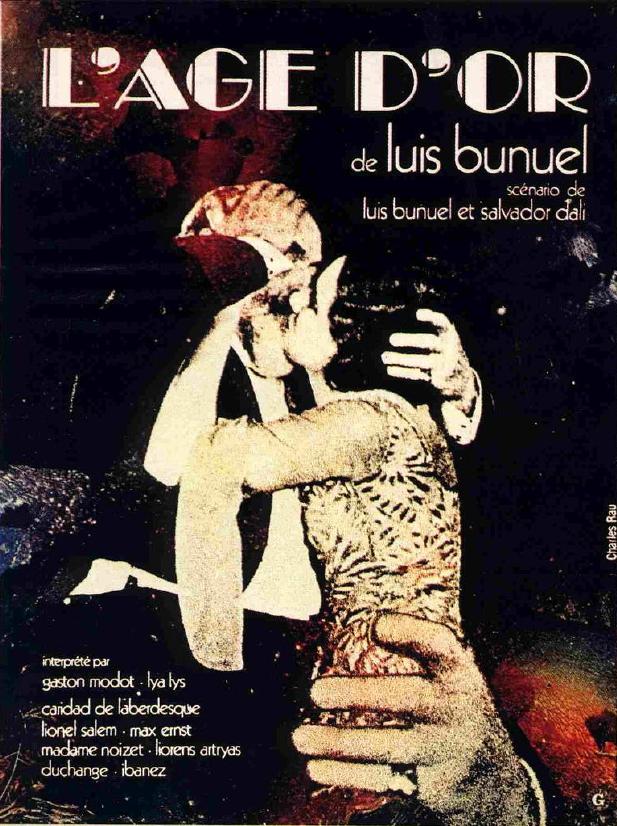
L'Âge d'Or

In 1929, as you may recall from our previous lessons, two young Spaniards, filmmaker Luis Buñuel and painter Salvador Dalí, collaborated to produce Un Chien Andalou, one of the most shocking films ever committed to celluloid. The image of a razor slicing a woman's eye, once seen, is never forgotten and the 16-minute film was a sensation, both among surrealists and the public at large.

The following year, Buñuel and Dalí collaborated again, this time on a feature-length film, L'Âge d'Or (The Golden Age). For audiences of the time at least, the fruit of their collaboration was even more shocking the second time around.

In general, surrealism reminds me of something Buddy Hackett once told Roger Ebert about stand-up comedy. "Ninety-nine percent is in the delivery. If you have the right voice and the right delivery, you're cocky enough, and you pound down on the punch line, you can say anything and make people laugh maybe three times before they realize you're not telling jokes."

And after my first cursory viewing, that's what I thought L'Âge d'Or was, another of Luis Buñuel's surrealist jokes, only instead of the shocking yet purposely meaningless images of Un Chien Andalou, here you had a series of scenes that could fit into the most mundane of Hollywood movies—a documentary about scorpions, soldiers on the eve of battle, lovers kissing, an angry crowd, a man arrested, a woman fretting about a dinner party, a reception—but instead of the payoff you're expecting, the scenes are punctuated with nonsense dialogue, cattle in the bedroom and blind beggars who get punched for no reason. Buñuel, I thought, was serving up nonsense and daring me once again not to try to make sense of it.

But in drafting this essay, I watched L'Âge d'Or again (anything for you, dear readers) and began to see that, though seemingly random, the images actually fall into one of three categories: acts of violence, stuffy clerics and aristocrats, and frustrated would-be lovers. Read together, not literally but as you would a dream, Buñuel seems to be saying that societal and religious norms are cramping his style—and he's mad as hell and not going to take it anymore.

Read that way, as the dream of an angry, frustrated fetishist, L'Âge d'Or is actually quite an achievement. Buñuel himself called the film "a desperate and passionate call to murder."

"For me," he said, "it was a film about passion, l'amour fou, the irresistible force that thrusts two people together, and about the impossibility of their ever becoming one." No wonder he wanted to kill somebody.

L'Âge d'Or was banned as an attack on the Catholic church and after a few performances, its producer Vicomte Charles de Noailles, who had commissioned the film as a birthday present to his wife, withdrew it from circulation. The film was not seen again for nearly fifty years.

L'Âge d'Or also marked the end of the working relationship between Luis Buñuel and Salvador Dalí. To say the two had a falling out while making this movie would be an understatement—on the first day of shooting, Buñuel chased Dalí off the set with a hammer.

To me at least, L'Âge d'Or is not quite as interesting as Un Chien Andalou —once you've slashed an eyeball, it's hard to top yourself —but it does reward repeat viewing and if you're at all interested in surrealism, avant garde film or the career of Luis Buñuel, L'Âge d'Or is indispensable. And I would say any artist—be they a painter, writer, director, whatever—should see it if only to gain some insight into how to present complex ideas metaphorically. Not to mention you get to watch the lovely Lya Lys suck on a marble statue's big toe—which you have to admit is not something you see every day.

In any event, I suspect that Buñuel couldn't have later made his masterpiece The Discreet Charm Of The Bourgeoisie (which won the Oscar for best foreign film of 1972) if he hadn't first made L'Âge d'Or and for that alone it was worth making.

"All of which is well and good," you say, "but what about us Saturday night movie fans? Should we rent this?" Well, let's just say L'Âge d'Or is about as far removed from Fun-Stupid as you're going to get. It's not even the movie to start with if you want to dive into surrealism (although you'd want to get there eventually) and frankly, if you haven't already seen all the other movies I've recommended on this blog, you've got a lot of watching to do before you need put this one on your list.

Still, cows in the bedroom. You could do a lot worse on a Saturday night.

Personal Note: With this essay, I've now posted roughly as many words on this blog as I wrote in my first (unpublished) novel. I'm not sure whether that's cause for celebration or lamentation. As Tim Robbins said to Tommy the oft-imprisoned thief, "Perhaps it's time you considered a new profession." On the other hand, the poet Charles Bukowski wrote, "I've learned to feel good when I feel good" and I feel good when I write this blog. So all in all, I guess it's a good thing. In any event, Katie-Bar-The-Door and I are having a happy Thanksgiving and we hope you are, too.

8:50 A.M. Postscript: I don't recommend writing about surrealism right before going to bed. I dreamed I was at a football game and I said, "The Marx Brothers always had good linebackers," which is ridiculous, of course—everybody knows Chico couldn't stop the run.

John Wayne, Raoul Walsh and The Big Trail

Although Cimarron won the Oscar for best picture of 1931, the Western that garners the most attention now was a little-seen, big-budget flop called The Big Trail. Directed by veteran Raoul Walsh and starring John Wayne, I almost nominated this one for best picture because of its historical significance as the first big budget widescreen movie. That, and because I like Westerns.

Raoul Walsh was one of the Fox Film Corporation's hardest working directors when he was tapped in 1930 to helm The Big Trail. Best known for directing the James Cagney classic White Heat (or, if you're a fan of this blog, Douglas Fairbanks's best movie, 1924's The Thief of Bagdad), Walsh worked in Hollywood for more than fifty years, racking up nearly 140 directing credits, including as an assistant director on The Birth of a Nation in 1915. He received his last film credit (as a writer) in 1970.

Walsh had also worked as an actor, appearing in forty films, and was set to star as the Cisco Kid in the Western In Old Arizona when his car struck a jackrabbit, shattering the windshield and costing Walsh his right eye. (After the accident, he opted to wear what became a trademark eye patch, reasoning that with a glass eye, "Every time I'd get in a fight, I'd have to put it in my pocket.") (Warner Baxter, incidentally, went on to win an Oscar in the role.)

Shot on location in Fox's new 70 mm Grandeur process, The Big Trail was one of the first feature-length widescreen movies and the first big budget one. Its $2 million budget was enormous at the time and represented something of a gamble for the studio during the early days of the Depression. Walsh spotted a young unknown named Marion Morrison working with director John Ford and, renaming Morrison "John Wayne," cast him in the lead.

The Big Trail is the story of a young wagon master (Wayne, just 23 at the time) who leads a band of settlers across the frontier while battling Indians, weather and a murderous gambler. It's a beautiful film to look at and if I were handing out awards for cinematography, Arthur Edeson (All Quiet On The Western Front, Casablanca) would certainly have received a nomination.

That said, The Big Trail suffers from the same problem all Westerns of that era suffered from—simplistic storylines and characterizations—and it flopped at the box office. It took John Ford and his 1939 masterpiece Stagecoach to turn the Western into adult fare.

It didn't help that few theaters were able to exhibit a widescreen movie and most theaters received the inferior 35 mm print, filmed at the same time as the 70 mm version (actually, five versions were shot on location, with French, Spanish and German language editions, filmed mostly with different casts, accounting for the other three). After its premiere, a half hour was reportedly trimmed from its run time, but the changes made no difference—audiences just weren't interested in The Big Trail.

John Wayne took most of the blame for the failure and was relegated to low budget B-Westerns for the rest of the decade. Though gifted, he was raw and maybe his long exile in the cinematic wilderness was just what he needed. By the time Ford fought to cast him as the Ringo Kid in Stagecoach, Wayne was a screen veteran with sixty movies under his belt. Though still unbelievably young, by 1939 he knew how to carry a movie—and if you think there's no skill involved in commanding the screen, that it's just a matter of a movie star with looks and charisma "playing himself," then you should compare The Big Trail to, say, The Searchers or Rio Bravo.

Widescreen movies took even longer than John Wayne to catch on. As a cost-cutting move during the Depression, studios abandoned the effort to convert movie houses to widescreen which audiences had never been much interested in anyway. It would be more than twenty years before Hollywood took another crack at a widescreen movie.

In 2006, the National Film Preservation Board included The Big Trail in the National Film Registry. If you're going to watch it, make you sure you get hold of the widescreen version. It is available as part of a two-disc set from Fox and shows up on the Fox Movie Channel from time to time.

Wednesday, October 21, 2009

Best Supporting Actress of 1930-31: Joan Blondell (Sinners' Holiday, Other Men's Women and Night Nurse)

If any one person has come to personify in my mind the glorious excesses of Hollywood's pre-Code era, it's Joan Blondell. She was sexy, she was sassy, and stripped down to her skivvies as she invariably was, she was always on the make. She had big blue eyes that rivaled those of Bette Davis, but unlike Bette's eyes, which always promised a knee to the groin if you got too close, Blondell's eyes promised a good time—if you measured up. And with very few predecessors to point the way, she had a gift for projecting moral ambiguity on the screen that set her work apart from the black-and-white caricatures her peers presented. Her very real talent was too often taken for granted but it really shone during the Early Sound Era when the brakes of censorship were off and if you want to know what film historians mean when they talk about "pre-Code" movies, you need look no further than Joan Blondell.

You know about the Code, don't you?

After a series of scandals in the 1920s, particularly the Roscoe "Fatty" Arbuckle trial, had inspired charges that Hollywood was a den of iniquity corrupting the morals of American youth, studios put Will Hays, formerly the Postmaster General of the United States, in charge of heading off a call for federal regulation of the movie industry. In 1927, Hays drafted an informal list of topics that typically inspired state censorship of movies (the Supreme Court had ruled in 1915 that the First Amendment didn't cover motion pictures which it held was business rather artistic speech, a position long ago reversed) and then in 1930 wrote a more formal list of prohibited topics called "A Code to Govern the Making of Talking, Synchronized and Silent Motion Pictures," popularly known as the Hays Code.

It was quite a lengthy document actually and I won't reprint it here (if you're interested, you can read the 1930 version of the Production Code here) but it enumerated three guiding principles which should give you an idea of what the Code was all about:

1. No picture shall be produced that will lower the moral standards of those who see it. Hence the sympathy of the audience should never be thrown to the side of crime, wrongdoing, evil or sin.

2. Correct standards of life, subject only to the requirements of drama and entertainment, shall be presented.


3. Law, natural or human, shall not be ridiculed, nor shall sympathy be created for its violation.

Without any formal authority to enforce the Code, however, filmmakers ignored it and sometimes purposely flouted it for commercial, and even occasionally artistic, purposes, and would continue to do so until June 1934 when the studios bowed to public pressure and began requiring films to earn a certificate of approval before their release. (Imogen Sara Smith has written a fine article about the pre-Code era called "Sinners' Holiday: An Ode To The Pre-Code" at Bright Lights Film Journal.)

In the meantime, though, movie audiences wouldn't see this much explicit behavior on screen again until Hollywood abandoned the Code altogether in 1968 and suffice it to say the Joan Blondell movies I've cited here—Sinners' Holiday, Other Men's Women and Night Nurse—violated just about every aspect of its prohibitions, showing murder, revenge, the use of liquor, undressing scenes, scenes in bedrooms, adultery, impure love, semi-nudity, transparent clothing and God knows what else in ways that made all of those things seem like pretty good ideas. Throw in the cruelty to children and surgical operations that were central to the plot of Night Nurse and you've pretty much covered every aspect of the Code except venereal disease and the ridicule of religion.

No wonder these movies were so much fun to watch.

The first movie on my list, Sinners' Holiday, is typical of Blondell's pre-Code work, showing off both her no-nonsense sex appeal and talent for playing working class women. Set on the Coney Island boardwalk, Blondell here plays a photographer's model who gets mixed up with James Cagney and his penny ante bootleg liquor operation with tragic results. Although playing what are clearly supporting roles, Blondell and Cagney provided the movie's energy, blowing their higher-billed, better-paid co-stars off the screen, and drawing the attention of critics and moviegoers alike. Maybe it was their talent for making stock characters seem like real people—the eye is drawn to that on the screen that reminds you of something real, and both Blondell and Cagney imbue their characters with a reality otherwise sorely lacking in this pedestrian tale.

Sinners' Holiday was based on a stage play, Penny Arcade, that featured both Blondell and Cagney. The play only ran three weeks, but in the audience was Al Jolson (of The Jazz Singer) who was so impressed with the supporting work Blondell and Cagney turned in, he bought the film rights to the play for $20,000 and sold them to Jack Warner on the condition that he cast Blondell and Cagney in their original roles. Jolson had never met either performer, but he had an eye for talent. Sinners' Holiday was Blondell's fifth movie, co-star James Cagney's film debut, and for both performers it proved to be a promise of great things to come.

Blondell and Cagney teamed up again just three months later for Other Men's Women, the story of a love triangle involving a married couple and the husband's best friend. That neither Blondell nor Cagney, again relegated to supporting roles, figure into the affair should tell you all you need to know about the production's chief weakness. But the movie still works as a showcase of both stars' talents and is a prime example of the sort of things a pre-Code movie could get away with that movie audiences wouldn't see again for thirty years.

Blondell is slinging hash behind the counter at a railroad diner in this one, and with her eyes and with her voice, she draws a convincing portrait of a tired, jaded working woman, a real tough cookie. When she asks the customers "Anything else you guys want?" you can feel the slap in her voice and when one of them eyes her as she bends over and answers "Yeah, gimme a big slice of you on toast" she tells him with a look that let's him know she's heard it all before and is immune to his nonsense, "Listen, baby, I'm A.P.O.—Ain't Puttin' Out!"

Blondell's pining for the railroad engineer who's forgotten he's promised to marry her when he gets back into town—pining, that is, without love and without feeling any need to be particularly chaste while she's waiting. She blows him the raspberry and when he later rips her her dress, she gives him a slap he no doubt felt down to his heels; if Blondell pulled her punch, it was the most convincing pulled punch in movie history.

The star of Other Men's Women is a young and beautiful Mary Astor, who just as in Red Dust, can make you believe a guy would throw over a Joan Blondell or a Jean Harlow for her. But Blondell is the most convincing performer in the movie, and that includes Cagney in his last role before he became a star (by the way, what a swell movie this might have been if director Wellman had thought to cast Cagney as the lead). Blondell could play saucy in her sleep and hers is the performance you'll remember from this one.

After the January premiere of Other Men's Women, Blondell made nine more movies in 1931 (she made ten in 1932 and eight the year after that), her best roles coming in Night Nurse and Blonde Crazy, two of the best Code-busting movies ever made. The latter, with Blondell's famous bathtub scene, came out too late in 1931 to be eligible for a Katie here, but Night Nurse and its parade of lingerie just squeezed in with a July premiere in New York.

In Night Nurse, Blondell again has a supporting role, this time to Barbara Stanwyck who plays a nurse trainee paired with a more experienced nurse (Blondell) who specializes primarily in ways to skirt the strict rules against men, booze and late nights boozing with men.

"I'm sure in your heart you love it," says the eager Stanwyck.

"Sez you," sneers Blondell.

The movie is not eight minutes old before the actresses are out of their clothes. Blondell picks out a uniform for Stanwyck then watches as she undresses, sizing up the competition. William A. Wellman—this is the same guy who gave us a quick glimpse of Clara Bow's bare breasts in Wings—directs the scene in his typically leering style. "Oh, don't be embarrassed," says Dr. Smooth-Weasel when he saunters in. "You can't show me a thing. I just came from the delivery room."

Then Stanwyck plants her foot in Blondell's lap so Blondell can help Stanwyck off with her stockings. To their credit, the two actresses handle the scene so casually it almost doesn't occur to you to wonder what director Wellman thought he was up to. Almost. Stanwyck and Blondell spend an awful lot of the movie dressing and undressing, and in the case of Stanwyck, who at this point in her acting career was as green as wet wood, it helps disguise the fact that she didn't quite know what she was doing. In Blondell's case, it just seems a natural aspect of her gum-chewing, hip-swiveling character.

The plot is pure gangster melo- drama. In a part originally written for James Cagney (who, with the unexpected success of The Public Enemy, was now too big for supporting roles) (and yes, Blondell was in that Cagney effort, too; in the first five years of their careers, they made seven movies together), Clark Gable starves the children of his rich society lover so he can get his hands on their trust fund. Stanwyck and Blondell stumble across the scheme when they sign on as night nurses at the rich woman's estate and the rest of the plot concerns the plucky Stanwyck's attempts to thwart Gable, a charismatic brute who doesn't mind knocking a woman cold with a right cross.

Despite the role's size, the best performance in the movie once again belongs to Blondell. What I like most about her, in this movie and elsewhere, is you can't easily read her character. Does she have a heart of gold or a heart of brass? Usually, it's both, with the mix, depending on the role, sliding along the continuum toward one end or the other but never fully arriving—as with most people. This is her strength as a character actress, I think, and maybe her weakness as a lead: Hollywood typically likes its stars to be all one thing, a hero or a villain you can root for or against. With Blondell, well, you're never quite sure.

Take Night Nurse, for example. For Stanwyck, nursing is a calling and she's ready to risk her career to stop Gable. For Blondell—"I don't know a thing, I just work here"—nursing is a job and sticking her neck out is no way to keep the paychecks coming. In other words, Blondell is us the way we really are, Stanwyck as we like to pretend we are, and we go to the movies to pretend.

Joan Blondell worked very hard for a very long time but with a few exceptions—most notably in 1945's A Tree Grows In Brooklyn—she flew under the radar. Like Joan Crawford, Barbara Stanwyck and Jean Arthur, she excelled at playing working class women. Like Jean Harlow and Marlene Dietrich, she was genuinely sexy. But after a couple of successful starring roles, she was largely relegated to supporting status.

Between film, stage and television, Blondell worked steadily from 1930 to her death in 1979, receiving a Tony nomination in 1958 for The Rope Dancers and two Emmy nominations for the television series Here Come The Brides. She received her only Oscar nomination, a supporting actress nod, for the 1951 movie The Blue Veil, and won the National Board of Review's award for the best supporting actress of 1965 for her performance as Lady Fingers in The Cincinnati Kid.

"I don't know what the secret to longevity as an actress is," she once said. "It's more than talent and beauty. Maybe it's the audience seeing itself in you."

Trivia: Clark Gable made Night Nurse (which along with A Free Soul turned him from a bit player into a star) while on loan from MGM to Warner Brothers
and it's interesting to think about how different Gable's career might have been if he had been under contract to Warner Brothers rather than MGM. Judging from roles like this one, he likely would have been the fourth gangster superstar along with James Cagney, Edward G. Robinson and Humphrey Bogart instead of the romantic rogue/superstar he became.

But then who would have played Rhett Butler in Gone With The Wind? Mickey Rooney, I guess—and Lewis Stone could have played Scarlett O'Hara! Chew on that for a while.

Tuesday, September 22, 2009

Katie Award Nominees For 1930-31

August 1, 1930-to-July 31, 1931, was one of those movie years where looking at the list of the Academy's nominees and winners, you'd walk away with a completely distorted idea of what was actually going on in movie history.

1931 was a pivotal year. James Cagney, Edward G. Robinson and Clark Gable all went from bit players to stars within the space of twelve months and in so doing, they gave the cinema a distinctly American feel for the first time. Instead of actors aping polished stage performers with British or faux-British accents, audiences heard for the first time the inflections and rhythms of urban wise guys like Cagney and Gable, or in the case of Robinson, who was born in Romania and raised in New York's Lower East Side, the voice of the American immigrant experience.


It was also the year of the gangster picture, a genre that dominated the rest of the 1930s. The Public Enemy and Little Caesar, starring Cagney and Robinson, respectively, proved to be big, if controversial, hits with critics and audiences both. Censors were not so thrilled, however, contending that the films (and Howard Hawks's Scarface the following year) glamorized crime, and Hollywood, as usual, proved to be of two minds on the subject, happy to bank the money that was rolling in while paying lip service at Oscar time to the notion that gangster pictures were bad for us.

It was the same story with Universal's cycle of great horror pictures, which began in 1931 with Dracula, and continued in November of that year (too late for a Katie nomination) with Frankenstein. Their stars, Bela Lugosi and Boris Karloff, would dominate the genre and box office for years to come without either ever receiving any recognition from the Academy.

There was also the groundbreaking Western The Big Trail, starring an impossibly young John Wayne and featuring the first widescreen movie in history; two Joans—Blondell and Crawford—established themselves as major stars; and René Clair followed a winning lottery ticket from hand to hand in the French comedy Le Million.

And, of course, Groucho Marx gave us what was perhaps the most famous monologue of his career, confessing to audiences, "One morning I shot an elephant in my pajamas. How he got in my pajamas, I don't know."

If, however, you look at the list of winners and nominees from the Academy Award ceremony held on November 10, 1931, you won't see any of these films or performers. It wasn't the first time the Oscars would prove to be so clueless, nor the last. But if you care about this sort of thing, it's galling nevertheless.


Admittedly, although the Academy failed to recognize the revolution in their midst, the only truly inexplicable award was giving Norman Taurog the Oscar for direction. Skippy is a pleasant enough comedy with a fine performance from child star Jackie Cooper, but in terms of what went on in the director's chair, it isn't much unless you count Taurog's threat to shoot Cooper's dog if the kid didn't cry on cue (he cried buckets and earned an Oscar nomination). Nothing compared to the accomplishments of Charles Chaplin and René Clair, who were eligible for the award, or Josef von Sternberg and Lewis Milestone, who were actually nominated.

Not to mention Taurog might be the worst director to ever win the award—aside from nabbing the Oscar itself, Taurog is mostly remembered now for directing, among other things, nine Elvis Presley movies (and not the good ones either). Well, okay, he directed Boys Town, I'll give him that. But that hardly makes up for Dr. Goldfoot and the Bikini Machine.

The award for best picture went to the now largely reviled Cimarron. Based on Edna Ferber's prize-winning novel, it's actually a pretty entertaining yarn as historical potboilers go, and if I don't think it's the best movie of the year, I do think it's unjustly underrated.


The story begins in 1889 with the Oklahoma Land Rush—where 50,000 people lined up at the border of Oklahoma and raced to claim the two million acres the U.S. government had opened up for settlement, a perfectly insane way to parcel out land—and ends in 1930 with the descendants of these settlers marinating in oil money. (The movie is mute on the question of how the Indian tribes who were living in Oklahoma at the time of the Land Rush felt about having their homes stolen out from under them. Reportedly, when the tribes complained the action violated long-standing treaty obligations, President Benjamin Harrison replied, "You f*cked up! You trusted us!") Plenty of people in the audience would have been old enough to remember the events depicted, which were roughly as distant in time to them as the moon landing is to us, and the movie was a popular hit.

As hard as it is to believe, given that the intervening years gave us Stagecoach, My Darling Clementine, Red River, Shane, The Searchers, Rio Bravo, The Magnificent Seven, The Good The Bad And The Ugly, The Wild Bunch and many, many more, Cimarron was the last Western to win the Oscar for best picture until Kevin Costner's Dances With Wolves in 1991, and if you ever wonder what motivates otherwise seemingly sane people to start handing out crazy alternate Oscars like the Katies, there's a good part of your answer right there.

Cimarron was also the first of five Oscar nominations for Irene Dunne (no wins)—she lost to Marie Dressler in Min and Bill, one of the best performances of Dressler's career (I gave her a Katie for her supporting performance in Anna Christie just last year).

Lionel Barrymore won for best actor in A Free Soul, which was not just the only win of his career, but his only acting nomination (he got a best director nom the year before with Madame X). I have one problem with his win though: he's only the second best actor in the film, behind Clark Gable in a star-making performance.

The writing awards went to John Monk Saunders (for his original story, The Dawn Patrol) and Howard Estabrook (for his adaptation of the aforementioned Cimarron). Director Howard Hawks said later that Saunders hadn't written any of The Dawn Patrol, claiming instead that Saunders received $10,000 to attach his famous name to the screenplay to help Hawks get studio backing for the project. You can't prove it by me one way or the other.

Finally, I'll mention Fritz Lang's crime thriller, M, which premiered in Berlin on May 11, 1931. It didn't arrive on America's shores until 1933 and thus wasn't eligible for an Oscar this year, but when it comes to handing out Katies, I prefer to nominate them at the time of their initial release —gives you a better idea of their place in film history. I think that even if a general American audience hadn't seen it, the ideas and techniques Lang used in M were already percolating through the bedrock of Hollywood and had already influenced the movies by the time it officially premiered here. Thus, the three Katie nominations for M here rather than in 1933.

These are my nominees:

PICTURE
Animal Crackers (prod. Adolph Zukor)
City Lights (prod. Charles Chaplin)
Dracula (prod. Tod Browning and Carl Laemmle, Jr.)
M (prod. Seymour Nebenzal)
Le Million (prod. Frank Clifford)

ACTOR
James Cagney (The Public Enemy)
Charles Chaplin (City Lights)
Bela Lugosi (Dracula)
The Marx Brothers (Animal Crackers)
Edward G. Robinson (Little Caesar)

ACTRESS
Joan Crawford (Dance, Fools, Dance)
Marlene Dietrich (Morocco)
Marie Dressler (Min and Bill)
Irene Dunne (Cimarron)
Norma Shearer (A Free Soul)

DIRECTOR

Charles Chaplin (City Lights)
René Clair (Le Million)
Fritz Lang (M)

SUPPORTING ACTOR

Clark Gable (A Free Soul)
Peter Lorre (M)
Adolphe Menjou (The Front Page)

SUPPORTING ACTRESS

Joan Blondell (Sinners' Holiday, Other Men's Women and Night Nurse)
Margaret Dumont (Animal Crackers)
Sylvia Sidney (An American Tragedy)

SCREENPLAY

Morrie Ryskind (Animal Crackers)
Charles Chaplin (City Lights)
René Clair (Le Million)

Sunday, September 20, 2009

A Recap Of The Katie Award Winners For 1929-30 And The Year's Must-See Movies


Picture: All Quiet On The Western Front (prod. Carl Laemmle, Jr.)
Actor: Ronald Colman (Bulldog Drummond)

Actress: Louise Brooks (Pandora's Box and Diary Of A Lost Girl)
Director: Lewis Milestone (All Quiet On The Western Front)
Supporting Actor: Wallace Beery (The Big House)
Supporting Actress: Marie Dressler (Anna Christie)
Screenplay: George Abbott, Maxwell Anderson and Dell Andrews (All Quiet On The Western Front)
Special Awards: Hallelujah! (prod. King Vidor) (Best Picture-Comedy or Musical); Maurice Chevalier (The Love Parade) (Best Actor-Comedy/Musical); Jeanette MacDonald (The Love Parade) (Best Actress-Comedy/Musical); "Swanee Shuffle" (Hallelujah!) and "Falling In Love Again" (The Blue Angel) (Best Song); Arthur Edeson (All Quiet On The Western Front) (Cinematography); Rouben Mamoulian (Applause) and C. Roy Hunter and Lewis Milestone (All Quiet On The Western Front) (Special Achievement In The Use Of Sound)

Must-See: All Quiet On The Western Front; The Big House; The Blue Angel; The Cocoanuts; Diary Of A Lost Girl; Hallelujah!; Pandora's Box

"Must see" in this case depends on what you mean by must. If it means "boy, you're absolutely going to want to see it no matter whether you're a casual movie goer or a film fanatic," then we're talking All Quiet On The Western Front and possibly nothing else. It's not just an intense, insightful and historically important movie, it's also one of the most entertaining and watchable movies of the entire era. I've written about it at length here, here and here.

If, on the other hand, by "must see" you mean "what you'll need to see to get a real sense of this moment in movie history and prepare you for what comes next," then I'd say the movies on the above list would do you.

Pandora's Box and Diary Of A Lost Girl show Louise Brooks at her peak. The Big House was Hollywood's first great prison drama, it's packed with action and it features a career-making performance by Wallace Beery. The Blue Angel and The Cocoanuts introduced Marlene Dietrich and the Marx Brothers, respectively, to audiences for the first time. And Hallelujah!, the King Vidor musical starring an all-black cast gives you a chance to see talent, particularly Nina Mae McKinney, that thanks to Hollywood's racism you might never see again.

After that there are a handful of movies I'd give thumbs up to without necessarily calling them essential.

Anna Christie, Bulldog Drummond and The Love Parade I've written about, although in the case of the latter, not extensively. Judging by my readers' reaction to Maurice Chevalier, perhaps that's a good thing.

Our Modern Maidens, which along with Our Dancing Daughters and Our Blushing Brides forms what I'd call Joan Crawford's Flapper Trilogy, is a slight but amusing tale of rich kids in formalwear dancing, drinking and, in general, behaving badly. The only downside is that apparently the trilogy is nearly impossible to come by. None are available on DVD and Our Dancing Daughters, the best of the bunch, is selling for nearly fifty bucks as a VHS tape. I happened to catch all three one weekend on YouTube before they were deleted again, not knowing how lucky I was. If any of them show up again, I'll let you know.

Under The Roofs Of Paris is René Clair's oddball French comedy about a few weeks in the lives of four young Parisians—a street singer, the girl he fancies, her abusive beau and a pickpocket. Clair obviously hadn't quite made up his mind how he felt about the introduction of sound into movies and this is a combination musical, silent pantomime and slap-and-tickle love story that amounts to exactly nothing, like drinking and people-watching in an all-night café. But sometimes drinking and people-watching can be an awfully pleasant way to pass ninety minutes and, if you're like me and that's your idea of a good time, so is Under The Roofs Of Paris.

Raffles is an amusing caper flick starring best actor winner Ronald Colman as a retired safecracker who must elude the police one more time to save a friend from ruin. Raffles's nickname, "The Amateur Cracksman," makes him sound more like the star of a straight-to-video porn movie but it's actually a pretty nifty showcase for Ronald Colman and is readily available on YouTube.

You might also check out The Virginian, Gary Cooper's first talkie (which gave us the oft-misquoted line, "If you're going to call me that, smile!"), and Rouben Mamoulian's Applause, starring Helen Morgan as a stripper who reunites with her convent-raised daughter.

And finally, you may recall that I mentioned Man With The Movie Camera during my two-part discussion of the avant garde movies of the late 1920s. This experiment in film editing by Russian Dziga Vertov is highly regarded by some, including Roger Ebert. Not by me, though.

One problem with following the split-year format the Academy used for the first six years it handed out Oscars is that it obscures the fact that between the release of The Jazz Singer on October 6, 1927, and the premiere of Frankenstein on November 21, 1931, Hollywood only produced one truly great talking picture, and that was All Quiet On The Western Front. Everything else I've written about so far is either silent, foreign or flawed.

The next set of awards won't change things much—1930-31 pretty much shakes out as a three-way slugfest between Charles Chaplin's silent masterpiece City Lights and two foreign-language films, M, Fritz Lang's portrait of a serial killer, and Le Million, René Clair's delightful musical comedy—but at least the stars who eventually gave us the great movies of the Early Sound Era (Cagney, Robinson, Gable, Crawford, Stanwyck, Blondell, etc.) finally make their mark.

I, for one, am ready.

Saturday, September 19, 2009

Best Picture Of 1929-30: All Quiet On The Western Front (Prod. Carl Laemmle, Jr.)

In the Twentieth Century, no war seemed like a better idea beforehand and a worse idea after than the First World War. Most of Europe, and eventually the United States, marched merrily into what turned out to be a highly-efficient meat grinder destroying for many nations an entire generation of young men, all in the pursuit of what turned out to be not much. I think we Americans don't fully grasp to what degree war ravaged Europe in the Twentieth Century. Britain, for example, during World War I suffered 2.6 million dead and wounded out of a population of 45 million; and France's loss of 6 million dead and wounded out of 40 million would be the equivalent of 45 million casualties for the present-day U.S., losses not only unthinkable today but incomprehensible.

Afterwards, the debate centered not so much on the question of "Should we have fought the war?" as on "How did we get suckered into it?" The level of disillusionment, grief and revulsion was so great, the key European powers sat back while Hitler gobbled up one country after another, and even after the Nazis had overrun most of Europe, invaded Russia and were bombing Britain on a daily basis, America's president, Franklin Roosevelt, had a hard time convincing the nation to even prepare for war, much less fight it. By the time the United States entered the conflict, it was damned near too late—and was, in fact, too late for millions of people.

The effort to make sense of World War I and the political, social and economic upheaval of its aftermath inspired some of the finest art and literature of the Twentieth Century—cubism, surrealism, Picasso, Hemingway, Proust. Possibly the best novel about the war itself was Erich Maria Remarque's best-selling novel, All Quiet On The Western Front, the story of a classroom of German schoolboys on their journey from enthusiastic volunteers to disillusioned veterans to buried corpses.

Carl Laemmle, the legendary head of Universal Studios, quickly bought the rights to the novel. Laemmle had worked as a bookkeeper for twenty years before investing in a string of nickelodeons, eventually founding his own film distribution company, Laemmle Film Service, which after a merger with three other film studios became Universal. He put his son, Carl, Jr., in charge of production and it was "Junior," as he was widely known, who produced All Quiet On The Western Front.

In adapting the novel for the screen, writers George Abbott, Maxwell Anderson and Del Andrews retained the story's focus on the boys who fought and died in the war rather than on the generals and politicians who sent them, a focus that gave the book so much of its power. Director Lewis Milestone made the significant and (given that the studio was investing more than a million dollars in the production, a huge amount for the time, just weeks after the crash of the New York stock market) risky decision to cast young unknowns in the primary roles—and not in a J.J. Abrams, populate-the-bridge-of-the-Enterprise-with-GQ-pretty-boys sort of way either.

This choice, casting schoolboys to play schoolboys, is nearly unique in the history of Hollywood.

Kurt Vonnegut wrote in Slaughterhouse-Five that the problem with war stories is that instead of being about the children who actually manned the front lines they all pretend wars were fought by grown men, "played in the movies by Frank Sinatra and John Wayne or some of those other glamorous, war-loving, dirty old men" which he said made war "look just wonderful, so we'll have lots more of them." And indeed, Frank Sinatra and John Wayne and William Holden and many others were too old, too mature, too poised, too experienced, for the parts they played. Even the superb Saving Private Ryan relied on a cast—Tom Hanks (42), Tom Sizemore (37), Edward Burns (30), Matt Damon (28)—too old for the parts they played.

With the exception of Louis Wolheim, a veteran of fifty movies including the Oscar-winning Two Arabian Knights, the cast of All Quiet On The Western Front is nearly as young as the parts they are playing. When the film went into production in November 1929, Russell Gleason and William Bakewell were twenty-one, Lew Ayres was twenty, Ben Alexander, eighteen. Richard Alexander (no relation) was the old man of the group at twenty-five.

These are boys, raw recruits who soil their underwear during their first patrol, kids who've never been away from home, never had a drink, never so much as kissed a girl. Played by grown men, you might feel regret at their deaths, but you'd never get the same sense of how much is lost, how much of even the most basic aspects of life they've missed out on as when these parts are played by boys. The effect is tragic and poignant even now almost eighty years on.

The other significant choice Milestone made was to focus strictly on the war from the point of view of the unglamourous foot soldiers who fought it. No strategic overviews, no explanations of political objectives, not even a crane shot of the battlefield to let you know where the men are headed. Just a boot's level view (often literally) of the hunger, sleeplessness, fear, filth, lice, loneliness, rats, madness, amputations, shelling and unheroic death that was the daily routine for millions of men. Without a greater sense of the war's purpose, Milestone forced his audience to focus on the only goal that mattered to these boys, their survival.

Milestone strove for an unprecedented level of realism as he directed the action, drilling his actors like soldiers and casting veterans of the German army in supporting roles. The effort especially paid off in an extraordinary sequence late in the film: an attack, counterattack and counterattack repulsed, nearly all of it shown from Lew Ayres' point of view as he shelters in a bomb crater, with, first, French soldiers leaping the hole in one direction, then leaping it in the other as the Germans drive them back, finally one unfortunate French soldier leaping on top of Ayres leading to a desperate struggle with a bayonet. Then during the day and night that follow as Ayres is trapped in no man's land between the two lines, he watches the French soldier's life slowly drain away, the plight of the Frenchman told in sound from his screams, his cries and finally his silence.

The movie concludes with a shot long thought lost but rediscovered in 1998 when the film was finally restored to its original length: the silent, ghostly image of the boys we've come to know marching off to war superimposed over acres of white crosses.

All Quiet On The Western Front premiered in Los Angeles on April 21, 1930, and was a critical and commercial success, grossing $3 million, more than twice its budget. The National Board of Review named it one of the ten best movies of the year, Photoplay magazine awarded Laemmle, Jr. the Medal of Honor for producing the best movie of the year. The movie even won Japan's Kinema Junpo Award for best foreign language film. On November 5, 1930, the Academy awarded it two Oscars, for best picture and best director.

Decades later, the National Film Preservation Board included All Quiet On The Western Front in the National Film Registry. In 1998, the American Film Institute included the film on its list of the 100 best American movies ever made and ten years later ranked it seventh among the list of best "epic" features. Steven Spielberg later acknowledged its influence on Saving Private Ryan. In my opinion, not only was All Quiet On The Western Front the best picture of 1930, it's one of the five best (anti-)war movies ever made and arguably was the best film of the entire Early Sound Era (1927-33).

Lew Ayres was so moved by the experience of making All Quiet On The Western Front that he became a conscientious objector during the Second World War, a controversial stand that led the U.S. military to broaden its definition of conscientious objection. After serving in the Medical Corps in the South Pacific, Ayres returned to Hollywood and was better than before he left. Already a star of the Young Dr. Kildare movies, Ayres went on to receive an Oscar nomination in 1949 for his role in Johnny Belinda. He worked steadily until 1994 and died in 1996 at the age of eighty-eight.

Although Ayres was the only member of the cast to enjoy stardom after the film's successful run, the rest of the cast continued working in small roles, some well into the television age. Pat Collins, who played Lt. Bertinck, fought in both world wars and was a regular in Westerns until his death in 1959. Ben Alexander played Officer Frank Smith on the first television run of Dragnet in the 1950s, and Harold Goodwin, Richard Alexander and William Bakewell made regular appearances on television into the 1970s. Russell Gleason and Owen Davis, Jr., worked in the movies until they were killed in separate accidents, Gleason from a fall in 1945, Davis by drowning in 1949.

Louis Wolheim, the veteran actor who so memorably played Ayres's mentor, Sgt. Kat Katczinsky, died of stomach cancer within a year of the film's premiere.

For producer Carl Laemmle, Jr., All Quiet On The Western Front ushered in an era of big hits for Universal Pictures including Dracula, Waterloo Bridge (1931), Frankenstein, The Mummy, The Invisible Man, Bride Of Frankenstein and Show Boat. Unfortunately, Junior routinely spent more on his productions than they ever hoped to recoup at the box office and despite the lasting appeal of his films, Universal was virtually bankrupt by the mid-Thirties. In 1936, Universal's New York backers forced the Carl Laemmle and his son into retirement. Until his death in 1939, the elder Laemmle, himself a German Jewish immigrant, provided the financial support and political influence to bring hundreds of Jews from Nazi Germany to the United States. Carl, Jr. died forty years to the day after his father. Neither man ever again produced another picture.

Postscript: Arthur Gardner and Glen Boles, who had small, uncredited parts as students, are the only cast members still living as of this posting. Gardner, who went on to produce two long-running television series, The Rifleman and The Big Valley, later recounted his experiences working on All Quiet On The Western Front. "[Carl Laemmle] brought a man over from Germany who trained all of us in German military drills for two weeks on the back lot. That man was an early Nazi. I was a very happy-go-lucky kid, had a sense of humor which thank God I still have, and played practical jokes. One day, I played one that he didn't appreciate and he lost his temper, and said, 'Goldberg, you goddamn Jew, I warned you not to do that—you're fired.' The man was an idiot. Lewis Milestone, the director, was Jewish. George Cukor, the dialogue director, was Jewish. They called him up and fired him on the spot and put me back on the picture. But from then on, I was not quite so playful."