


 In 1929, as you may recall from our previous lessons, two young Spaniards, filmmaker Luis Buñuel and painter Salvador Dalí, collaborated to produce Un Chien Andalou, one of the most shocking films ever committed to celluloid. The image of a razor slicing a woman's eye, once seen, is never forgotten and the 16-minute film was a sensation, both among surrealists and the public at large.
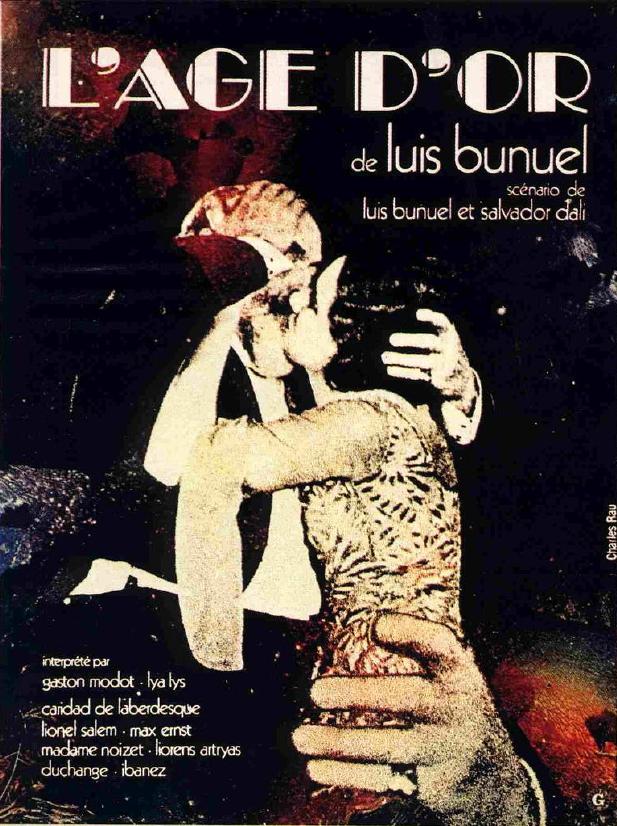
The following year, Buñuel and Dalí collaborated again, this time on a feature-length film, L'Âge d'Or (The Golden Age). For audiences of the time at least, the fruit of their collaboration was even more shocking the second time around.
In general, surrealism reminds me of something Buddy Hackett once told Roger Ebert about stand-up comedy. "Ninety-nine percent is in the delivery. If you have the right voice and the right delivery, you're cocky enough, and you pound down on the punch line, you can say anything and make people laugh maybe three times before they realize you're not telling jokes."
 And after my first cursory viewing, that's what I thought L'Âge d'Or was, another of Luis Buñuel's surrealist jokes, only instead of the shocking yet purposely meaningless images of Un Chien Andalou, here you had a series of scenes that could fit into the most mundane of Hollywood movies—a documentary about scorpions, soldiers on the eve of battle, lovers kissing, an angry crowd, a man arrested, a woman fretting about a dinner party, a reception—but instead of the payoff you're expecting, the scenes are punctuated with nonsense dialogue, cattle in the bedroom and blind beggars who get punched for no reason. Buñuel, I thought, was serving up nonsense and daring me once again not to try to make sense of it.
 But in drafting this essay, I watched L'Âge d'Or again (anything for you, dear readers) and began to see that, though seemingly random, the images actually fall into one of three categories: acts of violence, stuffy clerics and aristocrats, and frustrated would-be lovers. Read together, not literally but as you would a dream, Buñuel seems to be saying that societal and religious norms are cramping his style—and he's mad as hell and not going to take it anymore.
Read that way, as the dream of an angry, frustrated fetishist, L'Âge d'Or is actually quite an achievement. Buñuel himself called the film "a desperate and passionate call to murder."
 "For me," he said, "it was a film about passion, l'amour fou, the irresistible force that thrusts two people together, and about the impossibility of their ever becoming one." No wonder he wanted to kill somebody.
L'Âge d'Or was banned as an attack on the Catholic church and after a few performances, its producer Vicomte Charles de Noailles, who had commissioned the film as a birthday present to his wife, withdrew it from circulation. The film was not seen again for nearly fifty years.
L'Âge d'Or also marked the end of the working relationship between Luis Buñuel and Salvador Dalí. To say the two had a falling out while making this movie would be an understatement—on the first day of shooting, Buñuel chased Dalí off the set with a hammer.
 To me at least, L'Âge d'Or is not quite as interesting as Un Chien Andalou —once you've slashed an eyeball, it's hard to top yourself —but it does reward repeat viewing and if you're at all interested in surrealism, avant garde film or the career of Luis Buñuel, L'Âge d'Or is indispensable. And I would say any artist—be they a painter, writer, director, whatever—should see it if only to gain some insight into how to present complex ideas metaphorically. Not to mention you get to watch the lovely Lya Lys suck on a marble statue's big toe—which you have to admit is not something you see every day.
In any event, I suspect that Buñuel couldn't have later made his masterpiece The Discreet Charm Of The Bourgeoisie (which won the Oscar for best foreign film of 1972) if he hadn't first made L'Âge d'Or and for that alone it was worth making.
 "All of which is well and good," you say, "but what about us Saturday night movie fans? Should we rent this?" Well, let's just say L'Âge d'Or is about as far removed from Fun-Stupid as you're going to get. It's not even the movie to start with if you want to dive into surrealism (although you'd want to get there eventually) and frankly, if you haven't already seen all the other movies I've recommended on this blog, you've got a lot of watching to do before you need put this one on your list.
Still, cows in the bedroom. You could do a lot worse on a Saturday night.
Personal Note: With this essay, I've now posted roughly as many words on this blog as I wrote in my first (unpublished) novel. I'm not sure whether that's cause for celebration or lamentation. As Tim Robbins said to Tommy the oft-imprisoned thief, "Perhaps it's time you considered a new profession." On the other hand, the poet Charles Bukowski wrote, "I've learned to feel good when I feel good" and I feel good when I write this blog. So all in all, I guess it's a good thing. In any event, Katie-Bar-The-Door and I are having a happy Thanksgiving and we hope you are, too.
8:50 A.M. Postscript: I don't recommend writing about surrealism right before going to bed. I dreamed I was at a football game and I said, "The Marx Brothers always had good linebackers," which is ridiculous, of course—everybody knows Chico couldn't stop the run.


