skip to main |
skip to sidebar
[To read Part One of this essay, click here. To read Part Two, click here. For Part Three, click here, and for Part Four, click here.]
V. Later Comedies and Lubitsch's Legacy
 After Trouble In Paradise and Design For Living, "comedies without music" he called them, Lubitsch returned to the comfort of the operetta form he had perfected during the first days of sound. The story of a randy army officer ordered to woo a wealthy widow in order to save the country from bankruptcy, The Merry Widow—made while on loan to MGM—was the most polished and least suggestive of his five musicals. The Hays Office, by 1934 enforcing the Production Code, objected to several scenes and required extensive cutting before it would approve the film for release. (Fortunately, this footage was saved and has been restored.)
The Merry Widow received good reviews and won an Oscar for art direction, but with production costs of $1.6 million, it was the most expensive musical made to date and wound up losing money. It was also the last pairing of stars Maurice Chevalier and Jeanette MacDonald. The former found himself relegated to smaller and smaller parts and eventually returned to France; the latter paired up with Nelson Eddy and made commercially successful movies for the next decade, though in retrospect, none are as satisfying as those she made with Lubitsch.
 After the commercial failure of The Merry Widow, Lubitsch did not direct another movie for three years. In the meantime, he took a job as production manager at Paramount, becoming the only director to ever run a major studio. I'd like to say it was an inspired choice, but in fact, Lubitsch had never been able to delegate authority easily and wound up interfering in many of the sixty productions a year he oversaw without really being able to contribute anything substantive, a result that pleased no one.
"I think I am possessed only of a fascination for the work I have chosen to do," he said later. "I am so engrossed by the production of a film that I literally think of nothing else. I have no hobby, no outside interests and want none."
He was unceremoniously dismissed as head of production in early 1936.
The time away from the director's chair, though, gave Lubitsch time to consider what kind of film he really wanted to make. Whipsawed on the one hand by the enforcement of the Production Code which had effectively forbidden the racier aspects of his style; and on the other by the aggressive style of the screwball comedy which made his gentle approach passe, Lubitsch temporarily lost confidence in his ability to make a successful picture.
 He eventually figured it out, though not at Paramount, moving in 1939 to MGM, where he directed Greta Garbo in Ninotchka and James Stewart in The Shop Around The Corner, two of his best comedies, both preserved in the National Film Registry. In 1942, he made what is arguably his best movie, To Be Or Not To Be, an anti-war comedy starring Jack Benny and in the last role of her career, Carole Lombard. Blasted by critics at the time as being in bad taste, To Be Or Not To Be has become a particular favorite of critics over the intervening years and was included in the National Film Registry in 1996, one of five Lubitsch movies so honored.
"None of us thought we were making anything but entertainment for the moment," John Ford said later. "Only Ernst Lubitsch knew we were making art."
"Lubitsch had the greatest sense of humor of any individual I've ever met," said director Joseph M. Newman. "The actors all loved him. He had a very human quality about him. He was the type of man that became your friend after you met him once. A great man."
 His most faithful disciple was fellow German refugee Billy Wilder, who wrote the screenplay to Ninotchka and later directed such classics as Double Indemnity, Sunset Boulevard, Some Like It Hot and The Apartment. Over his desk, Wilder posted a sign "How would Lubitsch do it?" But despite winning six Oscars during his career, Wilder ultimately concluded he had never measured up to his mentor. "His art is lost," he said. "That most elegant of screen magicians took his secret with him."
In 1943, Lubitsch received an Oscar nomination for Heaven Can Wait, the third nomination of his career, but once again, he did not win. In March 1947, as it became clear that Lubitsch's health was failing, the Academy presented him with a special award "[f]or his distinguished contributions to the art of the motion picture."
 "With the passing years," wrote his biographer Scott Eyman, "it became increasingly clear that Ernst Lubitsch had accomplished something only vouchsafed the greatest artists: he had created a self-contained universe with a sensibility so singular, behavioral beauties so intense, that it forever altered the world view of those lucky enough to experience it. He believed in his dreams so strongly that millions of others came to believe in them as well, and the fact that the values and style of Lubitsch's work constituted the finest examples of the discarded heritage of elegant screen comedy made his everlasting, gentle brilliance even more poignant."
Ernst Lubitsch died of a heart attack in November,1947.
"No more Lubitsch," Billy Wilder lamented at the funeral.
"Worse than that," said William Wyler. "No more Lubitsch films."
[To read Part One of this essay, click here]
 II. The Lubitsch Touch
Ernst Lubitsch arrived at Paramount Pictures in 1928. Like Warner Brothers, Paramount gave the director complete creative control, but unlike Warners, Paramount's executives didn't care if his movies made money or not. As long as he delivered his pictures on time, stayed within his allotted budget and pleased the critics, the prestige his presence lent the studio was compensation enough.
Such latitude was virtually unheard of, then or now, and no artist could have taken wiser advantage of the opportunity. Although already established as one of the world's best directors (his silent Carmen, for example, made the New York Times top ten list in 1921), Lubitsch blossomed once he arrived at Paramount in 1928.
 So productive were Lubitsch's early years at Paramount that film historian James Harvey, in his study Romantic Comedy in Hollywood, called this period in movie history (1929-33) "The Lubitsch Era." He made full use of storytelling possibilities only just becoming apparent to a handful of directors as the new sound technology took hold in Hollywood, and in the process his films came to define the early romantic comedy.
It was during this period that Lubitsch turned an advertizing slogan—"The Lubitsch Touch"—into a very real style that filmmakers have been trying to define and emulate ever since.
The phrase "The Lubitsch Touch" has been associated with the man for so long, it's easy to forget it didn't just spontaneously attach itself to him sometime after birth. In fact, Hal Wallis, who years later would produce Casablanca, coined the phrase while working in the Warner brothers publicity department in the early '20s, but while Wallis may have only dreamed up the label to sell movie tickets, the tag wouldn't have stuck if it hadn't been founded on truth.
 In the silent era, what the "touch" mostly meant was that Lubitsch wasn't making D.W. Griffith pictures. Griffith, as you no doubt know, practically invented what we think of a "movie," and from 1915 to 1921, he was the most famous director in America. But while his technical expertise was sophisticated, Griffith's storytelling was not, with earnest tales of virginal heroines and cartoon villains. In lesser hands, these unfortunately are the kind of stories many people think of when they think of silent movies—Snidely Whiplash tying Penelope to the railroad tracks—and even as practiced by the talented Griffith, audiences during the Roaring Twenties were ready for something new.
Thus arrived Lubitsch to serve champagne to an audience raised on buttermilk and although some, such as author-activist Jim Tully, writing for Vanity Fair in 1926, criticized him for making "frothy films for sophisticated chambermaids and cinema critics," French director Jean Renoir later opined that by leading American tastes—or at least the studios' tastes—away from Griffith, Lubitsch had invented the modern Hollywood.
 Admittedly, I'm not sure Lubitsch in the silent era was doing anything all that different from Robert Weine, F.W. Murnau, Fritz Lang, Abel Gance and other European directors, but American audiences weren't seeing those films (Nosferatu, for example, wasn't released in the United States until 1929, seven years after its German premiere). The nearest thing to European sensibilities showing in American theaters in the '20s were the films of Erich von Stroheim, whose Foolish Wives and Greed were tough sledding indeed.
Later, though, once technical breakthroughs allowed him to add dialogue, songs, sound effects and a film score, Lubitsch really was doing something different, and when we speak of the "touch," it's most often the Paramount films we're talking about. He already had a sense of how to tell a story through visuals—for example, the way he established Irene Rich's character in Lady Windermere's Fan with just a shot of a man reaching for a checkbook while she bites her thumb—but with the coming of sound, he was able to draw deeper characters, sharpen the wit, speed the pace, and in the process, pull back the curtain on human behavior, particularly human sexuality, in a way no other director had managed before.
"He could do more to show the grace and humor of sex in a nonlustful way," said Charlie Chaplin, speaking years later, "than any other director I've ever heard of." He was "a man who was amused by sex rather than frightened of it," critic Michael Wilmington wrote, "and who taught a whole culture to be amused by it as well."
 After starting at Paramount with a historical drama, The Patriot, as much a part of his repertoire at the time as were his sophisticated comedies, Lubitsch commenced to make a series of "naughty operettas" (Harvey's phrase again), five of them altogether including The Merry Widow while on loan to MGM in 1934, and it was here that he mastered the art of talking about sex without talking about it at all.
"When I married her," says a cuckolded husband in One Hour With You, "she was a brunette. Now you can't believe a word she says."
"He created a style of sophisticated comedy peculiarly his own," said three-time Oscar winner William Wyler, "as well as a new style of musical, both unknown before his time. His films bore the recognizable and indelible stamp of the gay, clever, witty, mischievous master, whose delightful personality matched his work."
 Although nearly everyone agrees Lubitsch brought something unique to the screen, no two people can quite agree on what we mean when we speak of "the Lubitsch touch." For Orson Welles, it was his originality. For director-historian Peter Bogdanovich, it's "sophistication." For film critic Roger Ebert, it's "dialogue [that] shimmers like poetry." For director Cameron Crowe, it's the "elegant joke" followed by "an even funnier joke, which becomes the ultimate joke you never expected."
And on and on.
For me, the touch has come to be characterized by three things: elision, invention and exuberance—and by the latter, I mean both the joy Lubitsch took in his craft and the sense of euphoria I experience when I watch the best of his movies.
More than any other director before or after, maybe more than any artist not named Ernest Hemingway telling very different kinds of stories, Lubitsch relied on elision—omitting words, scenes and action—to tell his jokes and his stories. "He realized," Billy Wilder said, "that if you say two and two, the audience does not have to be told it's four." Give the audience the conspiratorial pleasure of finding the joke themselves, "and you were rewarded by the laugh of the people who added it up."
 Perhaps the most famous example of this was in The Merry Widow—a soldier (Maurice Chevalier) is guarding the door as the elderly, obese king leaves the queen's bedchamber. The camera follows the king down the hall until he realizes he's forgotten his saber. He returns, where we notice Chevalier is no longer standing. The camera lingers outside the door and a moment later, the king emerges with the forgotten sword. But as he attempts to buckle it on, the belt reaches only half way around his waist. And he and the audience arrive at a realization simultaneously.
Lubitsch was also obsessed with finding inventive ways to accomplish the otherwise mundane—"How can we do that without doing that?" was a question he was always asking of his writers. The answer was sometimes as simple as allowing the camera to linger on a vacated space when another director would have followed his actors; having a character enter the frame from an unexpected direction; editing out an actor's long walk from one part of a room to another; or, in a more complex sequence, the way he would establish a locale, eschewing the traditional long shot of a famous landmark, instead opening with something unexpected as in Trouble In Paradise where the focus is on an anonymous doorway, pulling back to reveal a garbage can, then following a trash collector until he reaches a gondola on the canals of what can only be Venice.
 The effect is cheerfully buoyant rather than coldly academic, and serves to create a sense that the characters are floating on air, and that even when ostensibly set in a real place, the events were happening in what biographer Scott Eyman called "Lubitschland."
"I've been to Paris, France," Lubitsch said, "and I've been to Paris, Paramount. Paris Paramount is better."
Sometimes this genius for invention represented the difference between a classic and a misfire. In Conversations With Wilder, director Billy Wilder described to Cameron Crowe how for Ninotchka Lubitsch solved the problem of how to show the transformation of Greta Garbo's character from an ardent communist to an equally ardent capitalist without writing pages and pages of turgid, political dialogue.
 "'The hat.' And we said, 'What hat?' He said, 'We build the hat into the beginning!' [Co-writer Charles] Brackett and I looked at each other—this is Lubitsch. The story of the hat has three acts. Ninotchka first sees it in a shop window as she enters the Ritz Hotel with her three Bolshevik accomplices. This absolutely crazy hat is the symbol of capitalism to her. She gives it a disgusted look and says, 'How can a civilization survive which allows women to wear this on their heads?' Then the second time she goes by the hat and makes a noise—tch-tch-tch. The third time, she is finally alone, she has gotten rid of her Bolshevik accomplices, opens a drawer and pulls it out. And now she wears it. Working with Lubitsch, ideas like that were in the air."
Working with Lubitsch, marveled Robert Stack after filming To Be Or Not To Be, was "like playing chess at ninety miles an hour."
"In an age in which machine-gun editing has replaced the cinematic equivalent of perfect pitch," Scott Eyman wrote in Laughter In Paradise, "Lubitsch might seem stodgy to a modern audience. If people lack the vocabulary to appreciate the beauty of this particular lost language, it's their loss. They'll never know the exhilaration of an impeccable artist."
 Lubitsch loved to work and took great pains to create precisely the right shot; he loved life, too, both its happy and its sad sides. He was funny, charming, exuberant, and forgiving of every human foible but mediocrity and sanctimony, and these aspects of the man show up in every frame of film he shot. Sometimes he's suggestive—shots of sounding artillery spliced into scenes of a wedding night in The Love Parade—and sometimes he playfully chides you for having your mind in the gutter—for example, in The Smiling Lieutenant when Chevalier suggests waggishly to Claudette Colbert that they could make beautiful music together, and then a cut to the two of them, what else, playing a duet on the piano.
"I let the audience use their imaginations," he said. "Can I help it if they misconstrue my suggestions?"
 I think more important is a reluctance on Lubitsch's part to judge others—Harvey calls it "moral grace"—that leaves us with the hope that despite all our human failings, love will ultimately win out. In the hands of another director, these stories of pleasure sought and found would curdle into something sour as the characters inevitably faced the consequences of their actions. But in Lubitschland, charm and good manners always prevail. Thus, in a tale such as Trouble In Paradise, thieves can steal and lovers can stray yet all involved can walk away unscathed if they can only conjure the appropriate elegant gesture. This is a fantasy to be sure, but one central to the human experience of longing.
That he could make Americans steeped in Puritan piety believe in the promise of guilt-free pleasure, if only for ninety minutes, is perhaps the most compelling proof of all that Lubitsch did indeed possess the "touch."
[To read Part Three of this essay, click here.]
 Next up was supposed to be Part Two of my essay on Ernst Lubitsch, which is well in hand and maybe you'll still get it today if I can squeeze it in before Katie-Bar-The-Door and I head to Nationals Park with Mister Muleboy and
 Michele Mishka to see Stephen Strasburg.
But it's Jeanette MacDonald's birthday today and since she and Lubitsch are inextricably linked, I just have to stop here and tell her hello.
She was a discovery of Lubitsch's, don't you know. Actor Richard Dix had seen her on the Broadway stage in 1928 and had her make a screen test for Paramount, but nothing came of it until Lubitsch happened upon it a year later and immediately saw her star potential. He flew to Chicago where she was working and signed her to star in his first sound production, The Love Parade with Maurice Chevalier. The picture was a hit, she was a hit and the rest is history.
 MacDonald made four movies for Lubitsch, The Love Parade (1929), Monte Carlo (1930), One Hour With You (1932) and The Merry Widow (1934), each better than the last. For those of you who only know her through her later work with Nelson Eddy, I strongly suggest you track down these musicals, and one other, Love Me Tonight, a Rouben Mamoulian musical in the Lubitsch style. She's beautiful and sexy and is allowed to show a naughty side you never get to see again once the studios began to enforce the Production Code in late 1934.
Born in Philadelphia in 1903, MacDonald began acting at the age of six and was winning singing contests by the age of thirteen. After her successful association with Lubitsch at Paramount, Irving Thalberg lured her MGM where she became known as the Iron Butterfly thanks to her skill at negotiating favorable contracts.
 She's best remembered now for her association with singer Nelson Eddy. They made eight pictures together, including Naughty Marietta, Rose-Marie and Maytime. She also made San Francisco with Clark Gable and Spencer Tracy, which includes a spectacular recreation of the 1906 earthquake.
A weak heart forced MacDonald into semi-retirement in the 1950s, although she did occasionally perform with Eddy. She died of a heart attack in 1965.
Trivia: MacDonald's sister Blossom, who performed under the name Marie Blake, played Grandmama on the television show The Addams Family.
 The poll for best song of 1932-33 quickly turned into a neck-and-neck contest between "We're in the Money" from Gold Diggers of 1933 and "Who's Afraid of the Big Bad Wolf" from Three Little Pigs, with the Busby Berkeley dance number edging the classic Disney cartoon theme right at the wire, 14 votes to 12. The Rogers and Hart standard, "Isn't It Romantic," finished third with 6 votes and two more songs, "42nd Street" and "Remember My Forgotten Man," both penned by the winning songwriting team of Harry Warren and Al Dubin, picked up three votes each. And while "We're in the Money" won only a plurality of the vote, the three Warren/Dubin numbers, taken together, took 20 of the 38 votes cast, a clear win in my book for perhaps the most prolific pair of songwriters you've never heard of.
 In a way, the story of "We're in the Money" begins with Al Jolson and The Jazz Singer way back in 1927—a story that so far has taken me more than a year to tell, so let me recap: when talkies supplanted silent films, studios actually had no idea what to do with the new technology. So movie producers, assuming audiences were just as dumb as they themselves were, copied The Jazz Singer formula over and over, dropping in songs and musical performances almost at random into every new film that came out, even into movies where a song made no sense at all. And audiences got sick of it in a hurry, so much so that by 1930, musicals were box office poison. (You can see Hollywood doing the same thing right now with 3-D, turning everything into a 3-D movie whether it makes sense or not.)
Come 1933, the only way Warner Brothers production chief Darryl F. Zanuck could convince his bosses to make a musical was to lie to them, telling them 42nd Street would be a gritty drama about the backstage intrigue typical of a Broadway show. He set up two separate film units, one for the dramatic material, one for the musical numbers, and hired a couple of Broadway veterans, composer Harry Warren and lyricist Al Dubin, to come up with the songs for the movie on the sly.
 For a guy you've probably never heard of, composer Harry Warren was a hit-writing machine. He wrote twenty-one number one hits in his career (nine with lyricist Al Dubin), including "Jeepers Creepers," "Chattanooga Choo Choo," "On the Atchison, Topeka and the Santa Fe" and "You Must Have Been A Beautiful Baby." He also wrote hits such as "That's Amore," "I Got A Gal in Kalamazoo," "Shuffle Off To Buffalo," "You'll Never Know" and "At Last." He was nominated for an Oscar eleven times, winning three. In addition to Al Dubin, Warren also worked extensively with Mack Brown and Johnny Mercer.
 Al Dubin meanwhile had written the lyrics for several hit Broadway musicals and found himself paired with Warren for the first time on 42nd Street, mostly because the two had backstage Broadway experience that Zanuck wanted to draw on. Among the numbers they wrote were "You're Getting To Be A Habit With Me" (inspired by a line from a studio secretary explaining why she was dating a particular man), "Shuffle Off To Buffalo" and the title song.
Incidentally, the two can be seen at the beginning of 42nd Street as the authors of the stinker of a song, "It Must Be June," which stage director Julian Marsh (Warner Baxter) throws out of the show over their protests.
Providing choreography for the dance numbers was Busby Berkeley. Berkeley had gotten his start choreographing parades and marching bands, before going to work for Samuel Goldwyn on the hit Eddie Cantor movie, Whoopee! in 1930. Berkeley took a novel approach to filming the numbers, arranging the performers in geometric patterns and allowing the camera itself to do the dancing as it flew overheard or dollied underneath. As Daniel Eagan writes in America's Film Legacy, "For purists, this technique was the antithesis of true dance, but in 1933 it seemed fresh, even daring."
42nd Street was a huge success, saving the studio from near bankruptcy. A follow-up, Gold Diggers of 1933, immediately went into production, using most of the same team—hoofers Ruby Keeler, Dick Powell and Ginger Rogers, choreographer Busby Berkeley and the songwriting team of Warren and Dubin. Stock Warner Brothers players Joan Blondell, Warren William and Aline MacMahon were added to carry the story.
 Like its predecessor, Gold Diggers is about the backstage shenanigans of a Broadway production, this time played for laughs instead of drama. To save time, Zanuck recycled the screenplay from 1929's hit Gold Diggers of Broadway, but instead of the original's rather dull numbers, such a nine-minute version of "Tip Toe Through the Tulips," Zanuck relied on Warren and Dubin to come up with something sizzling. The duo didn't disappoint.
Unlike 42nd Street which hid its intentions until the last twenty minutes, Gold Diggers of 1933 announces itself as a musical from the get-go. After the opening credits, the movie jumps straight to Ginger Rogers singing "We're in the Money" (called "The Gold Diggers Song" to tie the sheet music to the movie) while a bevy of beauties clad only in body stockings and giant gold coins dance around her.
We're in the money, we're in the money;
We've got a lot of what it takes to get along!
We're in the money, that sky is sunny,
Old Man Depression you are through, you done us wrong.
It's an ironically upbeat number, not just because the story is about chorus girls so broke they steal the neighbor's milk for their morning cereal, but because the country was mired in the depths of a Depression grinding along in its fourth year.
 The screenplay had originally called for a dreary montage of shuttered theaters showing the effects of the Depression on Broadway, but Berkeley and director Mervyn LeRoy junked the script and opted to dazzle the audience right away. It turned out to be an inspired choice. The number's energy sweeps you right past the movie's hokey storyline and by the time you start to wonder why you're watching this cookie cutter claptrap, there's another song and dance number on the screen and you're carried away all over again.
Gold Diggers of 1933 is not currently available on DVD and the only way to watch this song at the moment is to click this link, head on over to TCM and watch the clip there. Or you can come over to my house and watch it on tape. I suggest the former. [Note: In the comments section, Brian tells me that Gold Diggers of 1933 is available as part of the Busby Berkeley collection which also includes 42nd Street, Footlight Parade, Dames and Gold Diggers of 1935. That, my friends, is a good collection.]
While you're watching and listening, here are some of the faces to look for:
 Ginger Rogers—I hope you know who she is. Half of the greatest dance team in history, Rogers started as a contract player, appearing in ten movies in 1933, including small roles in both 42nd Street and Gold Diggers of 1933. In the former, she played "Anytime Annie," a roundheels who said no only once "and then she didn't hear the question." Here she plays Fay Fortune, a down-on-her-luck chorus girl who pals around with the three leads, Joan Blondell, Ruby Keeler and Aline MacMahon. She may well have gotten this plum spot in the proceedings because she was dating director Mervyn LeRoy at the time, but once she was paired with Broadway dancer Fred Astaire in Flying Down To Rio seven months later, she wouldn't need favors from anybody.
And in case you're wondering why Rogers sings a verse in pig Latin, she was amusing her fellow dancers with pig Latin between takes, and either Darryl Zanuck or Busby Berkeley or Mervyn LeRoy—depending on whose story you believe—saw her and decided to make it part of the routine.
 Ned Sparks—One of those ubiquitous character actors on the Warner Brothers payroll, his specialty was deadpan comedy delivered in a nasal, monotone voice of doom, so much a part of his persona that Lloyds of London insured his reputation for $10,000 in the event he was ever photographed smiling. At least that's what the New York Times reported in 1936, and they're never wrong. "I speedily realized that I was not destined to cause the ladies to swoon with romantic ecstasy as they watched me make love to one of their sex," he once said. "I have also divined that comedy and not romantic acting was my special forte." He appeared in over eighty movies and retired in 1947.
Ironically, Sparks's character Barney Hopkins growls at one point in the film "Cancel my contract with Warren and Dubin!" Obviously, Warner Brothers went in the other direction, hiring the duo to write songs for its next backstage musical, Footlight Parade.
 Joan Blondell—I've written about her before, at length (click here). One of my favorite pre-Code actresses, Blondell made more than a hundred movies in her career, eight in 1933 alone. There was always something tough and no-nonsense about Blondell's sex appeal (she knew what she wanted, said yes when she wanted and only when she wanted) that made her a fan favorite during the Depression. She's the star of this picture, playing a chorus girl who tries to keep the snooty Warren William from breaking up the romance of Dick Powell and Ruby Keeler, only to fall for the big lug herself. I imagine this plot was already a cliche when Adam told it to Eve in the Garden, but Blondell looks great in her skivvies and it's all great fun, so who cares?
 Ruby Keeler—The wife of Jazz Singer star Al Jolson, Keeler was the nominal star of Warner's backstage trilogy, with 42nd Street serving as her screen debut. "I couldn't act," she said later, "I had that terrible singing voice, and now I can see I wasn't the greatest tap dancer in the world, either." But she had a fresh-faced innocence that translated well with audiences and for a couple of years there, she was a big box office draw. She only made eleven movies and except for a handful of television appearances in the 1960s, was out of pictures by 1941. (For more on Keeler, check out "Shadow Waltz," a blog devoted to all things Ruby.)
 Aline Mac Mahon— Like Ned Sparks, she was one of those faces you'd see in Warner Brothers films of the period, usually playing someone good, wise and long-suffering. She began on Broadway in the 1920s, broke into movies as Edward G. Robinson's loyal secretary in Five Star Final and continued to act until her retirement in 1975. Nominated for an Oscar for her supporting performance in 1944's Dragon Seed, you might also want to track her down in Skyscraper Souls, co-starring Gold Digger's male lead, Warren William.
The movie was supposed to end with "Pettin' In The Park," which would have made more sense narratively but didn't pack much punch, either visually or as a tune. Instead, producer Hal Wallis (who took over mid-production when Zanuck quit in a contract dispute) opted to end with the picture's final Warren-Dubin song, "Remember My Forgotten Man," an explicitly political number about the Depression.
Remember my forgotten man,
You put a rifle in his hand;
You sent him far away,
You shouted, "Hip, hooray!"
But look at him today!
Sitting as it does at the end of the picture, the song serves as a big fat middle finger to everything that's come before it. Eagan calls it "a song of epic chutzpah." That it is.
Audiences ate it up. Gold Diggers of 1933 was an even bigger hit than 42nd Street, grossing a million dollars more than its predecessor, an enormous amount of money considering ticket prices ranged from 10¢ to a quarter.
 Looking to cash in on a trend, Warners quickly rushed Footlight Parade into production and gave the lead to its most popular star, James Cagney. In this one, they barely bother with a plot—more a case of "Did you see the other two? This is more of the same"—and gave Berkeley free rein. It's the most over-the-top of three, with numbers that wouldn't fit into an airplane hanger ostensibly taking place on a theater stage. It's worth looking up, though, to see Cagney in a pre-Yankee Doodle Dandy dancing role.
Harry Warren and Al Dubin wrote the songs for that one, too, and all three movies are preserved in the National Film Registry.
1933 represented the highwater mark for Berkeley's career. Within a year, his lavish production numbers were considered old hat and by the early '40s, even though he was still directing musicals, others, particularly Gene Kelly, had taken over his choreographing duties.
 Ironically, it was the star of the "We're In The Money" number that hastened Berkeley's downfall. Over the course of the next three summers, in The Gay Divorcee, Top Hat and Swing Time, Ginger Rogers and Fred Astaire would, like Berkeley before them, redefine the movie musical, turning dance into a most intimate expression of love and romance. Suddenly by comparison Berkeley's choreography seemed gaudy, abstract and impersonal, and what had thrilled audiences in 1933 was dismissed as so last year by 1934.
Harry Warren and Al Dubin continued to crank out hits throughout the 1930s, with their last number one together being 1937's "Remember Me." After that, Dubin returned to Broadway and wrote musicals until his death in 1945, while Warren teamed up with other lyricists and continued to write hit songs into the 1950s. "The familiarity of Harry Warren's songs," said one drama critic, "is matched by the anonymity of the man" and Time magazine noted, "By silent consensus, the king of this army of unknown soldiers, the Hollywood incognitos, was Harry Warren, who had more songs on the Hit Parade than [Irving] Berlin himself and who would win the contest hands down if enough people have heard of him."
Well, you've heard of him now, anyway.
 One of two Marx Brothers movies preserved in the National Film Registry (the other is A Night At the Opera) and the last to include Zeppo, Duck Soup is the funniest of their films, an exercise in inspired anarchy that nevertheless works with the precision of a Swiss watch.
Without ever feeling overburdened by superfluous plot, Duck Soup is one of the few Marx Brothers movies that actually has one, or at least one that serves not merely as an excuse for humor, but as a catalyst for it. Considering how many chefs stirred this particular cinematic pot, however, not just the credited writers but also director Leo McCarey and the Brothers themselves, all concerned likely counted themselves lucky that the movie worked at all. A study of the screenwriting process reveals that the story was actually a mishmash of old vaudeville gags, Laurel and Hardy routines and entire scenes lifted nearly intact from the Marx Brothers' short-lived radio program. That Duck Soup wound up the most effortlessly brilliant entry in the Marx Brothers' oeuvre is something of a modern movie miracle.
 Immediately after the release of the Marx Brothers' 1932 hit, Horse Feathers, work began on a follow-up, Firecrackers, to be set in the mythical Eastern European kingdom of Oo-La-La, with Ernst Lubitsch, whose resume was filled with comedies set in mythical Eastern European kingdoms, slated to direct. The script started as a handful of songs and a rough story idea from the songwriting team of Burt Kalmar and Harry Ruby, who had written songs for two other Marx Brothers movies, Animal Crackers and Horse Feathers.
His Excellency is due
To take his station
Beginning his new
Administration.
He'll make his appearance when
The clock on the wall strikes ten.
 Zeppo, by the way, who sings this opening number, was initially to play Groucho's son, as he had in Horse Feathers, and only at the last minute was the part rewritten to be Rufus T. Firefly's secretary, Bob Roland. It was probably just as well—it's his smallest part in the five films he appeared in and he was ready to leave the act and pursue a career as a Hollywood talent agent.
For the opening scene, a long sequence in a palace ballroom where foreign dignitaries and government officials have assembled to await the arrival of Freedonia's new leader, Kalmar and Ruby wrote two other songs, the two-line Freedonian national anthem and a big song and dance number for Groucho.
The last man nearly ruined this place
He didn't know what to do with it.
If you think this country's bad off now
Just wait 'till I get through with it.
Together with "His Excellency Is Due," the scene plays out more or less as it did in the final film.
During these early stages of the story's development, Kalmar and Ruby also penned the opening lines of what would later become the song and dance number, "The Country's Going To War," which was a spoof of, among other things, the spiritual "All God's Chillun Got Wings," and a 1924 Eugene O'Neill play of the same name starring Paul Robeson.
Then it's war!
Then it's war!
Gather the forces!
Harness the horses!
Then it's war!
 Taken together, the songs suggested something of a story arc—Rufus T. Firefly (Groucho) becomes leader of Freedonia and the country winds up in a war—but stitching those two bookends together proved to be a bit of a problem.
Grover Jones, a veteran of more than a hundred screenplays in his career, including the Ernst Lubitsch classic, Trouble in Paradise, made the first attempt at hashing out the storyline. Working with Kalmar and Ruby, Jones's draft of the script, now entitled Cracked Ice, imagined that Groucho, in addition to being president of Freedonia, is also an arms manufacturer who conspires with Chico to start a war to gin up a demand for his product, anticipating by nearly three decades Dwight Eisenhower's "military-industrial complex" speech, with Margaret Dumont throw in for comic relief.
 Some of the jokes survive—the recurring bit with "His Excellency's car," the "gala day" line, opting for a "standing" army to save on chairs—as does the scene introducing Firefly and the garden party at Mrs. Teasdale's, but everything after the first act went out the window. (One of the rejected ideas was an opera sequence, with Chico and Harpo disrupting the performance. An expanded form of the idea was revived two years later as A Night At The Opera.)
Aside from the fact that many of his gags were belabored and not very funny, Jones fundamentally misunderstood the Brothers' appeal. It was one thing for Groucho to scam the sorts of people we instinctively root against—gangsters, gamblers and rich buffoons—or for Chico to scam Groucho; it was another thing altogether for Groucho and Chico to be those people we root against. (You can read this draft online here.)
Next the studio brought in Groucho Marx's favorite writer, Arthur Sheekman, who along with Nat Perrin, had been writing a radio show for the Brothers, Flywheel, Shyster, and Flywheel, which briefly aired on NBC radio from late November 1932 to May 1933. Arthur Sheekman had been a show business columnist for the Chicago Sunday Times where Groucho sought him out, befriended him and hired him to work on two Marx Brothers films, Monkey Business and Horse Feathers, the latter without credit, before becoming the chief writer on the radio show. Perrin, a former lawyer working in the Warner Brothers' publicity department, landed a job as a gag writer for Groucho after forging a letter of introduction from Broadway playwright Moss Hart.
 The new script, now called Grasshoppers, was cobbled together from previous drafts and from the radio show. With minor refinements, Flywheel, Shyster and Flywheel provided fifteen of Duck Soup's gags and routines, including Chico's trial for treason, and lines such as "Go, and never darken my towels again" and "Would you give me a lock of your hair—I'm letting you off easy, I was going to ask for the whole wig." (I knew there was a reason I bought the transcripts of the radio show some twenty years ago.)
Chico's first scene in Duck Soup was lifted nearly verbatim from the program's first episode. This, from the show's transcript:
"Hey, you remember when you giva me that picture of your wife?"
"Yes."
"Well, I start right out. Joosta like a bloodhound, I tell you. And in one hour, even less than one hour—"
"Yes ..."
"I losa da pisch."
...
"Then you didn't shadow my wife?"
"Sure, I shadow her all day."
"What day was that?"
"That was Shadowday. ... Monday I shadow your wife. Tuesday I go to the ball game—she don't show up. Wednesday she go to the ball game—I don't show up. Thursday was a doubleheader. We both no show up. Friday it rain all day—there'sa no ball game, so I go fishing."
For the movie, the jokes were further polished and the characters altered to suit the story. In addition, business was written for Harpo, who as a silent act was of course not on the radio.
[To read more about Grasshoppers, click here.]
(Producer Herman J. Mankiewicz, who later won an Oscar for co-writing Citizen Kane, also contributed to the finished product—what, exactly, I can't tell you.)
 Finally, although director Leo McCarey wasn't credited with writing the script, I suspect he played a major role in the way the story played out. Originally a lawyer by trade, McCarey broke into the film business as a writer for the Hal Roach Studios; by 1929, McCarey was in charge of production there. A veteran director of comedy shorts, McCarey dipped into his past to provide the Brothers with new material. The scenes with Edgar Kennedy as the long-suffering owner of a lemonade stand are much more characteristic of the slow-burn frustration routines of W.C. Fields and Laurel and Hardy, whom McCarey had worked with extensively, than of the sort of comedy the Brothers had been doing. The scene where Chico and Harpo rob the safe is a reworked bit from Laurel and Hardy. And the famous mirror scene, which McCarey also suggested, was an old vaudeville routine.
McCarey was the first veteran comedy director the Brothers had ever worked with and to their delight, he encouraged improvisation on the set. And to the delight of many film fans, he also insisted on dropping the usual harp and piano interludes.
His main contribution, though, was knowing from experience what was funny and how to capture that comedy on film.
(For a more detailed and less adoring analysis of the film, stop by The Marx Brothers Council Of Britain.)
As filming came to an end in June 1933, the studio finally settled on a title, Duck Soup. The origin and meaning of the title has been the subject of speculation for years, and with his usual directness, Groucho explained it thusly: "Take two turkeys, one goose, four cabbages, but no duck, and mix them together. After one taste, you'll duck soup for the rest of your life."
In fact, though, "duck soup" was slang for "something easy to do," and Leo McCarey almost certainly suggested it—in 1927 while at Hal Roach's studio, he proposed pairing comedic actors Stan Laurel and Oliver Hardy for the first time in short named, yes, that's right, Duck Soup.
In any event, Duck Soup was in keeping with the three previous Marx Brothers movies which had worked an animal into the title.
 The movie premiered on November 27, 1933. Legend has it that Duck Soup flopped on its initial release, but in fact, it broke even at the box office, and although it did receive mixed reviews from critics, its relative lack of success (compared to its predecessors) may owe more to Paramount Pictures' lack of a marketing budget than to any inherent lack of interest on the part of the public. In any event, Paramount, which had been tottering financially throughout the Depression, soon after went bankrupt and the Brothers decamped for MGM where Irving Thalberg remade them in his own image. But that's a story I'll leave for another day.
Despite their ups and downs, Bert Kalmar and Harry Ruby worked together as a songwriting team from 1920 until Kalmar's death in 1947. The pair wrote such songs as "Who's Sorry Now," "I Wanna Be Loved By You," and their biggest hit, "Three Little Words," which provided the title of the 1950 fictionalized film account of the partnership starring Fred Astaire and Red Skelton.
Grover Jones was twice nominated for an Oscar, for the original story Lady and Gent and for the screenplay for The Lives Of A Bengal Lancer (shared with four other writers). He also wrote Abe Lincoln in Illinois, and during the silent era, he directed twenty-one movies. Jones died at the age of forty-six following surgery.
After hopping a train from New York with Groucho and Nat Perrin to write Duck Soup, Arthur Sheekman continued to work in Hollywood, and met his future wife, Gloria Stuart, while writing the Eddie Cantor musical, Roman Scandals. (You may remember Stuart for her Oscar-nominated turn in the 1997 movie Titanic.) Sheekman and Stuart married in 1934 and remained married until his death in 1978.
 Nat Perrin also stayed in Hollywood and did some uncredited script doctoring on Go West and wrote the screen story for The Big Store (recycling the name "Flywheel" and the plot of that movie from the radio show). He also wrote the hit play Hellzapoppin' and later produced The Addams Family for television. Although Duck Soup provided him with an entree into Hollywood, Perrin wasn't a fan of the movie. "[It] was so crazy—that was Leo McCarey's approach, and the boys loved working with him. But, to me, [A] Night at the Opera is a far better film. Of course, plenty of people disagree with me." He died in 1998.
Both Sheekman and Perrin remained lifelong friends with Groucho.
During a career which began in the silent era and ended in the early '60s, Leo McCarey directed 110 shorts and feature films. He was nominated for nine Oscars, winning four, one for directing Cary Grant's breakout performance in The Awful Truth, and three for writing, directing and producing 1944's best picture winner, Going My Way.
And as for the Marx Brothers? We'll be returning to them soon enough.
[To read about frequent Marx Brothers co-star Margaret Dumont, click here.]


 After Trouble In Paradise and Design For Living, "comedies without music" he called them, Lubitsch returned to the comfort of the operetta form he had perfected during the first days of sound. The story of a randy army officer ordered to woo a wealthy widow in order to save the country from bankruptcy, The Merry Widow—made while on loan to MGM—was the most polished and least suggestive of his five musicals. The Hays Office, by 1934 enforcing the Production Code, objected to several scenes and required extensive cutting before it would approve the film for release. (Fortunately, this footage was saved and has been restored.)
 After the commercial failure of The Merry Widow, Lubitsch did not direct another movie for three years. In the meantime, he took a job as production manager at Paramount, becoming the only director to ever run a major studio. I'd like to say it was an inspired choice, but in fact, Lubitsch had never been able to delegate authority easily and wound up interfering in many of the sixty productions a year he oversaw without really being able to contribute anything substantive, a result that pleased no one.
 He eventually figured it out, though not at Paramount, moving in 1939 to MGM, where he directed Greta Garbo in Ninotchka and James Stewart in The Shop Around The Corner, two of his best comedies, both preserved in the National Film Registry. In 1942, he made what is arguably his best movie, To Be Or Not To Be, an anti-war comedy starring Jack Benny and in the last role of her career, Carole Lombard. Blasted by critics at the time as being in bad taste, To Be Or Not To Be has become a particular favorite of critics over the intervening years and was included in the National Film Registry in 1996, one of five Lubitsch movies so honored.
 His most faithful disciple was fellow German refugee Billy Wilder, who wrote the screenplay to Ninotchka and later directed such classics as Double Indemnity, Sunset Boulevard, Some Like It Hot and The Apartment. Over his desk, Wilder posted a sign "How would Lubitsch do it?" But despite winning six Oscars during his career, Wilder ultimately concluded he had never measured up to his mentor. "His art is lost," he said. "That most elegant of screen magicians took his secret with him."
 "With the passing years," wrote his biographer Scott Eyman, "it became increasingly clear that Ernst Lubitsch had accomplished something only vouchsafed the greatest artists: he had created a self-contained universe with a sensibility so singular, behavioral beauties so intense, that it forever altered the world view of those lucky enough to experience it. He believed in his dreams so strongly that millions of others came to believe in them as well, and the fact that the values and style of Lubitsch's work constituted the finest examples of the discarded heritage of elegant screen comedy made his everlasting, gentle brilliance even more poignant."
 II. The Lubitsch Touch
 So productive were Lubitsch's early years at Paramount that film historian James Harvey, in his study Romantic Comedy in Hollywood, called this period in movie history (1929-33) "The Lubitsch Era." He made full use of storytelling possibilities only just becoming apparent to a handful of directors as the new sound technology took hold in Hollywood, and in the process his films came to define the early romantic comedy.
 In the silent era, what the "touch" mostly meant was that Lubitsch wasn't making D.W. Griffith pictures. Griffith, as you no doubt know, practically invented what we think of a "movie," and from 1915 to 1921, he was the most famous director in America. But while his technical expertise was sophisticated, Griffith's storytelling was not, with earnest tales of virginal heroines and cartoon villains. In lesser hands, these unfortunately are the kind of stories many people think of when they think of silent movies—Snidely Whiplash tying Penelope to the railroad tracks—and even as practiced by the talented Griffith, audiences during the Roaring Twenties were ready for something new.
 Admittedly, I'm not sure Lubitsch in the silent era was doing anything all that different from Robert Weine, F.W. Murnau, Fritz Lang, Abel Gance and other European directors, but American audiences weren't seeing those films (Nosferatu, for example, wasn't released in the United States until 1929, seven years after its German premiere). The nearest thing to European sensibilities showing in American theaters in the '20s were the films of Erich von Stroheim, whose Foolish Wives and Greed were tough sledding indeed.
 After starting at Paramount with a historical drama, The Patriot, as much a part of his repertoire at the time as were his sophisticated comedies, Lubitsch commenced to make a series of "naughty operettas" (Harvey's phrase again), five of them altogether including The Merry Widow while on loan to MGM in 1934, and it was here that he mastered the art of talking about sex without talking about it at all.
 Although nearly everyone agrees Lubitsch brought something unique to the screen, no two people can quite agree on what we mean when we speak of "the Lubitsch touch." For Orson Welles, it was his originality. For director-historian Peter Bogdanovich, it's "sophistication." For film critic Roger Ebert, it's "dialogue [that] shimmers like poetry." For director Cameron Crowe, it's the "elegant joke" followed by "an even funnier joke, which becomes the ultimate joke you never expected."
 Perhaps the most famous example of this was in The Merry Widow—a soldier (Maurice Chevalier) is guarding the door as the elderly, obese king leaves the queen's bedchamber. The camera follows the king down the hall until he realizes he's forgotten his saber. He returns, where we notice Chevalier is no longer standing. The camera lingers outside the door and a moment later, the king emerges with the forgotten sword. But as he attempts to buckle it on, the belt reaches only half way around his waist. And he and the audience arrive at a realization simultaneously.
 The effect is cheerfully buoyant rather than coldly academic, and serves to create a sense that the characters are floating on air, and that even when ostensibly set in a real place, the events were happening in what biographer Scott Eyman called "Lubitschland."
 "'The hat.' And we said, 'What hat?' He said, 'We build the hat into the beginning!' [Co-writer Charles] Brackett and I looked at each other—this is Lubitsch. The story of the hat has three acts. Ninotchka first sees it in a shop window as she enters the Ritz Hotel with her three Bolshevik accomplices. This absolutely crazy hat is the symbol of capitalism to her. She gives it a disgusted look and says, 'How can a civilization survive which allows women to wear this on their heads?' Then the second time she goes by the hat and makes a noise—tch-tch-tch. The third time, she is finally alone, she has gotten rid of her Bolshevik accomplices, opens a drawer and pulls it out. And now she wears it. Working with Lubitsch, ideas like that were in the air."
 Lubitsch loved to work and took great pains to create precisely the right shot; he loved life, too, both its happy and its sad sides. He was funny, charming, exuberant, and forgiving of every human foible but mediocrity and sanctimony, and these aspects of the man show up in every frame of film he shot. Sometimes he's suggestive—shots of sounding artillery spliced into scenes of a wedding night in The Love Parade—and sometimes he playfully chides you for having your mind in the gutter—for example, in The Smiling Lieutenant when Chevalier suggests waggishly to Claudette Colbert that they could make beautiful music together, and then a cut to the two of them, what else, playing a duet on the piano.
 I think more important is a reluctance on Lubitsch's part to judge others—Harvey calls it "moral grace"—that leaves us with the hope that despite all our human failings, love will ultimately win out. In the hands of another director, these stories of pleasure sought and found would curdle into something sour as the characters inevitably faced the consequences of their actions. But in Lubitschland, charm and good manners always prevail. Thus, in a tale such as Trouble In Paradise, thieves can steal and lovers can stray yet all involved can walk away unscathed if they can only conjure the appropriate elegant gesture. This is a fantasy to be sure, but one central to the human experience of longing.
 Next up was supposed to be Part Two of my essay on Ernst Lubitsch, which is well in hand and maybe you'll still get it today if I can squeeze it in before Katie-Bar-The-Door and I head to Nationals Park with Mister Muleboy and
  MacDonald made four movies for Lubitsch, The Love Parade (1929), Monte Carlo (1930), One Hour With You (1932) and The Merry Widow (1934), each better than the last. For those of you who only know her through her later work with Nelson Eddy, I strongly suggest you track down these musicals, and one other, Love Me Tonight, a Rouben Mamoulian musical in the Lubitsch style. She's beautiful and sexy and is allowed to show a naughty side you never get to see again once the studios began to enforce the Production Code in late 1934.
 She's best remembered now for her association with singer Nelson Eddy. They made eight pictures together, including Naughty Marietta, Rose-Marie and Maytime. She also made San Francisco with Clark Gable and Spencer Tracy, which includes a spectacular recreation of the 1906 earthquake.
 The poll for best song of 1932-33 quickly turned into a neck-and-neck contest between "We're in the Money" from Gold Diggers of 1933 and "Who's Afraid of the Big Bad Wolf" from Three Little Pigs, with the Busby Berkeley dance number edging the classic Disney cartoon theme right at the wire, 14 votes to 12. The Rogers and Hart standard, "Isn't It Romantic," finished third with 6 votes and two more songs, "42nd Street" and "Remember My Forgotten Man," both penned by the winning songwriting team of Harry Warren and Al Dubin, picked up three votes each. And while "We're in the Money" won only a plurality of the vote, the three Warren/Dubin numbers, taken together, took 20 of the 38 votes cast, a clear win in my book for perhaps the most prolific pair of songwriters you've never heard of.
 In a way, the story of "We're in the Money" begins with Al Jolson and The Jazz Singer way back in 1927—a story that so far has taken me more than a year to tell, so let me recap: when talkies supplanted silent films, studios actually had no idea what to do with the new technology. So movie producers, assuming audiences were just as dumb as they themselves were, copied The Jazz Singer formula over and over, dropping in songs and musical performances almost at random into every new film that came out, even into movies where a song made no sense at all. And audiences got sick of it in a hurry, so much so that by 1930, musicals were box office poison. (You can see Hollywood doing the same thing right now with 3-D, turning everything into a 3-D movie whether it makes sense or not.)
 For a guy you've probably never heard of, composer Harry Warren was a hit-writing machine. He wrote twenty-one number one hits in his career (nine with lyricist Al Dubin), including "Jeepers Creepers," "Chattanooga Choo Choo," "On the Atchison, Topeka and the Santa Fe" and "You Must Have Been A Beautiful Baby." He also wrote hits such as "That's Amore," "I Got A Gal in Kalamazoo," "Shuffle Off To Buffalo," "You'll Never Know" and "At Last." He was nominated for an Oscar eleven times, winning three. In addition to Al Dubin, Warren also worked extensively with Mack Brown and Johnny Mercer.
 Al Dubin meanwhile had written the lyrics for several hit Broadway musicals and found himself paired with Warren for the first time on 42nd Street, mostly because the two had backstage Broadway experience that Zanuck wanted to draw on. Among the numbers they wrote were "You're Getting To Be A Habit With Me" (inspired by a line from a studio secretary explaining why she was dating a particular man), "Shuffle Off To Buffalo" and the title song.
 Like its predecessor, Gold Diggers is about the backstage shenanigans of a Broadway production, this time played for laughs instead of drama. To save time, Zanuck recycled the screenplay from 1929's hit Gold Diggers of Broadway, but instead of the original's rather dull numbers, such a nine-minute version of "Tip Toe Through the Tulips," Zanuck relied on Warren and Dubin to come up with something sizzling. The duo didn't disappoint.
 The screenplay had originally called for a dreary montage of shuttered theaters showing the effects of the Depression on Broadway, but Berkeley and director Mervyn LeRoy junked the script and opted to dazzle the audience right away. It turned out to be an inspired choice. The number's energy sweeps you right past the movie's hokey storyline and by the time you start to wonder why you're watching this cookie cutter claptrap, there's another song and dance number on the screen and you're carried away all over again.
 Ginger Rogers—I hope you know who she is. Half of the greatest dance team in history, Rogers started as a contract player, appearing in ten movies in 1933, including small roles in both 42nd Street and Gold Diggers of 1933. In the former, she played "Anytime Annie," a roundheels who said no only once "and then she didn't hear the question." Here she plays Fay Fortune, a down-on-her-luck chorus girl who pals around with the three leads, Joan Blondell, Ruby Keeler and Aline MacMahon. She may well have gotten this plum spot in the proceedings because she was dating director Mervyn LeRoy at the time, but once she was paired with Broadway dancer Fred Astaire in Flying Down To Rio seven months later, she wouldn't need favors from anybody.
 Ned Sparks—One of those ubiquitous character actors on the Warner Brothers payroll, his specialty was deadpan comedy delivered in a nasal, monotone voice of doom, so much a part of his persona that Lloyds of London insured his reputation for $10,000 in the event he was ever photographed smiling. At least that's what the New York Times reported in 1936, and they're never wrong. "I speedily realized that I was not destined to cause the ladies to swoon with romantic ecstasy as they watched me make love to one of their sex," he once said. "I have also divined that comedy and not romantic acting was my special forte." He appeared in over eighty movies and retired in 1947.
 Joan Blondell—I've written about her before, at length (click here). One of my favorite pre-Code actresses, Blondell made more than a hundred movies in her career, eight in 1933 alone. There was always something tough and no-nonsense about Blondell's sex appeal (she knew what she wanted, said yes when she wanted and only when she wanted) that made her a fan favorite during the Depression. She's the star of this picture, playing a chorus girl who tries to keep the snooty Warren William from breaking up the romance of Dick Powell and Ruby Keeler, only to fall for the big lug herself. I imagine this plot was already a cliche when Adam told it to Eve in the Garden, but Blondell looks great in her skivvies and it's all great fun, so who cares?
 Ruby Keeler—The wife of Jazz Singer star Al Jolson, Keeler was the nominal star of Warner's backstage trilogy, with 42nd Street serving as her screen debut. "I couldn't act," she said later, "I had that terrible singing voice, and now I can see I wasn't the greatest tap dancer in the world, either." But she had a fresh-faced innocence that translated well with audiences and for a couple of years there, she was a big box office draw. She only made eleven movies and except for a handful of television appearances in the 1960s, was out of pictures by 1941. (For more on Keeler, check out "Shadow Waltz," a blog devoted to all things Ruby.)
 Aline Mac Mahon— Like Ned Sparks, she was one of those faces you'd see in Warner Brothers films of the period, usually playing someone good, wise and long-suffering. She began on Broadway in the 1920s, broke into movies as Edward G. Robinson's loyal secretary in Five Star Final and continued to act until her retirement in 1975. Nominated for an Oscar for her supporting performance in 1944's Dragon Seed, you might also want to track her down in Skyscraper Souls, co-starring Gold Digger's male lead, Warren William.
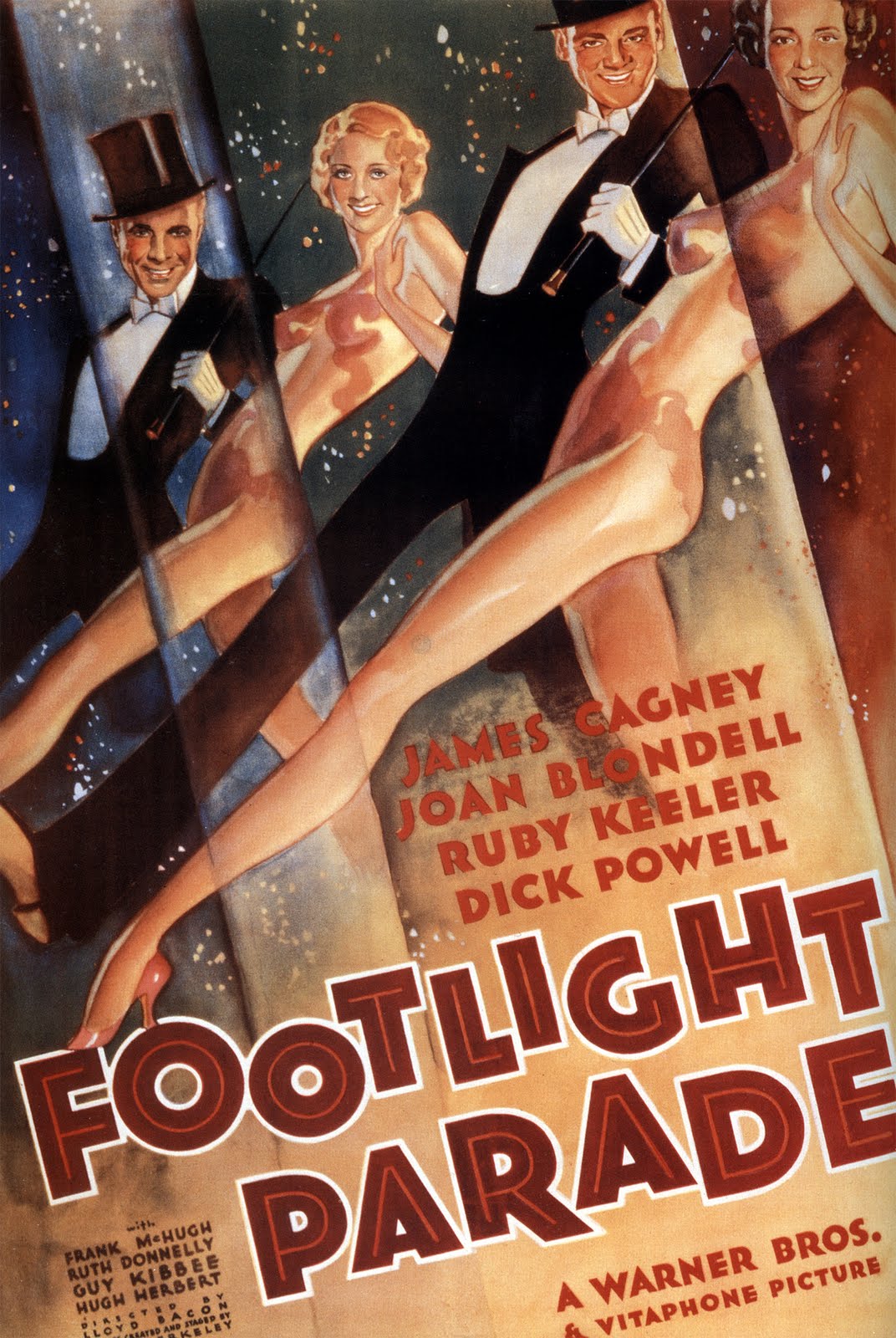 Looking to cash in on a trend, Warners quickly rushed Footlight Parade into production and gave the lead to its most popular star, James Cagney. In this one, they barely bother with a plot—more a case of "Did you see the other two? This is more of the same"—and gave Berkeley free rein. It's the most over-the-top of three, with numbers that wouldn't fit into an airplane hanger ostensibly taking place on a theater stage. It's worth looking up, though, to see Cagney in a pre-Yankee Doodle Dandy dancing role.
 Ironically, it was the star of the "We're In The Money" number that hastened Berkeley's downfall. Over the course of the next three summers, in The Gay Divorcee, Top Hat and Swing Time, Ginger Rogers and Fred Astaire would, like Berkeley before them, redefine the movie musical, turning dance into a most intimate expression of love and romance. Suddenly by comparison Berkeley's choreography seemed gaudy, abstract and impersonal, and what had thrilled audiences in 1933 was dismissed as so last year by 1934.
 One of two Marx Brothers movies preserved in the National Film Registry (the other is A Night At the Opera) and the last to include Zeppo, Duck Soup is the funniest of their films, an exercise in inspired anarchy that nevertheless works with the precision of a Swiss watch.
 Immediately after the release of the Marx Brothers' 1932 hit, Horse Feathers, work began on a follow-up, Firecrackers, to be set in the mythical Eastern European kingdom of Oo-La-La, with Ernst Lubitsch, whose resume was filled with comedies set in mythical Eastern European kingdoms, slated to direct. The script started as a handful of songs and a rough story idea from the songwriting team of Burt Kalmar and Harry Ruby, who had written songs for two other Marx Brothers movies, Animal Crackers and Horse Feathers.
 Zeppo, by the way, who sings this opening number, was initially to play Groucho's son, as he had in Horse Feathers, and only at the last minute was the part rewritten to be Rufus T. Firefly's secretary, Bob Roland. It was probably just as well—it's his smallest part in the five films he appeared in and he was ready to leave the act and pursue a career as a Hollywood talent agent.
 Taken together, the songs suggested something of a story arc—Rufus T. Firefly (Groucho) becomes leader of Freedonia and the country winds up in a war—but stitching those two bookends together proved to be a bit of a problem.
 Some of the jokes survive—the recurring bit with "His Excellency's car," the "gala day" line, opting for a "standing" army to save on chairs—as does the scene introducing Firefly and the garden party at Mrs. Teasdale's, but everything after the first act went out the window. (One of the rejected ideas was an opera sequence, with Chico and Harpo disrupting the performance. An expanded form of the idea was revived two years later as A Night At The Opera.)
 The new script, now called Grasshoppers, was cobbled together from previous drafts and from the radio show. With minor refinements, Flywheel, Shyster and Flywheel provided fifteen of Duck Soup's gags and routines, including Chico's trial for treason, and lines such as "Go, and never darken my towels again" and "Would you give me a lock of your hair—I'm letting you off easy, I was going to ask for the whole wig." (I knew there was a reason I bought the transcripts of the radio show some twenty years ago.)
 Finally, although director Leo McCarey wasn't credited with writing the script, I suspect he played a major role in the way the story played out. Originally a lawyer by trade, McCarey broke into the film business as a writer for the Hal Roach Studios; by 1929, McCarey was in charge of production there. A veteran director of comedy shorts, McCarey dipped into his past to provide the Brothers with new material. The scenes with Edgar Kennedy as the long-suffering owner of a lemonade stand are much more characteristic of the slow-burn frustration routines of W.C. Fields and Laurel and Hardy, whom McCarey had worked with extensively, than of the sort of comedy the Brothers had been doing. The scene where Chico and Harpo rob the safe is a reworked bit from Laurel and Hardy. And the famous mirror scene, which McCarey also suggested, was an old vaudeville routine.
 The movie premiered on November 27, 1933. Legend has it that Duck Soup flopped on its initial release, but in fact, it broke even at the box office, and although it did receive mixed reviews from critics, its relative lack of success (compared to its predecessors) may owe more to Paramount Pictures' lack of a marketing budget than to any inherent lack of interest on the part of the public. In any event, Paramount, which had been tottering financially throughout the Depression, soon after went bankrupt and the Brothers decamped for MGM where Irving Thalberg remade them in his own image. But that's a story I'll leave for another day.
 Nat Perrin also stayed in Hollywood and did some uncredited script doctoring on Go West and wrote the screen story for The Big Store (recycling the name "Flywheel" and the plot of that movie from the radio show). He also wrote the hit play Hellzapoppin' and later produced The Addams Family for television. Although Duck Soup provided him with an entree into Hollywood, Perrin wasn't a fan of the movie. "[It] was so crazy—that was Leo McCarey's approach, and the boys loved working with him. But, to me, [A] Night at the Opera is a far better film. Of course, plenty of people disagree with me." He died in 1998.


