I've already written about most of the Hollywood sex symbols of the pre-Code era—Jean Harlow, Joan Blondell, Marlene Dietrich, or if you prefer, Norma Shearer, Greta Garbo and Clara Bow. But before I put the era in this blog's rearview mirror, I should stop briefly to mention perhaps the most famous sex symbol of the age, Mae West.
Now let's be honest: although I nominated her for a Katie Award for her work in I'm No Angel, Mae West really doesn't work for me, not as an actress, not as a comedienne and certainly not as an object of fantasy. She took the role of sex goddess and dialed it up to "11," beyond vamp, beyond burlesque, more like a drag queen, except, you know, less subtle. Mae West played so broadly, with the leer and the voice and the double entendres, that ultimately she became completely sexless, a threat to no one.
But maybe that's how she got away with it.
Born on August 17, 1893, in Brooklyn, New York, Mary Jane West started performing at the age of five and was a regular on the vaudeville circuit by the age of fourteen. In 1926, she had her first starring role on Broadway in a show she wrote herself, the subtly named Sex. The show sold over three hundred thousand tickets during its run but also resulted in a morals charge that landed West in the workhouse for eight days (with two days off for good behavior). The resulting publicity—she told reporters she wore silk underwear in prison—made her nationally famous.
West wrote other plays, but it was 1928's Diamond Lil that proved to be the turning point in her career. Set in the Bowery during the Gay Nineties, Diamond Lil is the story of a barroom singer who battles white slavers on the one hand and the Salvation Army on the other. Broadway audiences loved it and although she was already pushing forty—ancient for a budding Hollywood actress—Paramount Pictures signed her to a movie contract.
Hollywood's censors prevented West from filming Diamond Lil as written, and instead, a watered-down version was released as She Done Him Wrong, co-starring Cary Grant and boasting the oft-misquoted line, "Why don't you come up some time and see me?"
She Done Him Wrong was nominated for an Academy Award as best picture of 1932-33 and in 1996, the Library of Congress included it in the National Film Registry.
If you're going to see only one Mae West movie, I would suggest I'm No Angel, the follow up to She Done Him Wrong. Again co-starring Cary Grant, here Mae West plays a circus performer who gyrates for the (as she puts it) "suckers," but as with all of her movies, the story is irrelevant. You're paying to see Mae West play Mae West and she does it better here than anywhere else, singing such numbers as "They Call Me Sister Honky-Tonk," spouting double entendres and, unusual for the times, hamming it up with a Greek chorus of African-American actresses who function as her only true friends and confidants.
West's films go rapidly downhill after Hollywood's studios began enforcing the Production Code in mid-1934—not much point to a Mae West movie without the innuendo. The best of the bunch is probably My Little Chickadee, a 1940 pairing with W.C. Fields. In 1978, she made her last movie, Sextette, a cinematic disaster that put the bomb in bombshell.
West was married twice, but had her longest relationship with Paul Novak, her live-in partner from 1954 until her death in 1980. He was thirty years her junior.
Among her better-known quips:
"It's not the men in your life that counts, it's the life in your men."
"When I'm good, I'm very good. But, when I'm bad, I'm better."
"A hard man is good to find."
"Too much of a good thing can be wonderful." [To a policeman in 1936] "Is that a pistol in your pocket or are you just glad to see me?"
"Never let one man worry your mind. Find 'em, fool 'em and forget 'em!"
"When women go wrong, men go right after them."
"Marriage is a great institution, but I'm not ready for an institution."
Joan Blondell (The Gold Diggers Of 1933) Jean Harlow (Red Dust, Dinner At Eight and Bombshell) Miriam Hopkins (Trouble in Paradise and Design For Living) May Robson (Lady For A Day) (here with co-star Warren William) Mae West (I'm No Angel) [To see the complete list of this year's nominees, click here]
Or should I say Blondell crazy? Joan Blondell, that is, who was the winner of the latest Monkey Poll, "Of the previous winners of the Katie Award for best supporting actress, who's your favorite?"
The final totals: Joan Blondell 10; Miriam Hopkins 5; Anita Page 3; and Marie Dressler and Clara Bow 2 each.
While Katie-Bar-The-Door is home sick and I'm working on my essay for best supporting actress of 1932-33, how about a poll? Of the previous winners of the Katie Award for best supporting actress, who's your favorite?
Clara Bow Anita Page Marie Dressler Joan Blondell Miriam Hopkins
The poll for best song of 1932-33 quickly turned into a neck-and-neck contest between "We're in the Money" from Gold Diggers of 1933 and "Who's Afraid of the Big Bad Wolf" from Three Little Pigs, with the Busby Berkeley dance number edging the classic Disney cartoon theme right at the wire, 14 votes to 12. The Rogers and Hart standard, "Isn't It Romantic," finished third with 6 votes and two more songs, "42nd Street" and "Remember My Forgotten Man," both penned by the winning songwriting team of Harry Warren and Al Dubin, picked up three votes each. And while "We're in the Money" won only a plurality of the vote, the three Warren/Dubin numbers, taken together, took 20 of the 38 votes cast, a clear win in my book for perhaps the most prolific pair of songwriters you've never heard of.
In a way, the story of "We're in the Money" begins with Al Jolson and The Jazz Singer way back in 1927—a story that so far has taken me more than a year to tell, so let me recap: when talkies supplanted silent films, studios actually had no idea what to do with the new technology. So movie producers, assuming audiences were just as dumb as they themselves were, copied The Jazz Singer formula over and over, dropping in songs and musical performances almost at random into every new film that came out, even into movies where a song made no sense at all. And audiences got sick of it in a hurry, so much so that by 1930, musicals were box office poison. (You can see Hollywood doing the same thing right now with 3-D, turning everything into a 3-D movie whether it makes sense or not.)
Come 1933, the only way Warner Brothers production chief Darryl F. Zanuck could convince his bosses to make a musical was to lie to them, telling them 42nd Street would be a gritty drama about the backstage intrigue typical of a Broadway show. He set up two separate film units, one for the dramatic material, one for the musical numbers, and hired a couple of Broadway veterans, composer Harry Warren and lyricist Al Dubin, to come up with the songs for the movie on the sly.
For a guy you've probably never heard of, composer Harry Warren was a hit-writing machine. He wrote twenty-one number one hits in his career (nine with lyricist Al Dubin), including "Jeepers Creepers," "Chattanooga Choo Choo," "On the Atchison, Topeka and the Santa Fe" and "You Must Have Been A Beautiful Baby." He also wrote hits such as "That's Amore," "I Got A Gal in Kalamazoo," "Shuffle Off To Buffalo," "You'll Never Know" and "At Last." He was nominated for an Oscar eleven times, winning three. In addition to Al Dubin, Warren also worked extensively with Mack Brown and Johnny Mercer.
Al Dubin meanwhile had written the lyrics for several hit Broadway musicals and found himself paired with Warren for the first time on 42nd Street, mostly because the two had backstage Broadway experience that Zanuck wanted to draw on. Among the numbers they wrote were "You're Getting To Be A Habit With Me" (inspired by a line from a studio secretary explaining why she was dating a particular man), "Shuffle Off To Buffalo" and the title song.
Incidentally, the two can be seen at the beginning of 42nd Street as the authors of the stinker of a song, "It Must Be June," which stage director Julian Marsh (Warner Baxter) throws out of the show over their protests.
Providing choreography for the dance numbers was Busby Berkeley. Berkeley had gotten his start choreographing parades and marching bands, before going to work for Samuel Goldwyn on the hit Eddie Cantor movie, Whoopee! in 1930. Berkeley took a novel approach to filming the numbers, arranging the performers in geometric patterns and allowing the camera itself to do the dancing as it flew overheard or dollied underneath. As Daniel Eagan writes in America's Film Legacy, "For purists, this technique was the antithesis of true dance, but in 1933 it seemed fresh, even daring."
42nd Street was a huge success, saving the studio from near bankruptcy. A follow-up, Gold Diggers of 1933, immediately went into production, using most of the same team—hoofers Ruby Keeler, Dick Powell and Ginger Rogers, choreographer Busby Berkeley and the songwriting team of Warren and Dubin. Stock Warner Brothers players Joan Blondell, Warren William and Aline MacMahon were added to carry the story.
Like its predecessor, Gold Diggers is about the backstage shenanigans of a Broadway production, this time played for laughs instead of drama. To save time, Zanuck recycled the screenplay from 1929's hit Gold Diggers of Broadway, but instead of the original's rather dull numbers, such a nine-minute version of "Tip Toe Through the Tulips," Zanuck relied on Warren and Dubin to come up with something sizzling. The duo didn't disappoint.
Unlike 42nd Street which hid its intentions until the last twenty minutes, Gold Diggers of 1933 announces itself as a musical from the get-go. After the opening credits, the movie jumps straight to Ginger Rogers singing "We're in the Money" (called "The Gold Diggers Song" to tie the sheet music to the movie) while a bevy of beauties clad only in body stockings and giant gold coins dance around her. We're in the money, we're in the money; We've got a lot of what it takes to get along! We're in the money, that sky is sunny, Old Man Depression you are through, you done us wrong.
It's an ironically upbeat number, not just because the story is about chorus girls so broke they steal the neighbor's milk for their morning cereal, but because the country was mired in the depths of a Depression grinding along in its fourth year.
The screenplay had originally called for a dreary montage of shuttered theaters showing the effects of the Depression on Broadway, but Berkeley and director Mervyn LeRoy junked the script and opted to dazzle the audience right away. It turned out to be an inspired choice. The number's energy sweeps you right past the movie's hokey storyline and by the time you start to wonder why you're watching this cookie cutter claptrap, there's another song and dance number on the screen and you're carried away all over again.
Gold Diggers of 1933 is not currently available on DVD and the only way to watch this song at the moment is to click this link, head on over to TCM and watch the clip there. Or you can come over to my house and watch it on tape. I suggest the former. [Note: In the comments section, Brian tells me that Gold Diggers of 1933 is available as part of the Busby Berkeley collection which also includes 42nd Street, Footlight Parade, Dames and Gold Diggers of 1935. That, my friends, is a good collection.]
While you're watching and listening, here are some of the faces to look for:
Ginger Rogers—I hope you know who she is. Half of the greatest dance team in history, Rogers started as a contract player, appearing in ten movies in 1933, including small roles in both 42nd Street and Gold Diggers of 1933. In the former, she played "Anytime Annie," a roundheels who said no only once "and then she didn't hear the question." Here she plays Fay Fortune, a down-on-her-luck chorus girl who pals around with the three leads, Joan Blondell, Ruby Keeler and Aline MacMahon. She may well have gotten this plum spot in the proceedings because she was dating director Mervyn LeRoy at the time, but once she was paired with Broadway dancer Fred Astaire in Flying Down To Rio seven months later, she wouldn't need favors from anybody.
And in case you're wondering why Rogers sings a verse in pig Latin, she was amusing her fellow dancers with pig Latin between takes, and either Darryl Zanuck or Busby Berkeley or Mervyn LeRoy—depending on whose story you believe—saw her and decided to make it part of the routine.
Ned Sparks—One of those ubiquitous character actors on the Warner Brothers payroll, his specialty was deadpan comedy delivered in a nasal, monotone voice of doom, so much a part of his persona that Lloyds of London insured his reputation for $10,000 in the event he was ever photographed smiling. At least that's what the New York Times reported in 1936, and they're never wrong. "I speedily realized that I was not destined to cause the ladies to swoon with romantic ecstasy as they watched me make love to one of their sex," he once said. "I have also divined that comedy and not romantic acting was my special forte." He appeared in over eighty movies and retired in 1947.
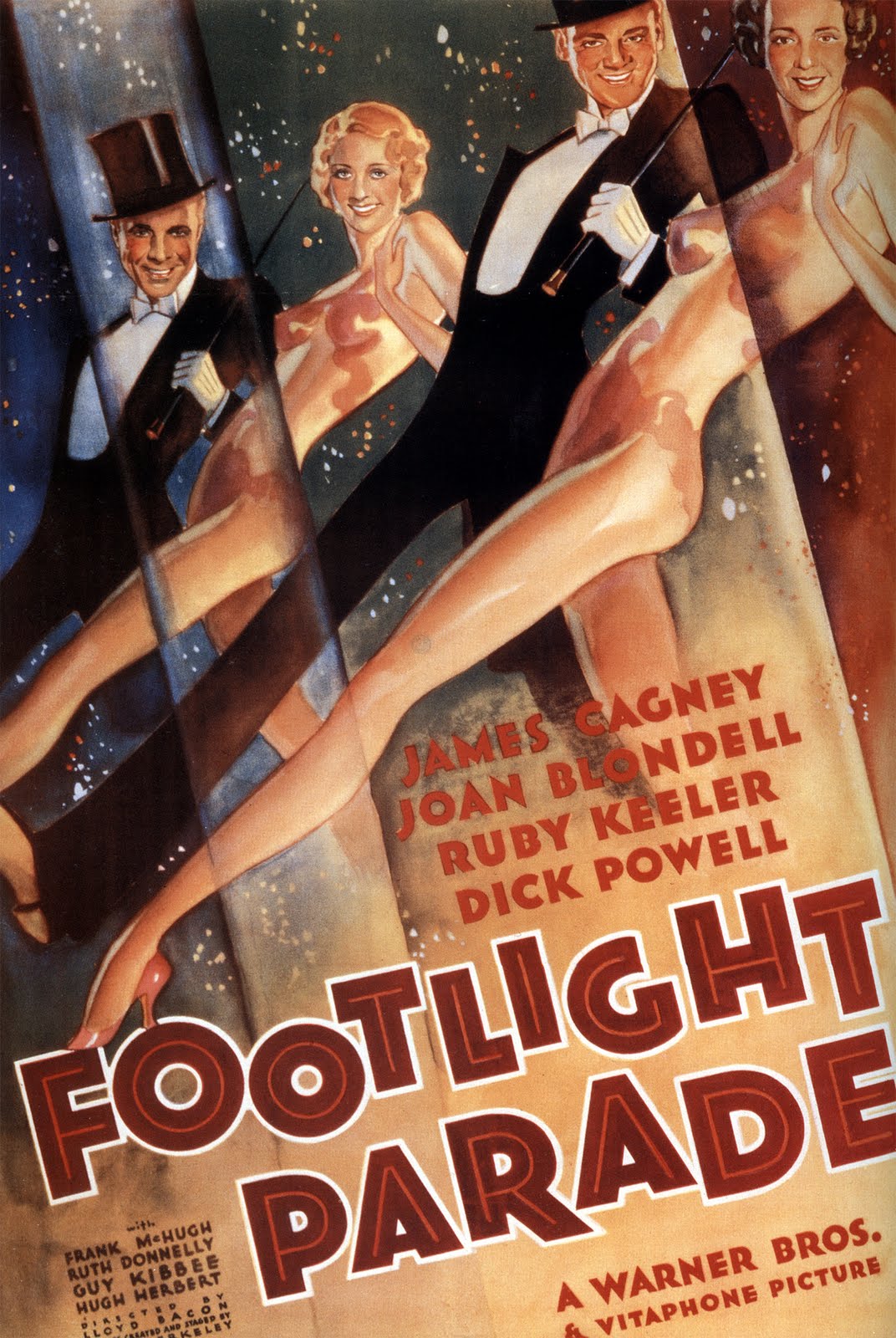
Ironically, Sparks's character Barney Hopkins growls at one point in the film "Cancel my contract with Warren and Dubin!" Obviously, Warner Brothers went in the other direction, hiring the duo to write songs for its next backstage musical, Footlight Parade.
Joan Blondell—I've written about her before, at length (click here). One of my favorite pre-Code actresses, Blondell made more than a hundred movies in her career, eight in 1933 alone. There was always something tough and no-nonsense about Blondell's sex appeal (she knew what she wanted, said yes when she wanted and only when she wanted) that made her a fan favorite during the Depression. She's the star of this picture, playing a chorus girl who tries to keep the snooty Warren William from breaking up the romance of Dick Powell and Ruby Keeler, only to fall for the big lug herself. I imagine this plot was already a cliche when Adam told it to Eve in the Garden, but Blondell looks great in her skivvies and it's all great fun, so who cares?
Ruby Keeler—The wife of Jazz Singer star Al Jolson, Keeler was the nominal star of Warner's backstage trilogy, with 42nd Street serving as her screen debut. "I couldn't act," she said later, "I had that terrible singing voice, and now I can see I wasn't the greatest tap dancer in the world, either." But she had a fresh-faced innocence that translated well with audiences and for a couple of years there, she was a big box office draw. She only made eleven movies and except for a handful of television appearances in the 1960s, was out of pictures by 1941. (For more on Keeler, check out "Shadow Waltz," a blog devoted to all things Ruby.)
Aline Mac Mahon— Like Ned Sparks, she was one of those faces you'd see in Warner Brothers films of the period, usually playing someone good, wise and long-suffering. She began on Broadway in the 1920s, broke into movies as Edward G. Robinson's loyal secretary in Five Star Final and continued to act until her retirement in 1975. Nominated for an Oscar for her supporting performance in 1944's Dragon Seed, you might also want to track her down in Skyscraper Souls, co-starring Gold Digger's male lead, Warren William.
The movie was supposed to end with "Pettin' In The Park," which would have made more sense narratively but didn't pack much punch, either visually or as a tune. Instead, producer Hal Wallis (who took over mid-production when Zanuck quit in a contract dispute) opted to end with the picture's final Warren-Dubin song, "Remember My Forgotten Man," an explicitly political number about the Depression.
Remember my forgotten man, You put a rifle in his hand; You sent him far away, You shouted, "Hip, hooray!" But look at him today!
Sitting as it does at the end of the picture, the song serves as a big fat middle finger to everything that's come before it. Eagan calls it "a song of epic chutzpah." That it is.
Audiences ate it up. Gold Diggers of 1933 was an even bigger hit than 42nd Street, grossing a million dollars more than its predecessor, an enormous amount of money considering ticket prices ranged from 10¢ to a quarter.
Looking to cash in on a trend, Warners quickly rushed Footlight Parade into production and gave the lead to its most popular star, James Cagney. In this one, they barely bother with a plot—more a case of "Did you see the other two? This is more of the same"—and gave Berkeley free rein. It's the most over-the-top of three, with numbers that wouldn't fit into an airplane hanger ostensibly taking place on a theater stage. It's worth looking up, though, to see Cagney in a pre-Yankee Doodle Dandy dancing role.
Harry Warren and Al Dubin wrote the songs for that one, too, and all three movies are preserved in the National Film Registry.
1933 represented the highwater mark for Berkeley's career. Within a year, his lavish production numbers were considered old hat and by the early '40s, even though he was still directing musicals, others, particularly Gene Kelly, had taken over his choreographing duties.
Ironically, it was the star of the "We're In The Money" number that hastened Berkeley's downfall. Over the course of the next three summers, in The Gay Divorcee, Top Hat and Swing Time, Ginger Rogers and Fred Astaire would, like Berkeley before them, redefine the movie musical, turning dance into a most intimate expression of love and romance. Suddenly by comparison Berkeley's choreography seemed gaudy, abstract and impersonal, and what had thrilled audiences in 1933 was dismissed as so last year by 1934.
Harry Warren and Al Dubin continued to crank out hits throughout the 1930s, with their last number one together being 1937's "Remember Me." After that, Dubin returned to Broadway and wrote musicals until his death in 1945, while Warren teamed up with other lyricists and continued to write hit songs into the 1950s. "The familiarity of Harry Warren's songs," said one drama critic, "is matched by the anonymity of the man" and Time magazine noted, "By silent consensus, the king of this army of unknown soldiers, the Hollywood incognitos, was Harry Warren, who had more songs on the Hit Parade than [Irving] Berlin himself and who would win the contest hands down if enough people have heard of him."
This was supposed to be my post on the Katie-Bar-The-Door Nominees of 1932-33, but rather than leave you without anything to chew on while I'm finishing that mammoth essay, I'm jumping ahead in my notes and letting you vote on the "Best Original Song Of 1932-33."
Yes, you get to tell the Monkey where to put it when he hands out the award for best song of 1932-33. And you just know you've been waiting for the chance.
In choosing, you'll have to decide what you think we should mean by "best" when we talk about "best song"—is it a song so successful everybody knows it ("Who's Afraid Of The Big Bad Wolf"); a beautiful standard recorded by anybody worth talking about ("Isn't It Romantic"); the memorable wedding of sound and imagery ("We're in the Money" and "Remember My Forgotten Man"); or a pivotal moment in film history ("42nd Street").
The nominees:
"Forty-Second Street" music by Harry Warren, lyrics by Al Dubin (42nd Street)
"The Gold Diggers Song (We're In The Money)" music by Harry Warren, lyrics by Al Dubin (Gold Diggers Of 1933)
"Isn't It Romantic" music by Richard Rodgers, lyrics by Lorenz Hart (Love Me Tonight)
"Remember My Forgotten Man" music by Harry Warren, lyrics by Al Dubin (Gold Diggers Of 1933)
I'm still working on Part Three of my essay on Scarface. In the meantime, chew on some photographs for a while. This is a collection of those actors and actresses who turned in notable performances in 1931-32, but just missed out on a Katie Award nomination. Some of these faces you've seen before, some you will see again.
(To see the list of nominees for 1931-32, click here.)
Edward G. Robinson (Five Star Final) James Cagney and Joan Blondell (Blonde Crazy) Marie Dressler (Emma) (pictured here with Katie Award nominee Norma Shearer) Dorothea Wieck (Mädchen In Uniform) Raimu and Pierre Fresnay (Marius) Warner Oland (Shanghai Express) Jackie Cooper and Irene Rich (The Champ) Anita Page (Skyscraper Souls) Warren William (Skyscraper Souls) Constance Bennett (What Price Hollywood?) Maurice Chevalier and Claudette Colbert (The Smiling Lieutenant)
Picture:City Lights (prod. Charles Chaplin) Actor: Charles Chaplin (City Lights) Actress: Marlene Dietrich (Morocco) Director: Fritz Lang (M) Supporting Actor: Peter Lorre (M) Supporting Actress: Joan Blondell (Sinners' Holiday, Other Men's Women and Night Nurse) Screenplay: René Clair (Le Million) Special Awards:M (prod. Seymour Hebenzal) (Best Picture-Drama); Edward G. Robinson (Little Caesar) (Best Actor-Drama); Marie Dressler (Min and Bill) (Best Actress-Comedy); René Clair (Le Million) (Special Achievement In The Use Of Sound); "Makin' Whoopee" (Whoopee!) (Best Song); Fritz Arno Wagner (M) (Cinematography) Must-See:L'Age d'Or; Animal Crackers; The Big Trail; City Lights; The Dawn Patrol; Dracula; Little Caesar; M; Le Million; Morocco; The Public Enemy In retrospect, the twelve months running from August 1, 1930, to July 31, 1931 (in the Academy's odd Oscar season of the day) turned out to be a year of beginnings and endings.
The best movie of the year, Charlie Chaplin's delicate, poignant comedy City Lights was the last silent movie Hollywood ever produced (like the website "Silent Era," I judge Modern Times to be a "mute sound picture"). For all practical purposes, the silent era had come to close by 1929, and only Chaplin's enormous popularity and the brilliance of City Lights could have induced an audience to accept the anomaly of a silent movie in 1931.
1931 marked the last gasp for a German film industry that had given the world F.W. Murnau, Fritz Lang, Marlene Dietrich, Peter Lorre, Expressionism, and such films as The Cabinet Of Dr. Caligari, Nosferatu, Metropolis and M. Within two years, the Nazis would come to power and those artists who didn't flee or collaborate soon found themselves censored, arrested or murdered. Many German filmmakers, such as writer-director Billy Wilder, emigrated to Hollywood and had successful careers. But the German film industry as a whole would never again have the impact on cinema that it had in the 1920s and early years of the 1930s.
But 1930-31 was also a year for beginnings. James Cagney and Edward G. Robinson burst onto the scene, dazzling audiences in two of the essential gangster flicks of the early sound era, and continuing to dominate the Hollywood scene for years to come. American audiences also became acquainted with Marlene Dietrich for the first time. And in the space of twelve months, Clark Gable would rise from uncredited bit player to major star with tough but sexy roles in A Free Soul and Night Nurse.
I've written at length about all the titles on my list of the Must-See Movies of 1930-31. I leave to you the pleasure of hunting for them through the last three months of this blog's archives.
As great as 1930-31 was, the next twelve months would prove even better, especially for Hollywood which was at last getting the hang of the sound technology that had turned the old order upside down in 1927. On the horizon are Frankenstein, Scarface, Grand Hotel and many others. I'll have the list of nominees for you tomorrow in celebration of the New Year.
Oh, and later today: an end-of-year top ten list! Even the Monkey is not immune to the demands of traditional movie criticism.
That, of course, was the famous grapefruit scene starring James Cagney and Mae Clarke from The Public Enemy. Even people who don't know gangster films from the early '30s know Cagney was the guy who'd poke you in the puss if you served him grapefruit for breakfast—and can you blame him? Give me Honeynut Cheerios or give me death, I always say.
But if that's all you know about the gangster films of the early sound era, boy, are you in for a tasty treat. A remarkable amount of violence and amorality showed up on the screen in the years before Hollywood began enforcing the Production Code in mid-1934 and except for a handful of phony disclaimers slapped on the prints in post-production, the purveyors of this fabulous filth were pretty unapologetic about it.
Several gangster pictures made it into theaters between 1928 and 1933 seeking to cash in on the much-publicized bootleg booze wars of the Prohibition era, but I'd call three essential—Little Caesar and The Public Enemy which were released in 1931, and Scarface, which was filmed at the same time but got hung up in endless wrangles with state censorship boards and didn't hit theaters for another year. Scarface I'll talk about at length after the New Year when we get to the movies of 1932, but the other two I've touched on before and now is the time to fulfill all those promises to talk about them at some length.
Little Caesar came first (either in December 1930 or January 1931 depending on who you believe; details are sketchy). Based on Al Capone's rise and fall, the story of a "tough mugg" (as Variety put it) who rises through the ranks to take control of an organized crime racket only to be done in by his own ambition was a familiar one to audiences when the film came out—"same formula and all the standard tricks," said the review in Variety—but Edward G. Robinson as Caesar Enrico Bandello was a sensation.
"Money's all right, but it ain't every- thing," Rico sneers in the very first scene. "Nah, be some- body, look hard at a bunch of guys and know they'll do anything that you tell 'em, have your own way or nothin'—be somebody!" It's this burning ambition that he doesn't yet know can never be satisfied no matter how high he climbs that drives him to murder his way up the organizational chart at an Eastern city's local mob office.
As with every role he ever essayed, Robinson played the part of a ruthless sociopath with utter conviction and was so convincing as a tough guy he was typecast for the rest of his life, a career that spanned more than fifty years and 93 movies, and every actor who afterwards stepped into the guise of a gangster had Robinson's template to deal with. In fact, Robinson was pretty much the opposite of the parts he played—cultured, sophisticated and well-educated, too, originally studying to become a rabbi until he received a scholarship to attend the American Academy of Dramatic Arts. Later in life he collected fine art with the same gusto Rico used to collect corpses.
Little Caesar is far from a perfect movie. If you've ever seen a gangster film, you already know the plot; as I mentioned before, even audiences in 1931 knew what was coming. Plus the work of the supporting actors is pretty bad—both stiff and hammy at the same time, and utterly unconvincing. Even Edward G. Robinson, as great as he is, isn't quite up to Edward G. Robinson standards. Maybe the primitive sound technology of the day didn't capture the fullness of his growling timbre, or maybe the cinematographer lit him differently, hiding the deep shadows of his face, but whatever the explanation, Robinson doesn't quite look or sound like himself and it's just enough off-putting to say that if you're somehow not familiar with his work, this is not the movie I'd start with.
Still, somewhere along the line as you journey toward film fluency, Little Caesar needs to be on your itinerary.
A better film, less predictable and centering on an even more explosive performance, is William Wellman's The Public Enemy. If Little Caesar is the study of an ambitious man's rise and fall, The Public Enemy, starring James Cagney as Tom Powers, is a study of the sort of man Rico Bandello would have routinely used to do his dirty work, a small-time thug with no ambition other than to have a few bucks in his pocket and with no scruples about how to get them.
The Public Enemy starts out with a traditional "good brother-bad brother" conflict, a favorite trope of storytellers ever since Moses penned the fourth chapter of Genesis, but then Cagney, director Wellman and screenwriters John Bright and Kubec Glasmon upset our expectations and with them, societal norms, by making Cagney's Tom dynamic and exciting and the good brother (Donald Cook) a shellshocked, underemployed sad sack. Part of this was the result of a last minute casting change—Cagney originally had a supporting part until Wellman saw him in rehearsals and switched him with projected lead Edward Woods—and part is the result of some wicked subversion on the part of all involved, especially Cagney, but in any event, the lesson is clear: crime pays better than a straight job and since either way you wind up dead, what are you waiting for?
As with Little Caesar before it and Scarface after it, the studio forced a disclaimer onto the picture, stating there was no intention to glamorize violence. Unlike the other two, which clearly wanted to bask in Al Capone's limelight, the character of Tom Powers as written really isn't a glamorous guy. He's strictly small-time, not too smart, impotent despite his locker room boasts and has some definite Oedipal issues—the only woman we know for sure he has sex with is an older woman who mothers him, gets him drunk and takes him to bed, an act that so disgusts him, he flees his hideout and leads his best friend into a hail of bullets—what we in the trade call a "loser."
And yet Cagney is so dynamic in the part that, as Chris Barsanti put it for Slant, "you can imagine kids at the time flocking out of the theater and cocking their caps just like him." Maybe the result is at odds with the intent, but the truth is, without Cagney, The Public Enemy wouldn't have amounted to much and the movie and movie history benefitted immensely from Wellman's casting change.
Both Little Caesar and The Public Enemy have been preserved in the National Film Registry and both Robinson's Rico Bandello and Cagney's Tom Powers made the American Film Institute's list of the Top Fifty Film Villains of All-Time.
Yet while both pictures did get noms for their screenplays—an Oscar tradition, by the way, using the screenwriting category to recognize edgier fare—the Academy ignored their stars and directors, and would continue to do so for years to come.
Maybe this shouldn't come as a surprise. The awards were created in part to stave off various attempts at state and federal censorship by creating the illusion that movies were art—"Art" with a capital "A"—stuffy snoozefests that your mom and her preacher could feel comfortable watching. Gangster movies, along with comedies and anything with, say, a nearly-naked Joan Blondell, not only didn't fit this definition of "Art," they were the very movies potential censors wanted to get their hands and scissors on.
So come Oscar-time, Hollywood in the early 1930s had to pretend gangster movies—and the people who made them—didn't exist. After a while, the Academy began to believe its own claptrap, that gangster movies, comedies and naked Joan Blondell flicks were not Oscar worthy. The studios were happy enough to bank the money that Robinson and Cagney brought in—they would have gone bankrupt without them—but God forbid they actually honor them for the effort.
Cagney eventually broke through this hidebound prejudice, receiving a nomination for Angels With Dirty Faces in 1938, but only after proving so versatile not only as tough guy but as a song-and-dance man and even as a Shakespearean actor that the Academy simply couldn't ignore him. Even then, it took a tour de force effort right after Pearl Harbor in what was billed as the most patriotic movie ever made—Yankee Doodle Dandy—to actually win the thing.
Robinson wasn't so lucky. As great as he was, no role ever came along so far outside of his expected range that he was able to shatter the perception of him as "merely" a tough guy actor. Not only did he never win an Oscar, he was never even nominated, not for Little Caesar, not for Double Indemnity, not for nothing. The Academy finally did award him an honorary Oscar at the 1973 ceremony—two months after his death. Too little, too late.
"If I were just a bit taller," he once said, "and I was a little more handsome or something like that, I could have played all the roles that I have played, and played many more. There is such a thing as a handicap, but you've got to be that much better as an actor. It kept me from certain roles that I might have had, but then, it kept others from playing my roles, so I don't know that it's not altogether balanced."
Not exactly the way a tough guy would have put it but then again that's not who Edward G. Robinson was. Too bad it took so long for Hollywood to recognize that fact.


 I've already written about most of the Hollywood sex symbols of the pre-Code era—Jean Harlow, Joan Blondell, Marlene Dietrich, or if you prefer, Norma Shearer, Greta Garbo and Clara Bow. But before I put the era in this blog's rearview mirror, I should stop briefly to mention perhaps the most famous sex symbol of the age, Mae West.
 But maybe that's how she got away with it.
 Hollywood's censors prevented West from filming Diamond Lil as written, and instead, a watered-down version was released as She Done Him Wrong, co-starring Cary Grant and boasting the oft-misquoted line, "Why don't you come up some time and see me?"
 If you're going to see only one Mae West movie, I would suggest I'm No Angel, the follow up to She Done Him Wrong. Again co-starring Cary Grant, here Mae West plays a circus performer who gyrates for the (as she puts it) "suckers," but as with all of her movies, the story is irrelevant. You're paying to see Mae West play Mae West and she does it better here than anywhere else, singing such numbers as "They Call Me Sister Honky-Tonk," spouting double entendres and, unusual for the times, hamming it up with a Greek chorus of African-American actresses who function as her only true friends and confidants.
 West was married twice, but had her longest relationship with Paul Novak, her live-in partner from 1954 until her death in 1980. He was thirty years her junior.
 "It's not the men in your life that counts, it's the life in your men."