The results are in on the latest, inelegantly-worded Monkey poll: "Of the four biggest Oscar snubs in history as chosen by EW.com, which overlooked performance most deserved a nomination?"
22 of you agreed that of these choices, Anthony Perkins's performance in Psycho was the most deserving of a nomination—after all, it's probably the best in a horror film ever, one that influenced everything that came after it and still resonates with viewers.
15 went with EW.com's choice of Jimmy Stewart in Alfred Hitchcock's classic Vertigo, 11 with Ingrid Bergman in Casablanca and 9 with Cary Grant in The Philadelphia Story. I suspect many of us agree that Grant deserved an Oscar at some point in his career, but that maybe there were better choices—The Awful Truth, Bringing Up Baby, His Girl Friday and Notorious, for example.
Let's face it, more often than not, the Academy blows it come Oscar time. But that's why we have the Monkey and his Katie-Bar-The-Door awards, to correct these mistakes, and make new ones in the process.
Postscript: Don't forget to vote in the March Madness best actress tournament over at All Good Things. Today is the final of the 1940 bracket, with Ingrid Bergman squaring off against Vivien Leigh. And tomorrow, it's the 1950s bracket, featuring stars such as Audrey Hepburn, Marilyn Monroe and Grace Kelly.
Lots of housekeeping to do today, blog-wise, so let's get to it:
1) The semi-final matches of the Silent Era/1930s bracket in All Good Things' best actress March Madness tournament is underway. Match-ups are number six seed Claudette Colbert versus ten seed Irene Dunne and four seed Carole Lombard versus nine seed Myrna Loy. Remember, democracy only works if you vote—and rarely even then—so click on over and do your part.
2) As for my own trivial pursuits, during Turner Classic Movies' 31 Days of Oscar marathon I passed along questions about Oscar history from TCM's monthly Now Playing magazine, 66 questions in all. No surprise, MovieNut14 answered the most questions correctly and wins the first annual Movie Nut Trivia Award, which consists of nothing more than worldwide recognition and a pat on the back. MovieNut14 is a self-described "Female teen living in upstate New York who's obsessed with movies and books." She also writes the blog Defiant Success. Check it out.
The final totals, quiz-wise:
MovieNut14—28 Erik Beck—9 Zoe—8 The Mythical Monkey himself—6 Beelzabub—3 Katie-Bar-The-Door—3 Dave—2 Jason Marshall—2 WhistlingGypsy—2 Ginger Ingenue—1 Mister Muleboy—1 Uncle Tom—1
Not to mention, the questions generated lots of comments, even from those who weren't answering the trivia, which is always fun. Thanks to everyone who participated—and, for that matter, to all those who didn't.
3) The results are in from the latest Monkey poll, "Of the top five songs in movie history, as chosen in 2004 by the American Film Institute, which is your favorite?" The results very nearly mirrored the AFI's list: "Over The Rainbow" (The Wizard Of Oz) was your favorite with 26 votes. "As Time Goes By" (Casablanca), which jumped out to an early 6-0 lead, wound up second with 16 votes. "Singin' In The Rain" (Singin' In The Rain), which was third on the AFI list, finished fourth here with 5 votes. "Moon River" (Breakfast At Tiffany's) tallied 6 votes and "White Christmas" (Holiday Inn) scored but a single vote.
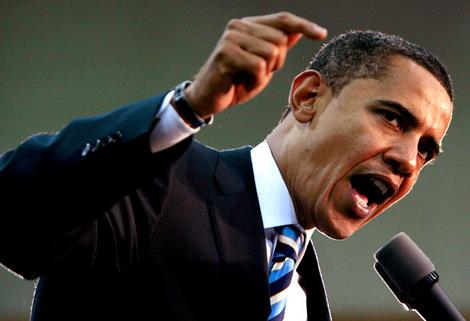
In case you're interested, Barack Obama, president of these here United States of America, mentioned earlier in the week that his favorite song from a movie is "As Time Goes By" from Casablanca. So said the Washington Post. Perhaps he's a secret reader of the Mythical Monkey. If so, welcome, Mr. President! It's a big tent we pitch here and whatever brings you to the party, here's hoping you stick around.
4) And how about a new poll? Of the four biggest Oscar snubs in history as chosen by EW.com, which overlooked performance most deserved a nomination?
Your choices are:
James Stewart (Vertigo) Anthony Perkins (Psycho) Cary Grant (The Philadelphia Story) Ingrid Bergman (Casablanca) As usual, cast your vote in the poll at the right hand side of the page.
The results are in on the latest Monkey survey, "What first brought you to the Mythical Monkey?" Not surprisingly, the majority of you said you first arrived here either while searching for a photo (22) or by way of a link from another blog (also 22). We here at the Monkey do tend to overstuff our posts with pictures. But what would you rather look at, Louise Brooks or a long gray block of impenetrable text? That's what I thought.
Among the other answers, five of you admitted to being a friend or family member, and six of you claimed brain damage—the latter of which strikes me as either way too many or not nearly enough. Three arrived here while searching for info or a movie-specific review, one got here by way of a review on the Internet Movie Database, and four chose "other."
The one vote for "an interest in alternate Oscars" was cast by yours truly. Although I think many readers find the whole "alternate Oscar" concept, first championed by Danny Peary in his book of the same name, confusing or frankly irritating, the truth is, I wouldn't have started this blog at all except for my own obsession with "who should have won," and what little forward momentum this blog has comes strictly from my own desire to get to the next award. So I think for the time being, I'll stick with the current format even if I do wind up tweaking it a bit.
Amazingly, no one picked "word of mouth." I would have thought sitting around in a bar talking about movie blogs would rank higher, especially when "Lets go back to my place and read the Monkey together" is a proven pick-up line. (Proven in the same sense that many things on the internet are proven, which is to say I made it up.)
Which reminds me of a true story from my law school days. At the end of one especially grueling semester, I held a film festival in my apartment—twenty-four consecutive hours of wholesome movie goodness, beginning at 11 in the morning and ending sometime after breakfast the following day. It turned into a bit of an event with something like fifty people showing up and camping out, including one woman I had never met who turned down a friend of mine for a date because she was "going to some guy's film festival."
There's a moral in there some place. I just don't know what it is.
Last week's poll question—"Which is your favorite Hollywood movie of the early sound era?"—resulted in a record turnout.
How you voted:
Duck Soup—14 King Kong—8 City Lights—7 Grand Hotel—6 Other—6 All Quiet On The Western Front—5 Trouble In Paradise—5 Frankenstein—2 Scarface—2 The Jazz Singer—0
Wonder what movies those six voters had in mind when they opted for "other." There are a lot of good choices, I have to admit. If you want to stop by and tell us, we at the Monkey would like to know.
In the meantime, you might well ask, where are the real blog entries? I'm working on it—two thousand words on the Nickelodeon Era and counting. Should be up tomorrow. Here's a taste of things to come:
It was a close vote, but in the end King Kong edged out The Invisible Man as your choice for best picture (drama) of 1932-33.
Which is very convenient considering I've already written 2000 words about King Kong, with more on the way.
"We're million- aires, boys!" crowed Carl Denham, the leader of the expe- dition that dis- covered Kong and signed the forty-foot gorilla to a lucrative three-picture deal. "I'll share it with all of you. Why, in a few months, it'll be up in lights on Broadway: Kong, the Eighth Wonder of the World!"
Of the twenty-four votes cast, Kong picked up eight to Invisible's seven, with I Am A Fugitive From A Chain Gang, Red Dust and The Bitter Tea Of General Yen tallying four, three and two votes, respectively.
Asked what would have happened if the vote had gone the other way, Denham said, "Well, now you know why I brought along those cases of gas bombs."
Claude Rains, star of The Invisible Man, was devastated by the loss. "We'll begin with a reign of terror," he said, "a few murders here and there, murders of great men, murders of little men, just to show we make no distinction. An invisible man can rule the world!" he shouted. "No one will see him come, no one will see him go!"
Rains wasn't the only one unhappy with the vote's outcome. "After this, I'm afraid I'll be typecast as a forty-foot gorilla," said Kong, as he nursed a martini at the end of the bar. "There aren't that many parts for a forty-foot gorilla."
No blogging yesterday. I was watching movies, nineteen of them to be exact, although to be fair, sixteen of them were made between 1888 and 1905 and consisted mostly of a single shot of passing traffic in places like Leeds Bridge and Jamaica Street, Glasgow. The briefest of these movies was two seconds—Roundhay Garden Scene. Filmed in 1888 by Louis Aimé Augustin Le Prince, it's the earliest surviving film, shot on a strip of paper shown at 10 frames per second.
You want to see it?
You want to see it again?
Just 27 years later, the same amount of time that has passed since Motorola introduced the first mobile phone, D.W. Griffith would be making three-hour epics for millions of paying customers.
But more about that in November.
Poll results are in. Last week I asked you to choose your favorite Carole Lombard performance from between four movies. The winner, no surprise, was My Man Godfrey, one of the great screwball comedies of the 1930s.
Is it my favorite? Well, that's the question. Because while I can guarantee you Carole Lombard will win a Katie-Bar-The-Door award as the best actress of some given year, I'm not promising it will be for My Man Godfrey. But it could be—you don't know. Stay tuned to see how this plays out.
The final tallies: My Man Godfrey 18; To Be Or Not To Be 7; Twentieth Century 4; and Nothing Sacred 0.
The latest poll results are in. "Of the five movies the Marx Brothers made at Paramount Pictures, which have you seen?" Thirty-one of you responded, with 28 saying you had seen Duck Soup, 25 Horse Feathers and Monkey Business and 21 Animal Crackers and The Cocoanuts.
Three admitted "I have not seen any of these movies!" which I choose to interpret as meaning three lucky souls still have a chance to experience their first Marx Brothers movie—or at least their first Marx Brothers movie from the Paramount Pictures era. Do you remember your first Marx Brothers movie? I do. Monkey Business on PBS one Saturday afternoon, initially because my parents insisted, but soon enough because it was so much fun to watch. And the first one in a theater? A midnight showing of Animal Crackers when I was a teenager.
As for the new poll? It's Carole Lombard's birthday. "Of these classic Carole Lombard performances, which is your favorite?" Your choices: 1) Twentieth Century 2) My Man Godfrey 3) Nothing Sacred 4) To Be Or Not To Be. As always, vote in the poll at the top right-hand side of the page.
The Monkey asked and you have spoken. "Of Greta Garbo's performances during the sound era to receive or likely to receive an alternate Oscar/Katie nomination, which do you think is her best?" By a vote of 16 to 11, her 1939 comedy Ninotchka edged out the cough-cough classic Camille as your choice for the best of her career. Queen Christina, which garnered Garbo a Katie-Bar-The-Door Award as the best dramatic actress of 1932-33, received 5 votes. Garbo's sound debut, Anna Christie received two votes and Anna Karenina received one.
Of course, there are no bad Garbo movies, only good ones and great ones, and all five of these movies qualify as great ones in my book. So whichever movie you voted for as her best, you're right, it is.
(The Garbo wallpaper, by the way, comes to you courtesy of Sylvie. As always, click on the photo to view it full size.)
Apparently blogger has been having a recurring problem with its "poll" gadgets—people vote only to see their vote disappear. We have enough of that sort of thing in the real world, so I'm going to remove the poll for the time being.
The numbers are in on the latest Monkey Poll and the results were decidedly mixed. In answer to the question "Of the previous winners of the Katie-Bar-The-Door award for best actress in a lead role, who is your favorite?" 10 of you chose silent film star Louise Brooks, while 8 each went for Lillian Gish and Marlene Dietrich. The always controversial "Queen of MGM," Norma Shearer, picked up 7 solid votes, while "America's Sweetheart," Mary Pickford, polled 5.
In a way I wasn't surprised that Brooksie won, albeit narrowly. Of the five choices, her face is the most famous, even among people who have no idea who she was or what she did. I was in a bookstore the other day, for example, and saw her image on the cover a magazine that had nothing to do with movies whatsoever. And last Christmas, I bought a pair of earrings for Katie-Bar-The-Door from a salesclerk wearing a Louise Brooks bob. Not to mention a new edition of The Diary Of A Lost Girl prepared by film historian Thomas Gladysz, the host of the Louise Brooks Society, the best site devoted to all things Brooks.
Louise Brooks is hot, in more ways than one. Pretty good for an actress who appeared in only 23 movies, with frankly no more than half a dozen worth talking about.
"A well dressed woman, even though her purse is painfully empty," she once said, "can conquer the world." And conquer the world she did. Just not in her lifetime.
I've written about Louise Brooks extensively here.
Or should I say Blondell crazy? Joan Blondell, that is, who was the winner of the latest Monkey Poll, "Of the previous winners of the Katie Award for best supporting actress, who's your favorite?"
The final totals: Joan Blondell 10; Miriam Hopkins 5; Anita Page 3; and Marie Dressler and Clara Bow 2 each.
The poll for best song of 1932-33 quickly turned into a neck-and-neck contest between "We're in the Money" from Gold Diggers of 1933 and "Who's Afraid of the Big Bad Wolf" from Three Little Pigs, with the Busby Berkeley dance number edging the classic Disney cartoon theme right at the wire, 14 votes to 12. The Rogers and Hart standard, "Isn't It Romantic," finished third with 6 votes and two more songs, "42nd Street" and "Remember My Forgotten Man," both penned by the winning songwriting team of Harry Warren and Al Dubin, picked up three votes each. And while "We're in the Money" won only a plurality of the vote, the three Warren/Dubin numbers, taken together, took 20 of the 38 votes cast, a clear win in my book for perhaps the most prolific pair of songwriters you've never heard of.
In a way, the story of "We're in the Money" begins with Al Jolson and The Jazz Singer way back in 1927—a story that so far has taken me more than a year to tell, so let me recap: when talkies supplanted silent films, studios actually had no idea what to do with the new technology. So movie producers, assuming audiences were just as dumb as they themselves were, copied The Jazz Singer formula over and over, dropping in songs and musical performances almost at random into every new film that came out, even into movies where a song made no sense at all. And audiences got sick of it in a hurry, so much so that by 1930, musicals were box office poison. (You can see Hollywood doing the same thing right now with 3-D, turning everything into a 3-D movie whether it makes sense or not.)
Come 1933, the only way Warner Brothers production chief Darryl F. Zanuck could convince his bosses to make a musical was to lie to them, telling them 42nd Street would be a gritty drama about the backstage intrigue typical of a Broadway show. He set up two separate film units, one for the dramatic material, one for the musical numbers, and hired a couple of Broadway veterans, composer Harry Warren and lyricist Al Dubin, to come up with the songs for the movie on the sly.
For a guy you've probably never heard of, composer Harry Warren was a hit-writing machine. He wrote twenty-one number one hits in his career (nine with lyricist Al Dubin), including "Jeepers Creepers," "Chattanooga Choo Choo," "On the Atchison, Topeka and the Santa Fe" and "You Must Have Been A Beautiful Baby." He also wrote hits such as "That's Amore," "I Got A Gal in Kalamazoo," "Shuffle Off To Buffalo," "You'll Never Know" and "At Last." He was nominated for an Oscar eleven times, winning three. In addition to Al Dubin, Warren also worked extensively with Mack Brown and Johnny Mercer.
Al Dubin meanwhile had written the lyrics for several hit Broadway musicals and found himself paired with Warren for the first time on 42nd Street, mostly because the two had backstage Broadway experience that Zanuck wanted to draw on. Among the numbers they wrote were "You're Getting To Be A Habit With Me" (inspired by a line from a studio secretary explaining why she was dating a particular man), "Shuffle Off To Buffalo" and the title song.
Incidentally, the two can be seen at the beginning of 42nd Street as the authors of the stinker of a song, "It Must Be June," which stage director Julian Marsh (Warner Baxter) throws out of the show over their protests.
Providing choreography for the dance numbers was Busby Berkeley. Berkeley had gotten his start choreographing parades and marching bands, before going to work for Samuel Goldwyn on the hit Eddie Cantor movie, Whoopee! in 1930. Berkeley took a novel approach to filming the numbers, arranging the performers in geometric patterns and allowing the camera itself to do the dancing as it flew overheard or dollied underneath. As Daniel Eagan writes in America's Film Legacy, "For purists, this technique was the antithesis of true dance, but in 1933 it seemed fresh, even daring."
42nd Street was a huge success, saving the studio from near bankruptcy. A follow-up, Gold Diggers of 1933, immediately went into production, using most of the same team—hoofers Ruby Keeler, Dick Powell and Ginger Rogers, choreographer Busby Berkeley and the songwriting team of Warren and Dubin. Stock Warner Brothers players Joan Blondell, Warren William and Aline MacMahon were added to carry the story.
Like its predecessor, Gold Diggers is about the backstage shenanigans of a Broadway production, this time played for laughs instead of drama. To save time, Zanuck recycled the screenplay from 1929's hit Gold Diggers of Broadway, but instead of the original's rather dull numbers, such a nine-minute version of "Tip Toe Through the Tulips," Zanuck relied on Warren and Dubin to come up with something sizzling. The duo didn't disappoint.
Unlike 42nd Street which hid its intentions until the last twenty minutes, Gold Diggers of 1933 announces itself as a musical from the get-go. After the opening credits, the movie jumps straight to Ginger Rogers singing "We're in the Money" (called "The Gold Diggers Song" to tie the sheet music to the movie) while a bevy of beauties clad only in body stockings and giant gold coins dance around her. We're in the money, we're in the money; We've got a lot of what it takes to get along! We're in the money, that sky is sunny, Old Man Depression you are through, you done us wrong.
It's an ironically upbeat number, not just because the story is about chorus girls so broke they steal the neighbor's milk for their morning cereal, but because the country was mired in the depths of a Depression grinding along in its fourth year.
The screenplay had originally called for a dreary montage of shuttered theaters showing the effects of the Depression on Broadway, but Berkeley and director Mervyn LeRoy junked the script and opted to dazzle the audience right away. It turned out to be an inspired choice. The number's energy sweeps you right past the movie's hokey storyline and by the time you start to wonder why you're watching this cookie cutter claptrap, there's another song and dance number on the screen and you're carried away all over again.
Gold Diggers of 1933 is not currently available on DVD and the only way to watch this song at the moment is to click this link, head on over to TCM and watch the clip there. Or you can come over to my house and watch it on tape. I suggest the former. [Note: In the comments section, Brian tells me that Gold Diggers of 1933 is available as part of the Busby Berkeley collection which also includes 42nd Street, Footlight Parade, Dames and Gold Diggers of 1935. That, my friends, is a good collection.]
While you're watching and listening, here are some of the faces to look for:
Ginger Rogers—I hope you know who she is. Half of the greatest dance team in history, Rogers started as a contract player, appearing in ten movies in 1933, including small roles in both 42nd Street and Gold Diggers of 1933. In the former, she played "Anytime Annie," a roundheels who said no only once "and then she didn't hear the question." Here she plays Fay Fortune, a down-on-her-luck chorus girl who pals around with the three leads, Joan Blondell, Ruby Keeler and Aline MacMahon. She may well have gotten this plum spot in the proceedings because she was dating director Mervyn LeRoy at the time, but once she was paired with Broadway dancer Fred Astaire in Flying Down To Rio seven months later, she wouldn't need favors from anybody.
And in case you're wondering why Rogers sings a verse in pig Latin, she was amusing her fellow dancers with pig Latin between takes, and either Darryl Zanuck or Busby Berkeley or Mervyn LeRoy—depending on whose story you believe—saw her and decided to make it part of the routine.
Ned Sparks—One of those ubiquitous character actors on the Warner Brothers payroll, his specialty was deadpan comedy delivered in a nasal, monotone voice of doom, so much a part of his persona that Lloyds of London insured his reputation for $10,000 in the event he was ever photographed smiling. At least that's what the New York Times reported in 1936, and they're never wrong. "I speedily realized that I was not destined to cause the ladies to swoon with romantic ecstasy as they watched me make love to one of their sex," he once said. "I have also divined that comedy and not romantic acting was my special forte." He appeared in over eighty movies and retired in 1947.
Ironically, Sparks's character Barney Hopkins growls at one point in the film "Cancel my contract with Warren and Dubin!" Obviously, Warner Brothers went in the other direction, hiring the duo to write songs for its next backstage musical, Footlight Parade.
Joan Blondell—I've written about her before, at length (click here). One of my favorite pre-Code actresses, Blondell made more than a hundred movies in her career, eight in 1933 alone. There was always something tough and no-nonsense about Blondell's sex appeal (she knew what she wanted, said yes when she wanted and only when she wanted) that made her a fan favorite during the Depression. She's the star of this picture, playing a chorus girl who tries to keep the snooty Warren William from breaking up the romance of Dick Powell and Ruby Keeler, only to fall for the big lug herself. I imagine this plot was already a cliche when Adam told it to Eve in the Garden, but Blondell looks great in her skivvies and it's all great fun, so who cares?
Ruby Keeler—The wife of Jazz Singer star Al Jolson, Keeler was the nominal star of Warner's backstage trilogy, with 42nd Street serving as her screen debut. "I couldn't act," she said later, "I had that terrible singing voice, and now I can see I wasn't the greatest tap dancer in the world, either." But she had a fresh-faced innocence that translated well with audiences and for a couple of years there, she was a big box office draw. She only made eleven movies and except for a handful of television appearances in the 1960s, was out of pictures by 1941. (For more on Keeler, check out "Shadow Waltz," a blog devoted to all things Ruby.)
Aline Mac Mahon— Like Ned Sparks, she was one of those faces you'd see in Warner Brothers films of the period, usually playing someone good, wise and long-suffering. She began on Broadway in the 1920s, broke into movies as Edward G. Robinson's loyal secretary in Five Star Final and continued to act until her retirement in 1975. Nominated for an Oscar for her supporting performance in 1944's Dragon Seed, you might also want to track her down in Skyscraper Souls, co-starring Gold Digger's male lead, Warren William.
The movie was supposed to end with "Pettin' In The Park," which would have made more sense narratively but didn't pack much punch, either visually or as a tune. Instead, producer Hal Wallis (who took over mid-production when Zanuck quit in a contract dispute) opted to end with the picture's final Warren-Dubin song, "Remember My Forgotten Man," an explicitly political number about the Depression.
Remember my forgotten man, You put a rifle in his hand; You sent him far away, You shouted, "Hip, hooray!" But look at him today!
Sitting as it does at the end of the picture, the song serves as a big fat middle finger to everything that's come before it. Eagan calls it "a song of epic chutzpah." That it is.
Audiences ate it up. Gold Diggers of 1933 was an even bigger hit than 42nd Street, grossing a million dollars more than its predecessor, an enormous amount of money considering ticket prices ranged from 10¢ to a quarter.
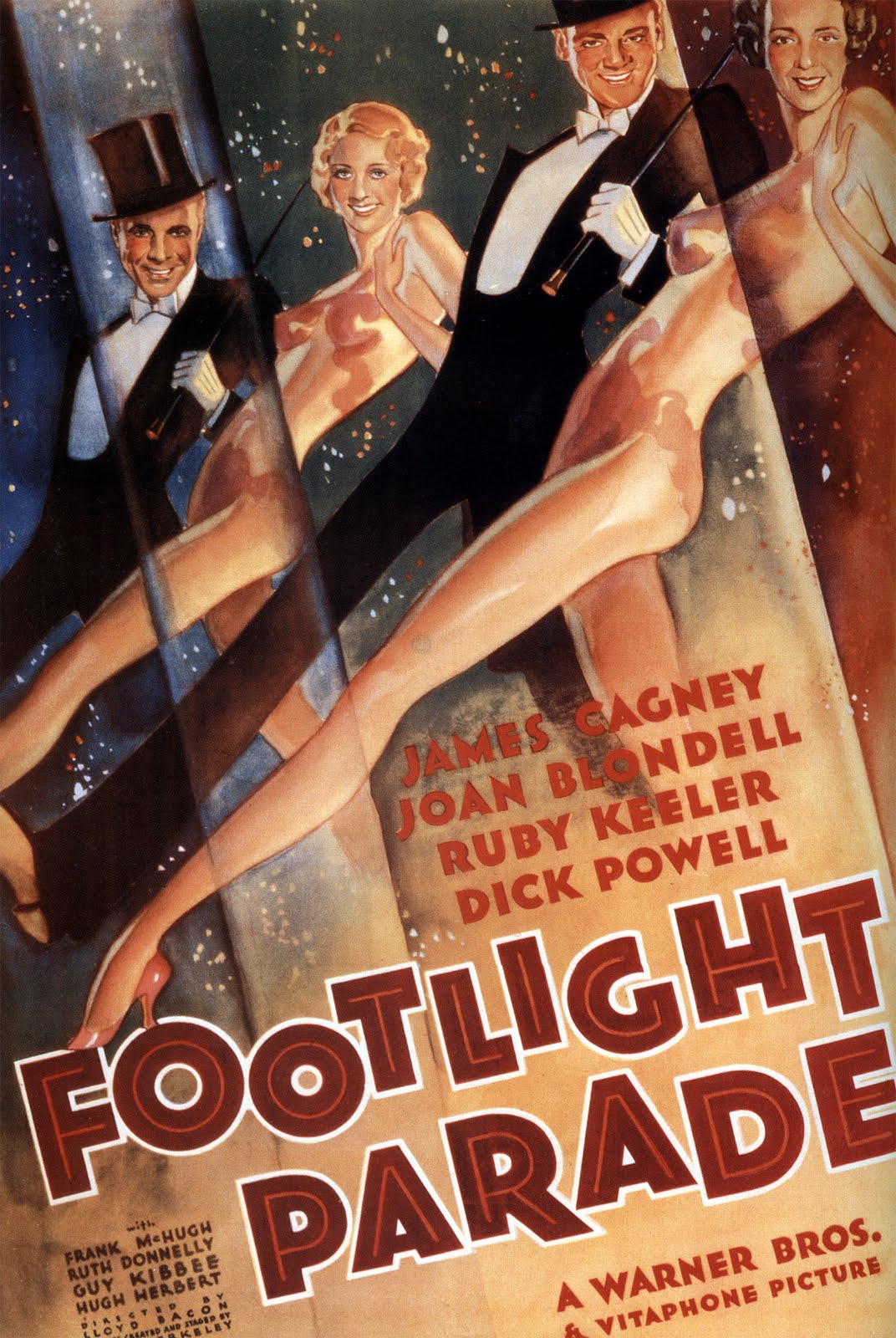
Looking to cash in on a trend, Warners quickly rushed Footlight Parade into production and gave the lead to its most popular star, James Cagney. In this one, they barely bother with a plot—more a case of "Did you see the other two? This is more of the same"—and gave Berkeley free rein. It's the most over-the-top of three, with numbers that wouldn't fit into an airplane hanger ostensibly taking place on a theater stage. It's worth looking up, though, to see Cagney in a pre-Yankee Doodle Dandy dancing role.
Harry Warren and Al Dubin wrote the songs for that one, too, and all three movies are preserved in the National Film Registry.
1933 represented the highwater mark for Berkeley's career. Within a year, his lavish production numbers were considered old hat and by the early '40s, even though he was still directing musicals, others, particularly Gene Kelly, had taken over his choreographing duties.
Ironically, it was the star of the "We're In The Money" number that hastened Berkeley's downfall. Over the course of the next three summers, in The Gay Divorcee, Top Hat and Swing Time, Ginger Rogers and Fred Astaire would, like Berkeley before them, redefine the movie musical, turning dance into a most intimate expression of love and romance. Suddenly by comparison Berkeley's choreography seemed gaudy, abstract and impersonal, and what had thrilled audiences in 1933 was dismissed as so last year by 1934.
Harry Warren and Al Dubin continued to crank out hits throughout the 1930s, with their last number one together being 1937's "Remember Me." After that, Dubin returned to Broadway and wrote musicals until his death in 1945, while Warren teamed up with other lyricists and continued to write hit songs into the 1950s. "The familiarity of Harry Warren's songs," said one drama critic, "is matched by the anonymity of the man" and Time magazine noted, "By silent consensus, the king of this army of unknown soldiers, the Hollywood incognitos, was Harry Warren, who had more songs on the Hit Parade than [Irving] Berlin himself and who would win the contest hands down if enough people have heard of him."
The results of the latest poll are in— despite intense lobbying efforts on behalf of both the Three Stooges and Laurel and Hardy, the Marx Brothers were your favorite comedy team of the 1930s, taking a plurality of the 37 votes cast, with 18. The Stooges received eleven heartfelt votes, and Laurel and Hardy and Our Gang 3 each. Burns and Allen and the Ritz Brothers closed out the voting with one vote each, although support for the latter was strongly suspected of being an inside joke between readers Muleboy and bellotoot.
"I knew it!" Zeppo Marx crowed at the awards ceremony. "I knew I'd win an award someday! I've been carrying these guys for years and finally it's my moment to shine. I'm king of the world!"
In an expansive mood at MGM Queen Norma Shearer's always raucous after-party, Chico Marx opined, "Comedy is a chair. I'm an artist and if you give me a tuba or perhaps a French horn or any of the wind instruments, I'll bring you a laugh out of it, either by falling into it or maybe by blowing on it and making a funny sound."
His brother Julius, who performs under the stage name "Groucho," was more subdued as he shared a quiet drink with his cigar and grease-paint moustache. "I don't want to belong to any club that will accept me as a member. Those are my principles," he added, "if you don't like them, well, I have others."
Accepting the silver medal on behalf of the Three Stooges was an eloquent Jerome "Curly" Howard whose tearful speech was the highlight of the awards ceremony. "Woo woo woo!" he said at one point, which he followed quickly with, "Nyuck nyuck nyuck."
George Burns was philosophical in defeat. "Everything that goes up must come down. But there comes a time when not everything that's down can come up."
"They laughed at Joan of Arc," his wife and lifelong partner, Gracie Allen, interrupted, "but she went right ahead and built it."
"Gracie, did the maid ever drop you on your head when you were a baby?"
"Don't be silly, George, we couldn't afford a maid. My mother had to do it."
"Say goodnight, Gracie."
"Goodnight!"
On the other hand, Spanky McFarland, one-time star of the Our Gang comedies, now every day third baseman for the Washington Nationals, was inconsolable after the loss.
"I blame Buckwheat," he said bitterly. "The Little Rascals were a tight little comedy act—me, Darla, Alfalfa, Stymie. Even a no-talent stiff like Dickie Moore could get a rise out of an audience from time to time. Then Buckwheat goes on Saturday Night Live and gets himself shot and suddenly we're a national joke! Comedy is no laughing matter, dammit!"
For the first time in Monkey Blog history, intense lobbying efforts from outside interest groups attempted to influence the outcome of the poll, no doubt a result of the recent Supreme Court ruling allowing corporate spending in elections. Who Am Us Anyway and Thingy, who supported the Three Stooges and Laurel and Hardy, respectively, sparred good-naturedly but passionately in favor of their candidates.
"Look what I'm up against," Who com- plained, "a basic misunder- standing on the part of the electorate regarding the actual question presented. And since there seems to be some confusion on this point, let me put it plainly: Comedy, to the aficionado, means 'falling, hitting and making funny noises.'"
His ardent support for the Stooges, he said, was motivated by "my continuing quest to drive away all high-class, intellectual readers who are smarter than me," and added that if you couldn't at least muster a wry grin at the antics of Moe, Larry and Curly, "I don't want to know you."
For her part, Thingy would stop at nothing to boost the chances of Laurel and Hardy, even at one point posting an enticing cheesecake photo of her legs. Yet afterwards, she shrugged off the duo's defeat. "I think I'll go watch The Thin Man," she said. "Now, that was a comedy team."
Poll numbers don't lie. Bringing Up Baby is your favorite Howard Hawks movie of the 1930s, even if it isn't.
My good pal and movie mentor, bellotoot, called this one a week ago when he wrote "Bringing Up Baby going away. Scarface and Only Angels Have Wings, pick 'em. Twentieth Century trails the pack." And indeed, the final numbers were 11 votes for Baby, 6 each for Scarface and Angels and 1 for Twentieth Century. Bellotoot, who has a Chaplin poster on his wall and a "Rufus T. Firefly" nameplate on his desk, proves once again that when it comes to movies, he is the master and the Monkey his humble servant.
The latest Monkey Movie poll question was "Looking ahead to 1931-32, four movies will definitely get Katie nominations for best picture—À Nous La Liberté, Frankenstein, Grand Hotel and Scarface. Which movie should get the fifth nomination?"
The results were decidedly inconclusive.
Of the eleven choices, three—The Guardsman, Marius and The Smiling Lieutenant—failed to garner any votes at all. Dr. Jekyll and Mr. Hyde got two votes and four others—The Champ, Mädchen In Uniform, The Music Box and Shanghai Express—copped one each.
That left Tod Browning's cult classic Freaks, the Marx Brothers' Monkey Business and a pre-Code version of the tragic romance Waterloo Bridge tied with four votes apiece.
What to do, what to do?
Well, I'll tell you. There's no rule that says I have to limit myself to five best picture nominees. The Academy certainly doesn't. It nominated eight movies for best picture in 1931-32 and as you probably know, it's nominating ten this year. No reason I can't nominate seven. So those of you who voted for Freaks, Monkey Business and Waterloo Bridge, rejoice, they're all getting best picture noms. As for those of you who voted for one of the other movies, some of them will receive nominations in other categories and I think I can safely promise I will be writing positive reviews of all of them. Something to look forward to—or not, depending on what you think of my essays.
I plan to announce all the the nominees for 1931-32 on New Year's Day. Stay tuned.
The results are in for this week's Monkey Movie poll, Which of these Katie nominees for best actor of 1930-31 would make the biggest splash if he were in his prime today? Arguments could be made for each of the contenders, James Cagney, Charles Chaplin and Edward G. Robinson, but for the twenty participants who voted, the issue was never in doubt.
"Made it, Ma! Top of the world!" crowed the exuberant Cagney at an afternoon press conference. "My mother thanks you, my father thanks you, my sister thanks you and I thank you!"
The margin of Cagney's win was as startling as it was decisive: 20 votes for Cagney, zero for Chaplin, zero for Robinson. That's right, 20-to-nothing. Those are the sort of numbers you'd expect to see in a petty dictator's plebiscite.
Allegations of voter intimidation and poll fraud were promptly dismissed with a couple of slaps across the kisser.
"Asking questions again, huh?" snarled Cagney. "Listen, someday you're gonna stick your nose in, you're gonna get something in it. You been reading a lot of stuff about 'Crime don't pay,'" he added. "Don't be a sucker! That's for yaps and small-timers on shoestrings. Not for people like us. Never steal anything small, I say!"
Cagney was exhumed from his final resting place as soon as the poll closed, breathing his first air above ground in more than twenty years.
"Those dirty rats!" he said without hesitation when asked what he disliked most about being dead. "I mean, sure, there's bugs, decomposition, the worm that doth corrupt—and just try getting a table at La Botte! But those dirty rats are the worst."
While sometimes hard to handle, Cagney admitted death had its moments. "They paid tribute to a bad man," he said, "by electing me the mayor of hell, winner take all. Everyone in that torrid zone knew me as Jimmy the Gent," he said, "even the seven little Foys, and though each dawn I died, it was something of a sinner's holiday, the time of my life."
Married forty-four years in life, Cagney was a lady killer in death, making time for other men's women, and even becoming involved with a strawberry blonde. "I was her man," he said, "just boy meets girl, and it was something to sing about until I found out the bride came C.O.D. I told her, 'Love me or leave me.' So she left.
"After that, I went a little blonde crazy—now she was a midsummer night's dream!"
When not chasing women, Cagney made powerful friends in the afterlife. "My advice?" he said. "At the doorway to hell, shake hands with the devil. Otherwise, run for cover!"
Attempts to work Yankee Doodle Dandy and Arizona Bushwhackers into his victory speech proved unsuitable for a family-friendly blog and were dropped.
After the poll results were announced, a subdued Edward G. Robinson said, "Mother of mercy! Is this the end of Rico?" then spent another ten minutes trying to explain who "Rico" was. Charlie Chaplin just twitched his moustache, doffed his hat and walked off into the sunset.
Legendary director Martin Scorsese immediately signed Cagney to a three-picture deal worth in excess of $60 million, by far the biggest payday of Cagney's career. "In terms of talent," Scorsese said, "Jimmy buries the competition."
"I'm ripe for a comeback!" said a beaming, if somewhat dazed and gamey Cagney. "I smell—Oscar, that is!"


 The results are in on the latest, inelegantly-worded Monkey poll: "Of the four biggest Oscar snubs in history as chosen by EW.com, which overlooked performance most deserved a nomination?"