skip to main |
skip to sidebar
[To read the first entry in this series, The Silent Oscars: 1888-1905, click here.]
Must-See Films: Dream Of A Rarebit Fiend (1906); The Story of the Kelly Gang (1906); A Trip Down Market Street (1906); Fantasmagorie (1908); A Corner in Wheat (1909); The Country Doctor (1909); The Lonely Villa (1909); Afgruden (1910); The Lonedale Operator (1911); Max Victime du Quinquina a.k.a. Max Takes Tonics (1911); Swords and Hearts (1911); Winsor McCay, the Famous Cartoonist of the N.Y. Herald and His Moving Comics, a.k.a. Little Nemo (1911); The Revenge of a Kinematograph Cameraman, a.k.a. The Cameraman's Revenge (1912); The Land Beyond the Sunset (1912); The Musketeers of Pig Alley (1912); An Unseen Enemy (1912); The Battle at Elderbush Gulch (1913); Der Student von Prag (1913); Fantômas (1913-14); Ingeborg Holm (1913); Suspense (1913); Traffic in Souls (1913); Twilight of a Woman's Soul (1913); The Avenging Conscience: or "Thou Shalt Not Kill" (1914); Cabiria (1914); Gertie The Dinosaur (1914); Judith of Bethulia (1914); The Rounders (1914); The Squaw Man (1914); Tillie's Punctured Romance (1914)
 ● The twelve years between The Great Train Robbery (1903) and The Birth Of A Nation (1915)—what the blog Film: Ab Initio calls "cinema's forgotten decade"—might be the least known years in all of movie history. Yet it was during these years that movies developed from a novelty into the most popular art form of the 20th century:
» D.W. Griffith took basic techniques introduced by his contemporaries and used them in ways so imaginative, he virtually invented the "language" of film we now take for granted.
» Speaking of language, a new concept entered the lexicon—"movie star"—with audiences for the first time flocking to theaters to see specific performers, among them Charlie Chaplin, Mary Pickford, Roscoe "Fatty" Arbuckle, Mabel Normand and Lillian Gish.
» And the idea of what constituted a movie evolved from brief, simplistic snippets viewed through coin-operated "peep shows" to ambitious, feature-length projects with complex storylines and characters.
 ● It's often difficult to discern evolution as it is occurring. It's especially difficult to see when the evidence remained squirreled away in studio vaults for half a century while critics and public relations men spun up easy to grasp narratives of film's history that sold tickets but did little to describe the true events. Fortunately, historians such as Kevin Brownlow and David Bordwell, among others, have devoted their careers to setting the record straight; and blogs such as 100 Years of Movies, Alt Film Guide, the aforementioned Film: Ab Initio, and others, have taken on the task of watching these early films and reporting on their efforts in thoughtful essay form.
And then there are crazy people like me who try to swallow the entire decade in one, 170+ movie sitting and boil it all down to a single, indigestible post.
● All of the movies on my must-see list (and many, many more) are now readily available to view. (I've only seen the first episode of the twenty-part serial The Perils Of Pauline, else it would make the list as well.) I can tell you from personal experience, if you watch movies in chronological order starting with those two-second fragments from Louis Le Prince in 1888 and work your way forward, film techniques so commonplace now as to be invisible to a modern fan will jump off the screen and you'll find yourself saying aloud, "Thank you, D.W. Griffith, for rescuing me from yet another static, single-shot movie where the actors mill around like ants."
D.W. Griffith and the Invention of a Film Language
 ● Speaking of David Wark Griffith, he was born in Kentucky to Confederate colonel "Roaring Jake" Griffith and Mary Perkins. He had aspirations of being a Broadway playwright, took small acting parts in movies for the money then switched to directing when he discovered it paid better. He directed his first movie, the twelve-minute short The Adventures of Dollie, in 1908 working from instructions written out on a single sheet of shirt cardboard by his cinematographer G.W. "Billy" Bitzer.
Over the course of the following five years, Griffith directed just shy of five hundred movies, mostly for the Biograph Company located in New York City.
● Like every other director of that era, Griffith wrestled with the problem of narrative—how to tell a story in a silent medium—but whereas other directors simply parroted the techniques that worked on stage and wound up with actors in togas milling around in front of painted backdrops, Griffith seemed to understand from the outset that film presented its own unique set of problems and opportunities. By composing his actors within the frame, by relying on revealing actions rather than words and, especially, by juxtaposing images and events through editing, Griffith was able to create within his audience an emotional involvement in his stories.
● A trio of short films from 1909 illustrate Griffith's gift at composing the frame, staging action, and creating suspense with pacing and editing.
» One of five Griffith films preserved in the National Film Registry, A Corner In Wheat is overpraised (to my mind) for being the first "message" picture, but its use of composition is masterful. Lone figures confined to the corner of the screen, overwhelmed by empty vistas, conveying through image alone the desperation the characters feel, could have come straight from an Edward Hopper painting—except that A Corner In Wheat pre-dates Hopper's breakthrough as an artist by some fifteen years.


» The Country Doctor opens with a panning shot which if you'd just watched 100+ movies from the years that preceded it, believe me, jumps off the screen with its technical sophistication. Starting with a long shot of a valley, then panning to a house on a hill to focus on a family already emerging to walk forward until they stand in medium shot, Griffith establishes with a single uninterrupted camera movement both the story's setting and the identity and socio-economic status of its characters, the sort of camera shot we take for granted now but which pretty much didn't exist before him.
That only a year into his career as a director, he concluded the tragic story with a mirror of that opening shot, panning from the now-empty house as the film ends to that same long shot of the valley, underscores just how quickly he raced ahead of his competitors in using film to convey emotion.
» Griffith didn't invent intercutting (a.k.a. cross-cutting)—the use of editing to alternate between two locations, usually to show simultaneous action—but he took it farther than anyone before him, using it not just to, say, show a key prop or establish a location, but to create a narrative flow and a sense of anticipation that was sorely lacking in early movies. In the thriller The Lonely Villa thieves break into a secluded country home and terrorize a woman and her children while her husband and the police race to their rescue. Griffith cuts back and forth between three points of view to create genuine suspense—will the would-be rescuers arrive in time to save the day?—an editing technique still used to this day.
(Griffith would return to this theme time and again, most memorably in 1911 with The Lonedale Operator and in what is perhaps the most controversial sequence of The Birth Of A Nation, where the Ku Klux Klan rides to the rescue of Lillian Gish's virginity.)
● Griffith continued to develop new approaches to film storytelling throughout his career at Biograph.
 » For example, in 1911's two-part short Enoch Arden—a wife stands on the shore waiting for her husband's return from the sea while at that moment the husband is shipwrecked and washed ashore on a tropic island—Griffith uses cutting not just to show the same action from different points of view as in The Lonely Villa, or even to establish that the action is simultaneous, but to show parallel storylines linked only by the emotional resonance between them. Griffith cuts back and forth between the two storylines—the shipwrecked sailor, the wife who waits—for the remainder of the film, showing the analogous plights of the castaway and his (presumed) widow as they each struggle to survive.
(By the way, I suggest that if you watch the copy of Enoch Arden I've embedded here, you mute the sound—the accompanying soundtrack doesn't fit the mood in the least.)
» The Musketeers Of Pig Alley (1912) (you can see it here) is credited with being the first gangster movie and while its story of a thug who robs the husband of the woman he fancies is well worth watching in its own right, the film is remarkable for another startling leap in film technique, in this case the likely invention of what is now called "follow-focus"—the practice of having the camera operator keeping moving actors in focus while allowing the background to go out of focus. At a time when cameramen prided themselves on keeping the entire frame in focus, Griffith's longtime cinematographer Billy Bitzer was reluctant to follow Griffith's direction in this instance and only acceded to his request after Griffith took him to an art museum to look at paintings where the foreground subjects were in sharper focus than the background. (Indeed, Griffith got many of his ideas while strolling through New York's museums.)

» Another of Griffith's innovations was the use of the iris shot, which Tim Dirks defines as "an earlier cinematographic technique or wipe effect, in the form of an expanding or diminishing circle, in which a part of the screen is blacked out so that only a portion of the image can be seen by the viewer." The iris shot was typically used to open or close scenes, and to focus the viewer's attention on a single character or action, but in more sophisticated instances (again, credit Griffith) it could be used to link characters thematically.

» Griffith also pushed his actors to adopt a more subtle acting style, eschewing the dramatic poses of the stage for something more reserved, which he thought played more effectively on the screen. The change was incremental, and sometimes you can see both styles in the same scene, but when compared to other films of the era, the difference is striking. Among those actors who worked with Griffith at Biograph were Mary Pickford, Lillian Gish, her sister Dorothy, Henry Walthall, Mae Marsh, Harry Carey, Mack Sennett, Donald Crisp, Robert Harron, Constance Talmadge and Florence Turner.
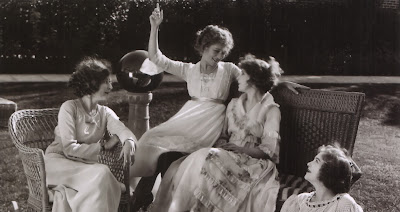 ● That we take Griffith's storytelling techniques for granted now—that every movie made in the last one hundred years has repeated these same tricks as a matter of routine—is a testament to just how innovative and influential he really was.
● In 1914, Griffith made his first feature-length film, Judith of Bethulia. Based on a book from the biblical apocrypha, Judith is the story of a beautiful young widow who sacrifices her own sense of virtue to seduce the leader of an invading army and save her people. Aside from its place in film history as one of the earliest feature-length films produced in America (the rest of world had been producing feature films since 1906), Judith of Bethulia features an early example of what is known as "classical continuity editing" or "classical Hollywood narrative"—the practice of cutting within a scene to make clear to the viewer at all times where the characters are in relationship to each other and to their surroundings, both in terms of the physical space and the chronology of the film story.
A good example comes early in the film. Griffith starts with a wide shot of seated figures threshing wheat, holding on them until Robert Harron enters the screen from the left—

and crosses to the far right where he sees something in the distance.

Griffith then cuts to a medium shot of Mae Marsh at a well, back to a wide shot to establish where she is in relation to her surroundings, then to the medium shot again to show Marsh's face as she struggles with the water jug. Griffith cuts back to the wide shot as Robert Harron enters from the left then cuts on his act of helping Marsh to a medium two-shot so you can see Marsh's face as she reacts to his kindness—

then finishes the scene with a wide shot as the couple walks off the screen, holding on the empty screen until someone else enters to draw water at the well. (You can watch Judith of Bethulia in its entirety here.)
The use of classical continuity editing—as opposed to the then-typical practice of having all the actors remain on screen in the same full shot throughout the scene, what David Bordwell calls the "tableau" style—became the industry standard by 1917, but its use in Judith of Bethulia was very advanced for its day and, again, I have to tell you that after plowing through more than two hundred movies made before 1915, all of them using the same tableau set-up, to suddenly see such sophisticated compositions and editing, well, the effect is startling. And a relief.
Although a critical success, Judith of Bethulia was extremely expensive to film and Biograph declined to finance Griffith's further ambitions in this direction. As a result, Griffith struck out on his own, taking his film crew and troop of actors with him. Within a year, Griffith would film The Birth of a Nation, the most lucrative film of the early silent era; Biograph was out of the film business by 1916.
● By ignoring this era of film history, critics have wound up overstating the significance of The Birth Of A Nation as a revolution in film technique. Every technique Griffith supposedly invented in The Birth of a Nation, he had already developed and mastered during his years at Biograph Studios. Likewise, because that film's racism wound up overshadowing his entire career, casual film fans have undervalued Griffith's impact as an artist and innovator.
 ● Ultimately, Griffith's reward for showing the world how to tell stories on film was to find himself left behind by filmmakers who used his techniques to tell better stories. To a great degree, this was his own fault. As you watch Griffith develop a film language, you can also see him develop the bad habits that would ultimately cost him his audience—his reverence for an outdated Victorian value system, his obsession with female virtue, particularly when Lillian Gish takes over the lead acting chores from Mary Pickford, and an appalling tendency in his Civil War films to sentimentalize, or worse justify, America's brutal system of racial apartheid—vices which have not only dated badly in our 21st century eyes, but which began to alienate audiences as early as the end of the First World War.
[Click here to continue to Part Two.]
[To read "Best Picture Of 1930-31: City Lights (prod. Charles Chaplin), Part One," click here. To read Part Two, click here.]
 The Film's Legacy—And The Filmmaker's
In reviewing City Lights for his Great Movies series, Chicago Sun-Times critic Roger Ebert wrote "If only one of Charles Chaplin's films could be preserved, City Lights (1931) would come the closest to representing all the different notes of his genius. It contains the slapstick, the pathos, the pantomime, the effortless physical coordination, the melodrama, the bawdiness, the grace, and, of course, the Little Tramp—the character said, at one time, to be the most famous image on earth."
I would go farther than that. City Lights is not only Chaplin's most representative work, it's also his best, which is saying something considering he also gave us The Kid, The Gold Rush, Modern Times, The Great Dictator, and many other wonderful movies. City Lights was, for me, the best movie of 1931, and arguably the best silent movie ever made, one of two I would recommend to you if you've never seen a silent movie (along with Buster Keaton's The General). It's also on my short list of history's great comedies, great romances, and well, great movies, period.
I'm not alone in my assessment. Orson Welles called it his favorite film. Stanley Kubrick and Andrei Tarkovsky included it in their personal top five. James Agee in 1949 called Chaplin's performance the "greatest single piece of acting ever committed to celluloid."
 In choosing it as the best picture of 1930-31, Danny Peary (whose book Alternate Oscars inspired this blog in the first place) called City Lights "a masterpiece" and "Chaplin's greatest film." Leonard Maltin, James Berardinelli, Tim Dirks, and many others, rank it as one of the hundred best films of all time. The American Film Institute includes it on no less than seven different lists honoring different film genres and performances—including the number one spot among romantic comedies. It has been selected for preservation in the National Film Registry. And on and on.
Charles Chaplin was without a doubt the most independent filmmaker in history, directing, producing, financing, writing, scoring, editing and starring in his own movies. After he formed United Artists to distribute his films, he was answerable to no one. If he could have played all the parts in his movies, I imagine he would have—certainly he didn't hesitate to tell his co-stars how to play their parts, choreographing their every move, gesture and expression.
When you look at the dictionary definition of an auteur—"a filmmaker whose individual style and complete control over all elements of production give a film its personal and unique stamp"—Chaplin's picture would serve as a prime, if unreproducible, illustration.
 But in assessing Chaplin's strengths and weaknesses, though, where does one role leave off and another begin? As a director, in the sense that we now think of a director—as the master of a three-ring circus, as an innovative storyteller, as an acting coach, as glorified cinematographer— Chaplin was actually fairly maddening. He cast an amateur actress as his lead on a whim; his camera work was if anything more stripped down than it was ten years before; and he took three years to make City Lights, shooting hundreds of takes, drafting the story as he went along, nearly going bankrupt in the process.
Nobody films that way today, of course; you couldn't afford to. Yet perhaps Chaplin's perfectionism was the essential ingredient that made the finished product look so effortless. Maybe that's why we don't often wind up with films as sublime as City Lights.
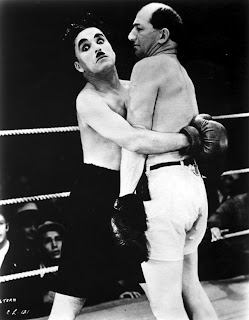 That said, I think Chaplin's strengths are primarily three-fold. First, as I've discussed here and here, I think he was one of the greatest actors in movie history, and his performance in City Lights is no exception. Two, he was also one of the greatest film editors ever, a much underappreciated art that as much as anything a director or actor does determines the pace and structure of the story. Certainly sifting through the mountains of film he had exposed to find just the right take of a given scene must have been a monumental task.
And three, and maybe most importantly, Chaplin understood his audience, how to please it, how to challenge it, and above all, how to move it to feel what he wanted it to feel. For some, a director who pleases his audience, who creates a work that is "merely" entertaining, is not a director to be taken seriously, as if producing a movie that can entertain all kinds of audiences over the course of decades is hack work. Alfred Hitchcock, thanks in part to the persistent advocacy of directors and historians such as Francois Truffaut, finally managed to shed that ridiculous label; Steven Spielberg, despite two Oscars, largely has not.
No one quite has the temerity to suggest Chaplin was "merely" anything. Instead, he's "sentimental," the worst sin a filmmaker can commit in a cynical age. It means the same thing, though. We now prefer the more modern Keaton, who worked so hard to make you think he didn't care.
 But questions like "Chaplin or Keaton" are, for a movie fan, self-defeating in the long run. The question, of course, is not Chaplin or Keaton, it's Chaplin and Keaton and who else?
And while movies, even timeless classics, go in and out of fashion, circumstances inevitably arise to bring them back to the public's attention and remind us why we loved these films in the first place. Maybe now, during this seemingly endless recession and as breakthroughs in communications (such as this blog, ironically) leave us ever more isolated, it's time to rediscover and reassess City Lights in particular and Chaplin in general, and remember what it was like to care so passionately about society's lowest figure while also laughing so loudly at his trials and travails.
[To read "Best Picture Of 1930-31: City Lights (prod. Charles Chaplin), Part Four," click here.]
When we celebrate great directors—Hitchcock, Kurosawa, Ford—we are actually often celebrating wildly different qualities. Sometimes it's the gift of an Ingmar Bergman (remember a chess-playing grim reaper in The Seventh Seal?) to translate a deeply personal vision into an unforgettable image. At other times it's the knack of a William Wyler (who directed the most Oscar-winning performances in history) for coaxing award-winning performances from his actors. And at yet other times, it's the sheer determination of a Marcel Carné (who directed Children of Paradise during the Nazi occupation of France) to conjure a masterpiece from nothing under the most difficult of circumstances.
 To turn a personal obsession into one of the greatest movies of all time, Danish director Carl Theodor Dreyer had to become a combination of all three.
Dreyer was already slated to direct a movie about Joan of Arc when he discovered in a Paris library the complete transcript of the trial that led to her execution. Poring over the court's meticulous notes, Dreyer became obsessed with the Joan revealed in the give and take of the trial. Dreyer threw out Joseph Delteil's screenplay, which was a more traditional account of Joan's life, and instead wrote his own screenplay focusing the story solely on the interrogation.
The result, as the opening titles put it, is a portrait of Joan "not in armor, but simple and human." It's also one of the best movies ever made about the collision of religious faith and worldly cynicism.
Dreyer subscribed to what Ernest Hemingway later called the iceberg theory of storytelling, that if you focus on the core of the story and get the details right, then like the seventh-eights of the iceberg that's underwater, the audience will intuitively sense the parts of the story that you've left out. In directing The Passion of Joan of Arc, Dreyer stripped away everything—subplots, politics, and especially showy, kabuki-style acting—that distracted from the emotional core of his story.
He even went so far as to bar the cast from wearing make-up, unprecedented in the Silent Era. The brutal demands Dreyer made on his star, Maria Fal- conetti, were legendary. To get the performance he wanted from Falconetti, a stage actress known for light comedy, Dreyer had her kneel on the stone floor of the set for weeks on end, blank all emotion from her face and do take after endless take. In addition to cropping her long hair, Dreyer insisted over Falconetti's objection that in a key scene where the judges cut her hair in preparation for her execution, her head be shaved for real. And when a doctor is brought in to bleed the ailing Joan, Dreyer took a knife to Falconetti's arm and opened a vein.
Reportedly, the suffering etched in every line of her face was genuine, the tears well-earned.
Dreyer was as demanding of every performer in the movie, from his star to the extras. For the duration of shooting which ran from May to November 1927, he required that his performers stay in character as much as possible and keep their heads shaved in monkish tonsure-style haircuts. As Gary Morris pointed out in an essay for Bright Lights Film Journal, this included even those actors whose characters wore caps that entirely covered their heads. Likewise Dreyer built an elaborate, three- dim- ensional set and then never showed it, shooting nearly the entire movie in a series of close-ups, possibly using more close-ups than any other movie in history. Yet following the iceberg principle again, the reality is there in the background so that without drawing attention to the set or stopping to pat himself on the back for the effort, you never question that what you're seeing is real.
Can you image a director now who would blow a substantial chunk of his budget to create such an elaborate set and then not shove it in your face every minute to the detriment of the final product? Because it stripped away every ex- traneous detail, Dreyer's version of the Joan story doesn't delve into the political or military conflict that drove the trial, nor does it directly answer the question of whether Joan was a saint (the Catholic church declared her to be so in 1920; my own religious background makes no allowance for such a possibility). Dreyer made clear, however, where his sympathies lay. As Roger Ebert noted in his review of the movie, the judges are photographed in a harsh white light that exposes every wrinkle and blemish that "seem to reflect a diseased inner life. Falconetti, by contrast, is shot in softer grays." Joan looks like a saint, bedeviled by corrupt, venal men with a worldly axe to grind.
In many ways, The Passion of Joan of Arc is the opposite of what I usually I like in a silent movie. It's a heavy drama, laden with dialogue (which of course must be read on intertitle cards that appear between scenes). Except at the end, it features little of the visual lyricism that can eliminate the need for pages of exposition. And yet, Dreyer, who along with Marguerite Beaugé edited the movie, found an effective rhythm as he cut between close-ups of Joan, her inquisitors and the intertitle cards, a rhythm that steadily increases the tension until it explodes, like screwing a lid tightly onto a pot of boiling water.
Dreyer's approach to filmmaking was idiosyncratic, wholly at odds with, say, F.W. Murnau's, who was aiming to make movies a purely visual experience. And yet because he did make it work, Dreyer managed a nearly unique achievement, a movie so modern in its look and its pared-down approach to storytelling, that if I didn't know better, I would have assumed it was made forty years later. That we can see this movie at all almost qualifies as a miracle in itself. Censors went to work on the movie soon after Dreyer completed it and then the film was lost to fire—twice. The negative was destroyed soon after its premiere and Dreyer cobbled together another print out of scraps from the cutting room floor only to see that print destroyed in a fire too. Dreyer died in 1968 believing that his finest achievement was lost forever.
Then in 1981, while cleaning out a janitor's closet in an insane asylum in Oslo of all places, workers discovered a complete copy of the original print, apparently ordered by a forgotten doctor to show to his patients fifty years before. Often these rediscovered lost films prove to be a disappointment that cannot live up to idealized memories; The Passion of Joan of Arc proved to be even better. Critics hailed it as a masterpiece, a word too casually tossed around, but for once they were right.Of my three nominees for best director, Luis Buñuel made the most influential movie, the sixteen-minute surrealist experiment Un Chien Andalou, possibly the best example of experimental film ever created. Victor Sjöström (credited here as Victor Seastrom) is better known now for his performance as an aging professor in Ingmar Bergman's classic Wild Strawberries, but in his native Sweden he is remembered as the father of Swedish cinema and he directed fifty-five movies in his career. Hand-picked by star Lillian Gish for The Wind, he directed a near textbook example of a silent movie that sheds the need for dialogue and he did it under grueling conditions in the Mojave Desert.
In other years, either of these nominees would have been an excellent choice for a Katie Award.
 In the case of The Passion of Joan of Arc, Dreyer made neither an influential movie nor a textbook example of anything. He simply made the best movie of the year and without his determination, it wouldn't have been made at all.
Dreyer followed The Passion of Joan of Arc with an atmospheric foray into the horror genre, Vampyr. Although some now believe it rivals Murnau's Nosferatu as the best vampire movie ever made, Vampyr flopped so miserably at its premiere in Berlin that Dreyer fell into a deep depression and didn't direct another movie for ten years.
In his career, Dreyer directed a total of twenty-three movies, including Day of Wrath (1943) and Ordet (1955); he wrote forty-nine others. He directed his last movie in 1964, just four years before his death at the age of 79.
 Un Chien Andalou was the best of the surrealist films but it wasn't the first—although what exactly was the first is hard to say. I mentioned that René Clare's Entr'acte with its runaway coffin came along in 1924 but some film historians argue that it's more Dada than surreal and who am I to disagree (especially since I wouldn't know how).
But one thing is certain. By 1928, the attempt to break away from the traditional narrative form as a way of conveying the human experience on film was in full swing.
Well, I say traditional.
The narrative structure of movies we today know and love was all of fourteen years old at this point, hardly established enough to qualify as a tradition. Let's say "trend" then, a trend toward making movies resemble the narrative structure of theater and literature. And not everyone was ready to concede that this particular trend made fullest use of film's potential to convey the human experience.
But anyway.
In addition to Entr'acte, a trio of highly-regarded films displaying surrealist influences beat Un Chien Andalou into the theaters.
La Coquille et le Clergyman (The Seashell and the Clergyman) premiered in Paris in February 1928, sixteen months before Buñuel's classic. Directed by Germaine Dulac, a leading radical feminist and one of the first women to direct movies in the French film industry, La Coquille et le Clergyman is the story (if there is a story) of a clergyman who becomes erotically obsessed with a general's mistress. Although this struggle is shown in symbolic terms—the priest's slowly fragmenting face, for example—and British censors banned La Coquille et le Clergyman on the basis that the "film is so obscure as to have no apparent meaning. If there is a meaning, it is doubtless objectionable," which no doubt thrilled Madame Dulac, there's nothing on screen that has the power of Buñuel's razor and its reputation has justly faded over the years.
 A superior exercise was Jean Epstein's La Chute de la Maison Usher, an adaptation of Edgar Allen Poe's The Fall Of The House Of Usher. Luis Buñuel worked as Epstein's assistant director and it shows. The movie combines the abstract, exaggerated sets common to German Expressionism with images of surrealism, particularly of a portrait central to the story that is at times a painting and at times a live woman, that are pure Buñuel.
Epstein did not set out to make a surrealist movie, but instead an adaptation of the novel that was faithful to the spirit of Poe, but the use of surrealism here keeps the audience off-balance in a way that heightens the sense of horror.
Maybe the best of the surrealist experiments that doesn't have Luis Buñuel's name on it is L'Étoile de Mer, one of six movies directed by Man Ray, better known for his photographs and paintings. There's no story, just a mood, a man and woman photographed through a pane of glass, juxtaposed with the poetry of Robert Desnos. The effect is as lyrical as Un Chien Andalou is brutal.
 You might also take a look at Jean Cocteau's Le Sang d'un Poète (The Blood Of A Poet), a mock- doc- umentary or as Cocteau put it "a realistic documentary of unreal events." Surrealists at the time weren't sure Cocteau qualified as one of their own, and I'm not going to wade into the argument. I'll just say that Cocteau, who here included such sequences as a painted portrait that begins to speak, was clearly influenced by surrealism and probably couldn't have made his beautiful and bizarre version of Beauty and the Beast in 1946 without first making The Blood Of A Poet. For that reason alone, I thought it was worth tracking down and you might, too.
The Russian director Dziga Vertov wasn't a surrealist but his Man With The Movie Camera is definitely another example from early 1929 of a film trying to subvert traditional expectations of narrative. Urban Cinefile calls it three films in one, a documentary of Russian life, a documentary of the making of the documentary and a documentary of the audience watching the documentary. These images—of Russian factories, trolley cars, women in undergarments, etc.—are served up as a collage that is not so much an experiment in film making as an experiment in film editing.
 I have read that Vertov intended this collage to be either a sly com- mentary on life in the Soviet Union, interesting and busy but a bit soulless, or an equally sly commentary on our insistence that even a random jumble of images must have meaning. The fact that he spent so much time in the editing room suggests Vertov meant something by it but if he did, the finished product resolutely keeps the secret safe from us. In the end any given image is well-made but overall most of Man With The Movie Camera is no more interesting than the random images you'd find in any tourist's camera.
Finally, while I'm writing about movies without a narrative that aren't necessarily surrealist, maybe I should mention People On Sunday (Menschen am Sonntag), directed by brothers Curt and Robert Siodmak with assists from Edgar G. Ulmer and Fred Zinnemann, and written by Billy Wilder. It's actually the opposite of surrealism, an exercise in early neo-realism—just following five young Berliners around on a lazy Sunday afternoon—but it is yet another attempt to tell a story without resorting to narrative.
In the case of all involved it was not an experiment they were much interested in repeating when their careers took off. Wilder, who wrote the script on pieces of scratch paper, dismissed it as not much more than a newsreel. "I would not see it. I don't know—I think it was just a freelance experiment of a picture. It never quite got into much depth."
That might be a pretty good epitaph for most of these movies.
In any event, the surrealist movement began to crack up within a few years, torpedoed by incessant bickering and internal strife as even its practitioners couldn't agree on what they meant as they endeavored to mean nothing. The founder of the surrealist movement, André Breton, bitterly denounced those who he felt had strayed from the party line, Buñuel and Epstein fell out during the filming of La Chute de la Maison Usher, and writer Antonin Arnaud was so incensed by how director Germaine Dulac had interpreted his screenplay La Coquille et le Clergyman, he called her a "cow" at the film's premiere.
Apparently there are a lot of very strict rules involved in doing anything you want.
In late 1928, Buster Keaton spoofed surrealism in his last great film, The Cameraman. In that one the experimental-looking collage was the result of a cameraman (Keaton) incorrectly loading film into the camera and a documentary on the Tong War in Chinatown was actually filmed by an organ grinder's monkey (don't ask). It's a very funny movie, certainly funnier than a razor blade slicing an eyeball.
 As a means of artistic ex- pression, sur- realism was a smashing success and remains influential to this day, although perhaps not in the way its founders envisioned. You'll find examples of it in animation (e.g., Tex Avery cartoons, Yellow Submarine), music videos, advertizing. Personally, I think surrealism works best as comedy, Monty Python, for example, and although even the most surreal imagery in Monty Python isn't quite surrealism as its early practitioners understood it since a joke is a form of comprehensible narrative, you have to admit there is always something unexpected about, say, the Spanish Inquisition.
On the other hand, as a political movement, surrealism was a complete bust. While the actions of our world's leaders often seem surreal, it turns out that no matter what system of government you adopt, war and oppression still occur—which shouldn't come as a surprise since governments are made up of people and on a fundamental level, people never change.
So should you bother tracking down Un Chien Andalou or any of the other movies I've mentioned? Well, that depends.
 I'm warning you up front, a little bit of this stuff goes a very long way. As with any new medium or technology, early users experimented for a while, eventually hit upon what worked, what didn't. The experiments were useful but definitely of more interest to a budding film student than to a middle-aged working man at the end of a hard week. Which is ironic because the surrealists hoped their films would lead the working man to reject the simplistic answers and bourgeois values that the surrealists felt had led to World War I and the excesses of the post-war bull market. Instead, they wound up preaching to a choir of fellow surrealists and after a while, not even them.
If you do choose to try some of these movies, my advice is "Don't think, you'll only hurt the ballclub." They were not meant to be understood literally, but emotionally, so don't try to figure them out; just watch them and react.


 ● The twelve years between The Great Train Robbery (1903) and The Birth Of A Nation (1915)—what the blog Film: Ab Initio calls "cinema's forgotten decade"—might be the least known years in all of movie history. Yet it was during these years that movies developed from a novelty into the most popular art form of the 20th century:
 ● It's often difficult to discern evolution as it is occurring. It's especially difficult to see when the evidence remained squirreled away in studio vaults for half a century while critics and public relations men spun up easy to grasp narratives of film's history that sold tickets but did little to describe the true events. Fortunately, historians such as Kevin Brownlow and David Bordwell, among others, have devoted their careers to setting the record straight; and blogs such as 100 Years of Movies, Alt Film Guide, the aforementioned Film: Ab Initio, and others, have taken on the task of watching these early films and reporting on their efforts in thoughtful essay form.
 ● Speaking of David Wark Griffith, he was born in Kentucky to Confederate colonel "Roaring Jake" Griffith and Mary Perkins. He had aspirations of being a Broadway playwright, took small acting parts in movies for the money then switched to directing when he discovered it paid better. He directed his first movie, the twelve-minute short The Adventures of Dollie, in 1908 working from instructions written out on a single sheet of shirt cardboard by his cinematographer G.W. "Billy" Bitzer.


 » For example, in 1911's two-part short Enoch Arden—a wife stands on the shore waiting for her husband's return from the sea while at that moment the husband is shipwrecked and washed ashore on a tropic island—Griffith uses cutting not just to show the same action from different points of view as in The Lonely Villa, or even to establish that the action is simultaneous, but to show parallel storylines linked only by the emotional resonance between them. Griffith cuts back and forth between the two storylines—the shipwrecked sailor, the wife who waits—for the remainder of the film, showing the analogous plights of the castaway and his (presumed) widow as they each struggle to survive.


 ● Ultimately, Griffith's reward for showing the world how to tell stories on film was to find himself left behind by filmmakers who used his techniques to tell better stories. To a great degree, this was his own fault. As you watch Griffith develop a film language, you can also see him develop the bad habits that would ultimately cost him his audience—his reverence for an outdated Victorian value system, his obsession with female virtue, particularly when Lillian Gish takes over the lead acting chores from Mary Pickford, and an appalling tendency in his Civil War films to sentimentalize, or worse justify, America's brutal system of racial apartheid—vices which have not only dated badly in our 21st century eyes, but which began to alienate audiences as early as the end of the First World War.


