skip to main |
skip to sidebar
Today is the centennial of Jean Harlow's birth. In her honor, I'm posting this Reader's Digest version of the four-part, 5000 word essay I wrote about her last year.
 If she'd just been another pretty face, she would have been forgotten long ago, one of the thousands of beauties who for a brief season capture the fancy of the paparazzi and the tabloids and the fickle paying public and then quickly fade from our memory. But more than just a platinum blonde beauty, Jean Harlow also possessed an unexpected gift for comedy and self-parody, and as the pre-Code era drew to a close, she became not only America's premier sex symbol but one of its premier actresses as well.
 Born to a Kansas City dentist and the daughter of a wealthy real estate developer, Harlean Harlow Carpenter tried out for the movies on a dare, got the job and later signed with the Hal Roach Studios. Working under her mother's maiden name, Jean Harlow played the "swanky blonde" in four Laurel and Hardy comedy shorts and appeared in uncredited bit roles in more than a dozen movies (including Chaplin's City Lights) before Howard Hughes cast her in Hell's Angels. Hughes epic about World War I flying aces proved to be Harlow's big break. Although she was as skittish as a newborn foal, barely able to speak her lines, the public immediately responded to her beauty—the expressions "platinum blonde" and "blonde bombshell" were coined to describe her—and she soon landed better parts, including that of James Cagney's love interest in William Wellman's gangster classic The Public Enemy, and the unobtainable society girl in Frank Capra's comedy Platinum Blonde.
Directors clearly had no idea what to do with Harlow in these early efforts and mostly she stood around, serving as a symbol of something the hero thinks he wants and learns the hard way that he doesn't. The bombshell image may have packed the theaters with the curious and the salivating, but it blinded directors and producers to her talent.
 "The newspapers sure have loused me up," she complained cheerfully, "calling me a sexpot! Where'd they ever get such a screwy idea?"
It was MGM's legendary producer Irving Thalberg who determined to mold a screen image for Harlow beyond that of sex symbol. Thalberg bought Harlow's contract from Howard Hughes and cast her in the screen adaptation of Red-Headed Woman, Katharine Brush's racy novel about a woman who sleeps her way into high society. F. Scott Fitzgerald took the first crack at the screenplay, but couldn't solve the puzzle of how to make the audience like a character he himself didn't approve of, and it was instead Anita Loos, a veteran screenwriter and author of Gentlemen Prefer Blondes, who drafted the final screenplay.
 Although Harlow played a manipulative gold digger—she seduces her married boss and breaks up his marriage—there was a sincerity to her transparent scheming, and with Harlow serving up the brassy bits with humor and wounded pride, audiences found themselves rooting for her. The result was one of the biggest hits of 1932.
Variety summed up the general reaction: "Jean Harlow, hitherto not highly esteemed as an actress, gives an electric performance."
 Next up was an even better vehicle for Harlow, one that would both display her talent for comedy and pair her with fast-rising star Clark Gable. Based on a failed stageplay, Red Dust starred Gable as the overseer of a Vietnamese rubber plantation, Harlow as the "cute little trick" who falls for him, and Mary Astor as the wife of the plantation's latest hire, a woman Gable sets out to seduce.
"What a pleasant little house party this is going to be," Harlow quips. The women's rivalry is not just one of sex and love but of class, education and manners—everything Astor's Mrs. Willis takes for granted, everything Harlow's Vantine has struggled to survive without—and as the love triangle plays out, Harlow really hits her stride as an actress. As Vantine competes with Mrs. Willis (and Harlow with Astor), she is funny, bawdy, hurt, angry, and then as much as her Vantine wishes she weren't, compassionate, too, protecting her rival when she could just as easily destroy her.
 Harlow's "uniquely effortless vulgarity, humor and slovenliness," wrote Movie Diva in her review of Red Dust, "create the rarest of Hollywood goddesses, the beautiful clown."
It's one of the best performances of the pre-Code era.
The following year Harlow gave what may be her best-remembered performance, that of none-too-bright social climber Kitty Packard in the comedy-drama, Dinner At Eight.
A successful play by Broadway legends George S. Kaufman and Edna Ferber, Dinner At Eight is a loosely-connected series of vignettes about a group of wealthy Manhattanites preparing for a dinner party as their respective worlds fall down around their ears. For the movie adaptation, producer David O. Selznick assembled the brightest of MGM's stars, including the three male leads from Grand Hotel, and added America's most popular actress Marie Dressler as a faded Broadway star, Billie Burke as the twittery hostess of this train wreck, and Harlow as the spoiled young trophy wife of Wallace Beery's crooked businessman.
 Director George Cukor, fresh off Katharine Hepburn's successful debut in A Bill Of Divorcement, cast Harlow over the objections of Louis B. Mayer, who felt she wasn't actress enough to keep up with her more experienced co-stars. But Red Dust had convinced Cukor that Harlow had a gift for comedy and with the director's help, she wound up stealing the show. Harlow's Kitty manipulates her men, bullies her maid, and otherwise lazes around, eating bonbons and complaining of boredom. Yet because she hungers to improve herself (even if she seems to think the surest path to knowledge is to sleep with an educated man), we find ourselves cheering her on.
"I'm going to be a lady if it kills me," she vows.
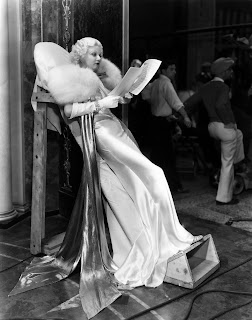 In terms of its complexity, the role of Kitty Packard was a leap for Harlow, but where she had been ill-equipped to handle early roles in Hell's Angels and Platinum Blonde, now she was ready. In Red-Headed Woman, she'd learned how to gain an audience's sympathy despite playing an unlikeable character. In Red Dust, she'd learned how to deliver tough wisecracks while conveying hurt and vulnerability. In Dinner At Eight, she found the last piece of the puzzle, "the ability," in the words of Frank Miller, writing for Turner Classic Movies, "to deliver lines as though she didn't quite know what they meant."
The result was the best performance of her career, and when Harlow finished her last scene for the movie, she went to her dressing room and cried, perhaps knowing that nothing she would ever do afterwards would top this performance.
"Harlow played comedy," said Cukor, "as naturally as a hen lays an egg."
 Movie-going audiences loved Dinner At Eight and loved Harlow in it, not only because she looked great in her backless evening gown (designed by Adrian, it was known as the "Jean Harlow dress" and was so tight she couldn't sit down in it), but also because she had proven herself once and for all as one of Hollywood's great comedic actresses.
"Acting honors," said Variety at the time, "probably will go to Dressler and Harlow, the latter giving an astonishingly well-balanced treatment of Kitty, the canny little hussy who hooks a hard-bitten and unscrupulous millionaire and then makes him lay down and roll over."
"I was not a born actress," Harlow confessed later. "No one knows it better than I. If I had any latent talent, I have had to work hard, listen carefully, do things over and over and then over again in order to bring it out."
After the critical and commercial successes of Red Dust and Dinner At Eight, Jean Harlow leapt to the top of her profession, surpassing Joan Crawford, Greta Garbo and Norma Shearer as the most popular actress at MGM. And although Hollywood began enforcing the Production Code in 1934 and as a result toned down the more explicit sexuality of her movies, Harlow remained an audience favorite. In fact, from 1932 until her untimely death in 1937, Harlow had at least one movie, and often two, finish among the top ten grossing films of the year.
 Despite her success with critics and audiences, Harlow was never nominated for an Academy Award—comedic performances rarely are—but she did rank twenty-second on the American Film Institute's list of the top 100 movie legends and forty-ninth on Entertainment Weekly's list of the all-time greatest movie stars. In his cult classic Alternate Oscars, Danny Peary chose her performance in the screwball comedy Libeled Lady as the best by an actress in 1936.
In contrast to her movie career, Harlow's personal life was marked by scandal and heartbreak. Harlow's mother was overbearing and controlling, living out dreams of movie stardom through her daughter. In 1932, Harlow's second husband Paul Bern died of a gunshot wound under mysterious circumstances. In 1933, MGM arranged a quick, short-lived marriage to cinematographer Harold Rosson to cover up Harlow's affair with a married man. Like her character Lola Burns in the 1933 comedy Bombshell, Harlow was hounded by greedy studio bosses, greedier family members, stalkers, fraudsters, slicky boys and the tabloid press, and treated more as a cash cow than a flesh and blood woman.
"She didn't want to be famous," said Clark Gable, "she wanted to be happy."
 In 1935, Harlow fell in love with William Powell, her co-star in the movie Reckless, and finally after years of turmoil, her personal life began to match the success of her professional one. The two secretly engaged although never married—in his early forties, Powell worried about being linked to such a young actress, and Harlow also claimed MGM studio chief Louis B. Mayer didn't approve of the union.
In 1937, during filming of her sixth movie with Clark Gable, Saratoga, Harlow fell ill with a serious kidney ailment and died before the end of production. The studio finished the film with long shots of a stand-in and released the film with much fanfare. It was the highest grossing film of 1937, a fitting tribute to her brief but brilliant career.
Postscript
 You can check out other tributes to Jean Harlow at the Kitty Packard Pictorial, a site devoted to all things Harlow. The Pictorial is also promoting a new biography, Harlow in Hollywood: The Blonde Bombshell in the Glamour Capital, 1928-1937 by Darrell Rooney and Mark A. Vieira.
[To read Part One of this essay, click here.]
Dinner At Eight: Harlow Arrives At Last
 "I was reading a book the other day."
"Reading a book?!?"
"Yes. It's all about civilization or something. A nutty kind of a book. Do you know that the guy says that machinery is going to take the place of every profession?"
"Oh, my dear, that's something you need never worry about."
 After a second movie with Gable, Hold Your Man (actually their third—Gable and Harlow had small roles in the 1931 gangster movie The Secret Six, but weren't paired together), Harlow gave what may be her best-remembered performance, that of none-too-bright social climber Kitty Packard in the comedy-drama, Dinner At Eight.
A successful play by Broadway legends George S. Kaufman and Edna Ferber, Dinner At Eight is a loosely-connected series of vignettes about a group of Manhattan social climbers preparing for a dinner party as their respective worlds fall down around their ears. Seeing Dinner At Eight as a potential follow-up to 1932's Grand Hotel, a star-studded extravaganza that had won the Academy Award for best picture, MGM producer Irving Thalberg bought the film rights to the play, but fell ill soon after and took a leave of absence from the studio. Louis B. Mayer, long jealous of Thalberg, sensed an opportunity to increase his control of MGM and brought in his son-in-law, David O. Selznick, who reluctantly left his post as head of RKO Studios to head up the production (prompting wags to quip "the son-in-law also rises").
 For Dinner At Eight, Selznick assembled the brightest of MGM's stars, including the three male leads from Grand Hotel, and added America's most popular actress Marie Dressler as a faded Broadway star, Billie Burke as the twittery hostess of this train wreck, and finally Harlow as the spoiled young trophy wife of Wallace Beery's crooked businessman. (Joan Crawford turned down the part of a woman cheating on her fiance, the most thankless role in the movie; it went to Madge Evans instead.)
 Director George Cukor, fresh off Katharine Hepburn's successful debut in A Bill Of Divorcement, cast Harlow over the objections of Louis B. Mayer, who felt she wasn't actress enough to keep up with her more experienced co-stars. But Red Dust had convinced Cukor that Harlow had a gift for comedy and with the director's help, she wound up stealing the show.
Outside of Karl Marx, Dinner At Eight is as scathing an indictment of the monied classes as you're likely to find, and no character is more indolent than Harlow's Kitty. She manipulates her men, bullies her maid, and otherwise lies around in a torpor, eating bonbons and complaining of boredom. "She holds court from her bed," Matthew Kennedy wrote for Bright Lights Film Journal, "like a spoiled Persian cat, a disagreeable chocolate substituting for a furball."
 And yet because she hungers to improve herself (even if she seems to think the surest path to knowledge is to sleep with an educated man), we find ourselves rooting for Kitty. "I'm going to be a lady if it kills me," she vows.
Ironically, the woman Kitty most aspires to be—Billie Burke's Millicent Jordan—is even more empty-headed than she is, and without a backless evening gown to take your mind off the fact.
In terms of its complexity, the role of Kitty Packard was a leap for Harlow, but where she had been ill-equipped to handle early roles in Hell's Angels and Platinum Blonde, now she was ready. In Red-Headed Woman, she'd learned how to gain an audience's sympathy despite playing an unlikeable character. In Red Dust, she'd learned how to deliver dialogue (tough wisecracks, for example) while conveying a deeper truth (hurt, vulnerability) with her eyes.
In Dinner At Eight, she found the last piece of the puzzle, "the ability," in the words of Frank Miller, writing for Turner Classic Movies, "to deliver lines as though she didn't quite know what they meant."
The result was the best performance of her career.
 "Harlow played comedy," said Cukor, "as naturally as a hen lays an egg."
The most famous scene in Dinner At Eight is the last one between Harlow and Marie Dressler—and justly so, with Dressler's famous doubletake and last line—but it's not really Harlow's scene, except to serve up a couple of terrific straight-lines. Instead check out her scenes with Wallace Beery, who plays her boorish husband. The two bicker and battle, the collision of small minds and titanic wills, and despite Beery's expertise at hammy scene stealing, it's Harlow the viewer remembers.
Their verbal sparring ("Remember what I told you last week?" "I don't remember what you told me a minute ago.") escalates to point of physical violence, with Harlow delivering a pivotal ultimatum in one breathless rant:
 "Who do you think you're talking to, that first wife of yours out in Montana? That poor mealy-faced thing with a flat chest that didn't have nerve enough to talk up to you, washing out your greasy overalls and cooking and slaving in some lousy mining shack—no wonder she died. Well, you can't get me that way, you're not going to step on my face to get where you want to go, you big windbag! ... Politics? Ha! You couldn't get into politics. You couldn't get in anywhere. You couldn't even get in the men's room at the Astor!"
It's a tour de force moment both for Harlow and for the film, and it contrasts nicely with Kitty's previous lethargy and coy manipulations. The antipathy between Beery and Harlow was genuine, but they were a great screen couple and they made one more movie together, China Seas in 1935.
 Movie-going audiences loved Dinner At Eight and loved Harlow in it, not only because she looked great in her backless evening gown (designed by Adrian, it was known as the "Jean Harlow dress" and was so tight she couldn't sit down in it), but also because she had proven herself once and for all as one of Hollywood's great comedic actresses.
"Acting honors," said Variety at the time, "probably will go to Dressler and Harlow, the latter giving an astonishingly well-balanced treatment of Kitty, the canny little hussy who hooks a hard-bitten and unscrupulous millionaire and then makes him lay down and roll over."
According to KC at Classic Movies, Dressler was so impressed with Harlow that she hoped she and Harlow could work together again, starting "an entirely new kind of comedy team—the glamour girl and the matron." Dressler, however, died of cancer just a year later and the two never made another movie together.
As it was, when Harlow finished her last scene for the movie, she went to her dressing room and cried, perhaps knowing nothing she ever did afterwards would top this performance.
 As a postscript, I should mention that Harlow's real-life dinner at eight didn't go nearly so well as the onscreen one. At a party for the British prime minister, Harlow found herself seated next to the PM's wife, Margot Asquith, Countess of Oxford and Asquith. Throughout the dinner, Harlow addressed her as "Margot," pronouncing the "t," until finally the Countess said, "No, no, the 't' is silent, as in 'Harlow.'"
Apocryphal, perhaps, but a good punchline.
Note: To read my essay on John Barrymore's performance in Dinner At Eight, click here.
[To read Part Three of this essay, click here.]
 Many actors have laid claim to the title of the Biggest Ham in Hollywood over the years—Wallace Beery, Christopher Walken, William Shatner, Jack Nicholson, even Laurence Olivier when he was bored and phoning it in—but few at their peak were as deliciously hammy as John Barrymore.
Bad ham acting takes no especial skill other than a lack of talent and self-awareness, and bad ham actors, whose numbers would fill a football stadium, take you right out of the action, start you looking for the exits and are either quickly forgotten or wind up making miniseries on the Lifetime Channel. "[A] bad ham actor," writes "Greg" at Cinema Styles, "is a bad actor period, someone who overplays, overemotes and overinflects every move, tear and shout. They're bad, they don't know how to do anything else.
"But a great ham actor is also a great actor who is in possession of so much skill and talent they know when to go over the top and how far to take it."
Great ham acting is an underappreciated art form and great ham actors, so few we can nearly name them all, last for years, energize the mundane, create a giddy sense of the possible. And with Dinner At Eight, John Barrymore put the capstone on a career that featured some of the best ham acting in the history of Hollywood. His Larry Renault—like Barrymore, an alcoholic ham on the downside of his career—was, as TV Guide put it in its 5-star review, "a bitchy casting idea, chilling to watch," but Barrymore was open to taking himself to task on screen, and though it was all downhill after this, he played the part to perfection.
 The action opens as Park Avenue socialite Millicent Jordan (Billie Burke, in a performance that would establish her chirpy screen persona) frantically puts the finishing touches on an important dinner party she's planned for that evening. Absorbed with trivial worries about aspic and ice sculptures, she's oblivious to the crises mounting around her—her ailing husband (Lionel Barrymore) finds himself on the verge of losing everything to a rapacious tycoon (a particularly boorish Wallace Beery), her daughter is about to marry a man she no longer loves, and old friend Carlotta Vance (Marie Dressler), an over-the-hill actress, needs money fast.
Add to the list of the desperate a last-minute substitution on the guest list, Larry Renault (John Barrymore), a one-time silent film star now fallen on hard times thanks to his outsized ego and fondness for the bottle. Reduced to pawning his cufflinks for cabfare, he's in New York hoping to make a comeback on the Broadway stage. "The play's not much," he says, "but I think I can put it over. I play the only male character," then shrugs, "oh, there's a small male part for a bit actor ... but I dominate that."
Perhaps you can guess how this is going to turn out for him, even if he can't.
 Dinner At Eight is usually billed as a comedy, and it is, but only in the same sense that Anton Chekhov's masterpiece of endless Russian gloom, The Cherry Orchard, is a comedy. That is, it's a tragedy about foolish people in relentless pursuit of the ephemeral, behaving as if they'll live forever and discovering too late that they won't. You see this same comedy played out, in high places and in low, every day, and always with the same ending.
The cast of characters neatly divides into those who, either through careless living or bad luck, find themselves at the end of their ropes; and those who prey upon them, both wittingly (Beery) and unwittingly (Burke). (That Jean Harlow, playing a low-rent Billie Burke in training, proves to be an angel of mercy for one of these desperate souls gives us the only hopeful moment in the entire movie.)
In the self-contained universe of the New York blue bloods who populate Dinner At Eight, it perhaps shouldn't come as a surprise that Renault is sleeping with Mrs. Jordan's nineteen year old daughter Paula (Madge Evans in a part originally offered to Joan Crawford). For her, Renault represents a chance to escape the spiritually-empty and empty-headed future her mother has so carefully planned for her; but for him, Paula is a last taste of the life he has wasted and she's too young to understand why he feels only anxiety when what she feels is bliss.
"You're young and fresh," he tells her, "and I'm burned out."
 For Renault, it's an all-too-infrequent moment of clarity that lends poignancy to his plight—it's one thing to spiral into the abyss in ignorance, quite another to watch yourself do it—and Barrymore is at his best in these moments, quiet, still, a great actor inhabiting a burned-out shell without resorting to showy actor tricks. Then as Renault puffs himself up with self-pity, paranoia and memories of past glory, Barrymore reaches for just those hammy touches that a bad actor would use on a stage when playing a part too big for his talent.
Ultimately, the moral of Dinner At Eight is "adapt or die," a timely message in 1933 for both out-of-work actors and a nation suffering through the fourth year of the Great Depression, but advice Renault is incapable of following. He may be a high-functioning alcoholic, immaculately dressed and able dip into his bag of acting tricks just enough to fuddle his way through a speech or two—watch Barrymore dial up the ham factor as he demonstrates Renault's "acting" ability—but he can't keep his delusions of grandeur in check and, like a man on a ledge with an uncontrollable urge to jump, each moment of clarity turns into self-pity and another excuse to take a drink.
 Whether the bottle has kept him from acclimating or he turned to the bottle because he couldn't (it doesn't really matter; an alcoholic doesn't need a reason to drink), Renault is a man frozen in time. He still fancies himself an "important artist," a matinee idol, a big name. "$8000 a week is what I got," he says, "and I was gonna get ten until the talkies came in, so don't think you're doing me a favor by asking me to play in your ratty little show because I'm doing you one." But the sad fact is, he's a forgotten has-been and when he finally grasps the truth, it's brutal to watch.
"Look at those pouches under your eyes," says his long-suffering agent, steering Renault to the mirror. "Look at those creases. You sag like an old woman. ... You're a corpse, and you don't know it. Go get yourself buried."
 Barrymore's Renault is by turns buffoonish, arrogant, reflective, bullying, anxious, humiliated, and ultimately, by remaining true to his idea of himself to the very end, somehow heroic. In a contemporaneous review of Dinner At Eight, Variety heralded Barrymore's performance as "a stark, uncompromising treatment of a pretty thorough-going blackguard and ingrate."
Recent reviews have echoed the sentiment: "John Barrymore is beautiful as the only honest man in the entire picture." (Movie Reviews UK) Renault is "played with the right touch of self-centered clownishness to undercut the pathos." (Slant Magazine) Barrymore's Renault, "the Profile in winter [is a] small, honest portrait of reaching the end of your tether." (Bright Lights Film Journal)
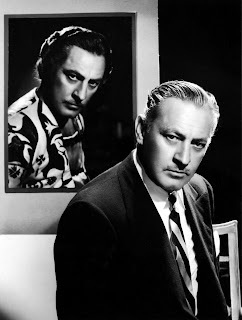 And me? I think it's possibly the best portrayal of an alcoholic in the movies before Ray Milland's Oscar-winning turn in The Lost Weekend twelve years later, certainly one of the few serious ones at a time when alcoholics in movies were almost always treated as comic relief. And as a portrait of a man at the end of his rope, Barrymore's performance would make a terrific double feature with his work from the year before in another glamorous MGM ensemble piece, Grand Hotel.
Director George Cukor later said of Barrymore that he had no vanity and noted that many of the ideas for Renault's character came from Barrymore himself:
"[Renault] found out that another actor got the job that he desperately needed," Cukor recalled, "And he'd say, 'I can be English. I can be as English as ahnybohdy.' Then he'd say, 'Ibsen, Ibsen. I can do Ibsen,' and he had just heard vaguely of Ibsen, and he would strike this absolutely inappropriate pose and he said, 'Mother dear, give me the moon.' Whereas the Ibsen line was, 'Mother, give me the sun'—to show that he'd gone over, he'd become mad.'"
Yet as good as Barrymore's performance was, it almost didn't happen.
 According to Frank Miller, writing for Turner Classic Movies, MGM Studio chief Louis B. Mayer objected to the casting of Barrymore. "He was worried about Barrymore's drinking and erratic behavior," Miller writes, "but Cukor assured him that they had developed a good working relationship on A Bill of Divorcement (1932). On the set of Dinner at Eight Barrymore was cooperative and helpful. Far from resisting comparisons between himself and his character, a fading matinee idol succumbing to alcoholism, he suggested playing up the similarities. At his instigation, [Frances] Marion and co-writer Herman J. Mankiewicz added references to his profile and his three wives. On the set, he even improvised imitations of faded actors he'd run into in New York."
Born John Sidney Blyth in Philadelphia in 1882, John Barrymore was the youngest sibling of an acting dynasty that included Oscar-winners Lionel and Ethel (they took their stage name from their father, who performed as Maurice Barrymore). While Lionel and Ethel took to the stage at an early age, John began as a painter, and only followed his siblings into acting at their urging. Despite his late start, he was a major Broadway star by 1909. His Broadway performance in the title role of Hamlet in 1922 purports to be one of the best in history although no recording of it exists and recreations nearly two decades on are marred by Barrymore's shameless mugging.
 Although he may have appeared in films as early as 1912, his first confirmed role was in An American Citizen in 1914. Known as "The Great Profile," Barrymore was a star throughout the silent era, appearing in such films as Dr. Jekyll and Mr. Hyde (1920), Sherlock Holmes (1922), Beau Brummel (1924) and Don Juan (1926).
Barrymore made the transition to talkies successfully, and I'm not convinced playwrights George Kaufman and Edna Ferber (Marion and Mankiewicz handled the screenplay chores) had Barrymore in mind when they wrote the part—he was still a star even if his drinking and ego were already the stuff of legend, and the story of the silent era matinee idol reduced to penury with the coming of the talkies was so commonplace as to be a cliche. Still, I couldn't help wondering as he studied his aging, alcohol-ravaged face in that last, painful scene, whether Barrymore saw his own future writ large in the mirror.
 Aside from his terrible thirst, I get the impression Barrymore's biggest problem was not so much an oversized ego, as a lack of regard for the art of motion pictures—much like Marlon Brando after him, he rarely thought of the movies he made as worth the effort. "Watching Barrymore on screen," Dan Callahan wrote, "we are always waiting to see whether he will engage with his material; if he does, he's capable of large-spirited magic, and if he doesn't, he merely moves his face and pops his eyes, wearily, as if he's trying to be amused."
"My memory is full of beauty," Barrymore once quipped, explaining why he hadn't bothered to learn his lines before filming a scene, "Hamlet's soliloquies, the Queen Mab speech, King Magnus' monologue from The Apple Cart, most of the Sonnets. Do you expect me to clutter up all that with this horseshit?"
 For a while at least, until the effects of indolence and alcohol caught up with him, Barrymore could still reach down for worthy films such as Grand Hotel, A Bill Of Divorcement, Counsellor-at-Law and Dinner at Eight and produced a good performance. The rest of the time, though, he was content to give the people what they wanted, a parody of himself.
"I like to be introduced as America's foremost actor. It saves the necessity of further effort."
John Barrymore died in 1942 of pneumonia as a complication of cirrhosis of the liver. He was sixty years old.
[To read my take on Jean Harlow's performance in Dinner At Eight, click here.]


 If she'd just been another pretty face, she would have been forgotten long ago, one of the thousands of beauties who for a brief season capture the fancy of the paparazzi and the tabloids and the fickle paying public and then quickly fade from our memory. But more than just a platinum blonde beauty, Jean Harlow also possessed an unexpected gift for comedy and self-parody, and as the pre-Code era drew to a close, she became not only America's premier sex symbol but one of its premier actresses as well.
 Born to a Kansas City dentist and the daughter of a wealthy real estate developer, Harlean Harlow Carpenter tried out for the movies on a dare, got the job and later signed with the Hal Roach Studios. Working under her mother's maiden name, Jean Harlow played the "swanky blonde" in four Laurel and Hardy comedy shorts and appeared in uncredited bit roles in more than a dozen movies (including Chaplin's City Lights) before Howard Hughes cast her in Hell's Angels. Hughes epic about World War I flying aces proved to be Harlow's big break. Although she was as skittish as a newborn foal, barely able to speak her lines, the public immediately responded to her beauty—the expressions "platinum blonde" and "blonde bombshell" were coined to describe her—and she soon landed better parts, including that of James Cagney's love interest in William Wellman's gangster classic The Public Enemy, and the unobtainable society girl in Frank Capra's comedy Platinum Blonde.
 "The newspapers sure have loused me up," she complained cheerfully, "calling me a sexpot! Where'd they ever get such a screwy idea?"
 Although Harlow played a manipulative gold digger—she seduces her married boss and breaks up his marriage—there was a sincerity to her transparent scheming, and with Harlow serving up the brassy bits with humor and wounded pride, audiences found themselves rooting for her. The result was one of the biggest hits of 1932.
 Next up was an even better vehicle for Harlow, one that would both display her talent for comedy and pair her with fast-rising star Clark Gable. Based on a failed stageplay, Red Dust starred Gable as the overseer of a Vietnamese rubber plantation, Harlow as the "cute little trick" who falls for him, and Mary Astor as the wife of the plantation's latest hire, a woman Gable sets out to seduce.
 Harlow's "uniquely effortless vulgarity, humor and slovenliness," wrote Movie Diva in her review of Red Dust, "create the rarest of Hollywood goddesses, the beautiful clown."
 Director George Cukor, fresh off Katharine Hepburn's successful debut in A Bill Of Divorcement, cast Harlow over the objections of Louis B. Mayer, who felt she wasn't actress enough to keep up with her more experienced co-stars. But Red Dust had convinced Cukor that Harlow had a gift for comedy and with the director's help, she wound up stealing the show. Harlow's Kitty manipulates her men, bullies her maid, and otherwise lazes around, eating bonbons and complaining of boredom. Yet because she hungers to improve herself (even if she seems to think the surest path to knowledge is to sleep with an educated man), we find ourselves cheering her on.
 In terms of its complexity, the role of Kitty Packard was a leap for Harlow, but where she had been ill-equipped to handle early roles in Hell's Angels and Platinum Blonde, now she was ready. In Red-Headed Woman, she'd learned how to gain an audience's sympathy despite playing an unlikeable character. In Red Dust, she'd learned how to deliver tough wisecracks while conveying hurt and vulnerability. In Dinner At Eight, she found the last piece of the puzzle, "the ability," in the words of Frank Miller, writing for Turner Classic Movies, "to deliver lines as though she didn't quite know what they meant."
 Movie-going audiences loved Dinner At Eight and loved Harlow in it, not only because she looked great in her backless evening gown (designed by Adrian, it was known as the "Jean Harlow dress" and was so tight she couldn't sit down in it), but also because she had proven herself once and for all as one of Hollywood's great comedic actresses.
 Despite her success with critics and audiences, Harlow was never nominated for an Academy Award—comedic performances rarely are—but she did rank twenty-second on the American Film Institute's list of the top 100 movie legends and forty-ninth on Entertainment Weekly's list of the all-time greatest movie stars. In his cult classic Alternate Oscars, Danny Peary chose her performance in the screwball comedy Libeled Lady as the best by an actress in 1936.
 In 1935, Harlow fell in love with William Powell, her co-star in the movie Reckless, and finally after years of turmoil, her personal life began to match the success of her professional one. The two secretly engaged although never married—in his early forties, Powell worried about being linked to such a young actress, and Harlow also claimed MGM studio chief Louis B. Mayer didn't approve of the union.
 You can check out other tributes to Jean Harlow at the Kitty Packard Pictorial, a site devoted to all things Harlow. The Pictorial is also promoting a new biography, Harlow in Hollywood: The Blonde Bombshell in the Glamour Capital, 1928-1937 by Darrell Rooney and Mark A. Vieira.


